Kurfirst Vojtěch, Mokráček Aleš, Krupauerová Martina, Canádyová Júlia, Bulava Alan, Pešl Ladislav, Adámková Věra
Cardiac Surgery Department, BoŽeny Němcové str, 54, Hospital České Budějovice, České Budějovice, Czech Republic.
J Cardiothorac Surg. 2014 Mar 11;9:46. doi: 10.1186/1749-8090-9-46.
Factors influencing the postoperative health-related quality of life (HRQOL) after cardiac surgery have not been well described yet, mainly in the older people. The study's aim was to explore differences in clinical conditions and HRQOL of patients before and after cardiac surgery taking into account the influence of age and to describe factors influencing changes of HRQOL in the postoperative period.
This was a prospective consecutive observational study with two measurements using the SF-36 questionnaire before surgery and 1 year after surgery. It considered main clinical characteristics of participants prior to surgery as well as postoperative complications.
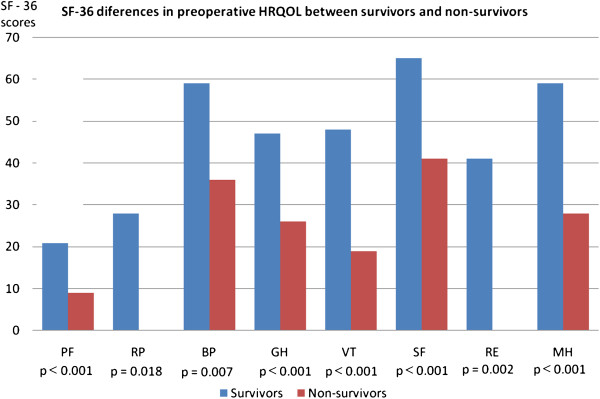
At baseline assessment the study considered 310 patients, predominantly male (69%). Mean age was 65 (SD 10.4) years and 101 patients (33%), who were older than 70, constituted the older group. This older group showed greater comorbidity, higher cardiac operative risk and lower HRQOL in the preoperative period as well as a higher prevalence of postoperative complications than the younger group. Thirty-day mortality was 1.4% in the younger group and 6.9% in the older group (p < 0.001). One year mortality was 3.3% in the younger group and 10.9% in the older group (p < 0.001). There was a significant improvement in all 8 health domains of the SF-36 questionnaire (p < 0.001) in the overall sample. There was no significant difference in change in a majority of HRQOL domains between the younger and the older group (p > 0.05). Logistic multivariate analysis identified a higher values of preoperative PCS (Physical component summary) scores (OR 1.03, CI 1.00 - 1.05, p = 0.0187) and MCS (Mental component summary) scores (OR 1.02, CI 0.997 - 1.00, p = 0.0846) as the only risk factors for potential non-improvement of HRQOL after cardiac surgery after correction for age, gender and type of surgery.
Older patients with higher operative risk have lower preoperative HRQOL but show a similar improvement in a majority of HRQOL domains after cardiac surgery as compared with younger patients. The multivariate analysis has shown the higher preoperative HRQOL status as a only significant factor of potential non-improvement of postoperative HRQOL.
心脏手术后影响患者健康相关生活质量(HRQOL)的因素尚未得到充分描述,尤其是在老年患者中。本研究旨在探讨心脏手术前后患者临床状况和HRQOL的差异,同时考虑年龄的影响,并描述术后影响HRQOL变化的因素。
这是一项前瞻性连续观察性研究,术前和术后1年使用SF-36问卷进行两次测量。研究考虑了参与者术前的主要临床特征以及术后并发症。
在基线评估时,研究纳入了310例患者,其中男性占主导(69%)。平均年龄为65岁(标准差10.4),101例年龄大于70岁的患者(33%)构成老年组。与年轻组相比,老年组术前合并症更多、心脏手术风险更高、HRQOL更低,术后并发症发生率也更高。年轻组30天死亡率为1.4%,老年组为6.9%(p<0.001)。年轻组1年死亡率为3.3%,老年组为10.9%(p<0.001)。总体样本中,SF-36问卷的所有8个健康领域均有显著改善(p<0.001)。年轻组和老年组在大多数HRQOL领域的变化无显著差异(p>0.05)。多因素逻辑回归分析显示,在校正年龄、性别和手术类型后,术前身体成分总结(PCS)评分较高(OR 1.03,CI 1.00 - 1.05,p = 0.0187)和心理成分总结(MCS)评分较高(OR 1.02,CI 0.997 - 1.00,p = 0.0846)是心脏手术后HRQOL可能未改善的唯一危险因素。
手术风险较高的老年患者术前HRQOL较低,但与年轻患者相比,心脏手术后大多数HRQOL领域的改善情况相似。多因素分析表明,术前较高的HRQOL状态是术后HRQOL可能未改善的唯一重要因素。