Hong Linbi, Walz Jennifer M, Sajda Paul
Department of Biomedical Engineering, Columbia University, New York, New York, United States of America.
PLoS One. 2014 Mar 11;9(3):e91321. doi: 10.1371/journal.pone.0091321. eCollection 2014.
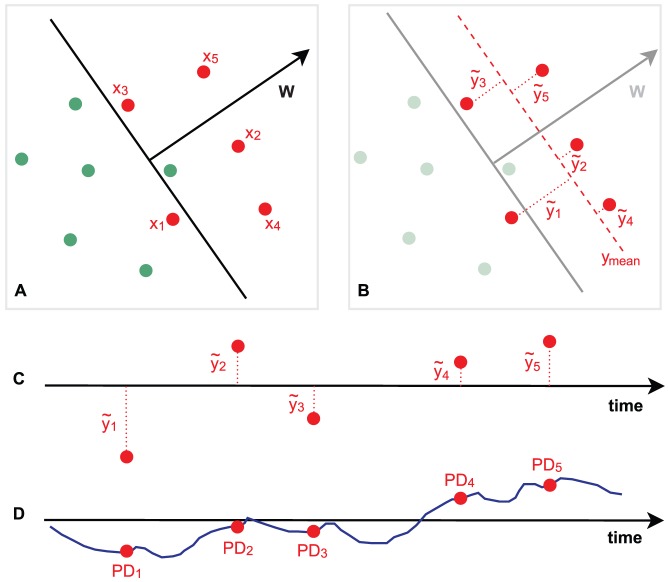
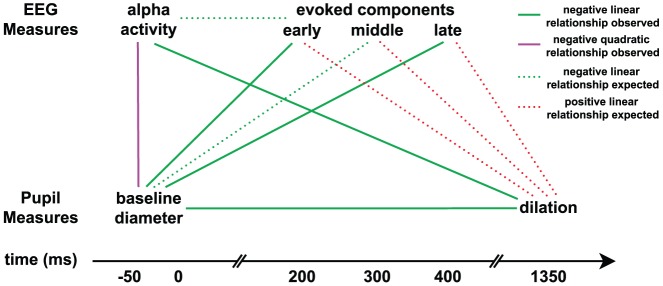
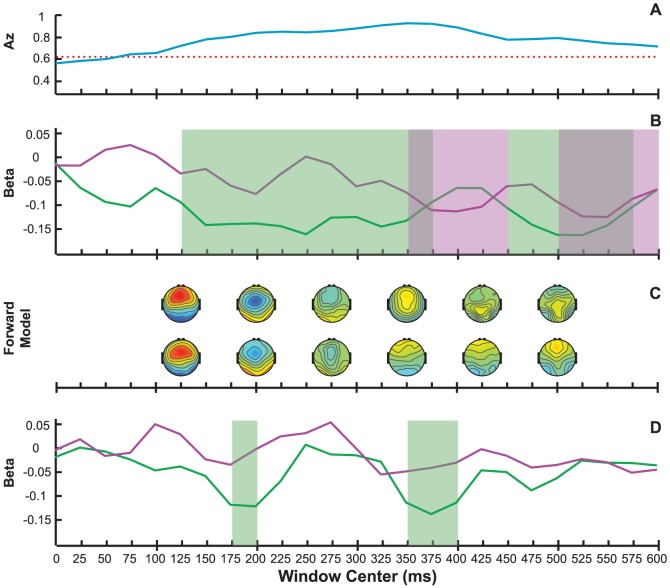
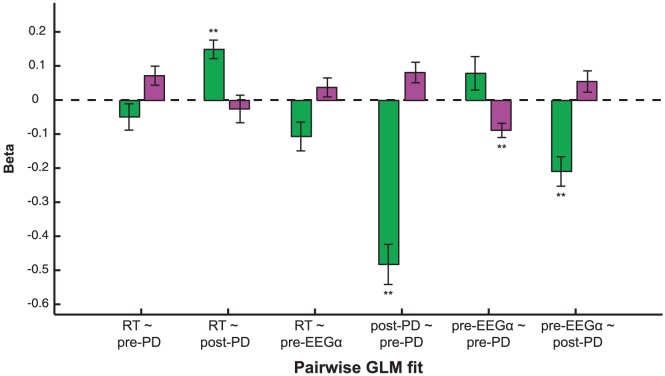
Pupillary measures have been linked to arousal and attention as well as activity in the brainstem's locus coeruleus norepinephrine (LC-NE) system. Similarly, there is evidence that evoked EEG responses, such as the P3, might have LC-NE activity as their basis. Since it is not feasible to record electrophysiological data directly from the LC in humans due to its location in the brainstem, an open question has been whether pupillary measures and EEG variability can be linked in a meaningful way to shed light on the nature of the LC-NE role in attention and arousal. We used an auditory oddball task with a data-driven approach to learn task-relevant projections of the EEG, for windows of data spanning the entire trial. We investigated linear and quadratic relationships between the evoked EEG along these projections and both prestimulus (baseline) and poststimulus (evoked dilation) pupil diameter measurements. We found that baseline pupil diameter correlates with early (175-200 ms) and late (350-400 ms) EEG component variability, suggesting a linear relationship between baseline (tonic) LC-NE activity and evoked EEG. We found no relationships between evoked EEG and evoked pupil dilation, which is often associated with evoked (phasic) LC activity. After regressing out reaction time (RT), the correlation between EEG variability and baseline pupil diameter remained, suggesting that such correlation is not explainable by RT variability. We also investigated the relationship between these pupil measures and prestimulus EEG alpha activity, which has been reported as a marker of attentional state, and found a negative linear relationship with evoked pupil dilation. In summary, our results demonstrate significant relationships between prestimulus and poststimulus neural and pupillary measures, and they provide further evidence for tight coupling between attentional state and evoked neural activity and for the role of cortical and subcortical networks underlying the process of target detection.
瞳孔测量已与唤醒、注意力以及脑干蓝斑去甲肾上腺素(LC-NE)系统的活动相关联。同样,有证据表明,诸如P3等诱发脑电图反应可能以LC-NE活动为基础。由于LC位于脑干,直接在人类身上记录其电生理数据不可行,一个悬而未决的问题是,瞳孔测量和脑电图变异性是否能以有意义的方式联系起来,以阐明LC-NE在注意力和唤醒中的作用本质。我们使用了一种听觉oddball任务,并采用数据驱动的方法来了解脑电图在整个试验数据窗口中的任务相关投影。我们研究了沿着这些投影的诱发脑电图与刺激前(基线)和刺激后(诱发扩张)瞳孔直径测量值之间的线性和二次关系。我们发现,基线瞳孔直径与早期(175 - 200毫秒)和晚期(350 - 400毫秒)脑电图成分变异性相关,这表明基线(紧张性)LC-NE活动与诱发脑电图之间存在线性关系。我们未发现诱发脑电图与诱发瞳孔扩张之间的关系,而诱发瞳孔扩张通常与诱发(相位性)LC活动相关。在排除反应时间(RT)的影响后,脑电图变异性与基线瞳孔直径之间的相关性仍然存在,这表明这种相关性无法用RT变异性来解释。我们还研究了这些瞳孔测量值与刺激前脑电图α活动之间的关系,α活动已被报道为注意力状态的一个指标,结果发现与诱发瞳孔扩张呈负线性关系。总之,我们的结果表明刺激前和刺激后神经及瞳孔测量之间存在显著关系,并且它们为注意力状态与诱发神经活动之间的紧密耦合以及目标检测过程中皮层和皮层下网络的作用提供了进一步的证据。