Instituto de Medicina Molecular, Faculdade de Medicina da Universidade de Lisboa, Lisbon, Portugal.
Instituto de Medicina Molecular, Faculdade de Medicina da Universidade de Lisboa, Lisbon, Portugal ; Gulbenkian Programme for Advanced Medical Education, Lisbon, Portugal.
Mediators Inflamm. 2014;2014:195327. doi: 10.1155/2014/195327. Epub 2014 Jan 30.
We have previously reported a continuous activation of caspase-1 and increased interleukin (IL)-1β levels in early rheumatoid arthritis (RA). These observations raised the hypothesis that drugs targeting the IL-1β pathway, in addition to tumour necrosis factor (TNF), may be particularly effective for early RA treatment. We have recently identified gambogic acid as a promising therapeutic candidate to simultaneously block IL-1β and TNF secretion. Our main goal here was to investigate whether gambogic acid administration was able to attenuate inflammation in antigen-induced arthritis (AIA) rats.
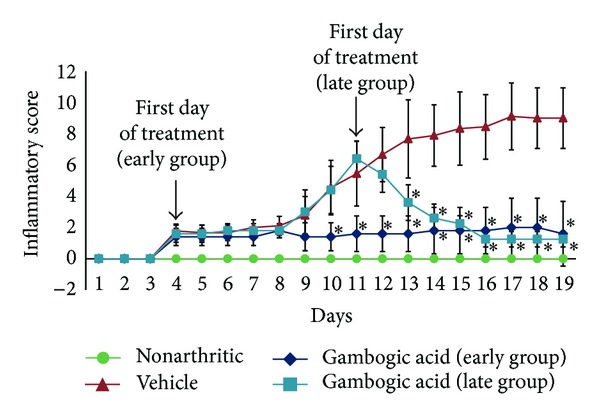
Gambogic acid was administered to AIA rats in the early and late phases of arthritis. The inflammatory score, ankle perimeter, and body weight were evaluated during the period of treatment. Rats were sacrificed after 19 days of disease progression and paw samples were collected for histological and immunohistochemical evaluation.
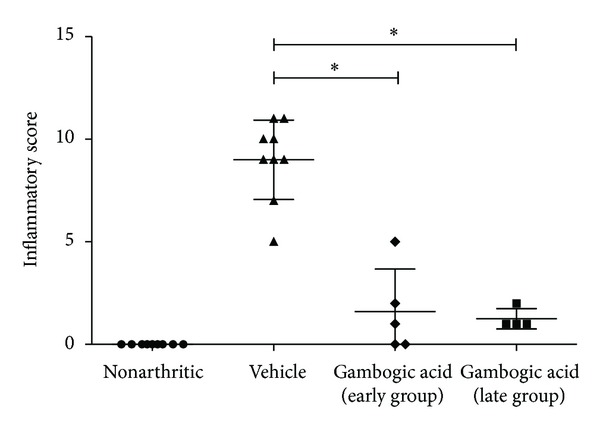
We found that inflammation in joints was significantly suppressed following gambogic acid administration. Histological and immunohistochemical evaluation of treated rats revealed normal joint structures with complete abrogation of the inflammatory infiltrate and cellular proliferation.
Our results suggest that gambogic acid has significant anti-inflammatory properties and can possibly constitute a prototype anti-inflammatory drug with therapeutic efficacy in the treatment of inflammatory diseases such as RA.
我们之前曾报道过,在早期类风湿关节炎(RA)中,半胱氨酸天冬氨酸蛋白酶-1(caspase-1)持续激活,白细胞介素(IL)-1β水平升高。这些观察结果提出了这样一个假设,即除肿瘤坏死因子(TNF)以外,靶向 IL-1β 通路的药物可能对早期 RA 的治疗特别有效。我们最近发现藤黄酸是一种很有前途的治疗候选药物,能够同时阻断 IL-1β和 TNF 的分泌。我们的主要目标是研究藤黄酸给药是否能够减轻抗原诱导性关节炎(AIA)大鼠的炎症。
在关节炎的早期和晚期阶段,藤黄酸被给予 AIA 大鼠。在治疗期间评估炎症评分、踝关节周长和体重。在疾病进展 19 天后处死大鼠,采集爪样本进行组织学和免疫组织化学评估。
我们发现,藤黄酸给药后关节炎症明显受到抑制。对治疗大鼠进行组织学和免疫组织化学评估显示,关节结构正常,炎症浸润和细胞增殖完全消失。
我们的结果表明,藤黄酸具有显著的抗炎特性,可能成为一种具有治疗疗效的原型抗炎药物,可用于治疗 RA 等炎症性疾病。