Aerden Dimitri, Denecker Nathalie, Gallala Sarah, Debing Erik, Van den Brande Pierre
Diabetic Foot Clinic, Universitair Ziekenhuis Brussel, Laarbeeklaan 101, 1090 Jette, Belgium ; Department of Vascular Surgery, Universitair Ziekenhuis Brussel, Laarbeeklaan 101, 1090 Jette, Belgium.
Diabetic Foot Clinic, Universitair Ziekenhuis Brussel, Laarbeeklaan 101, 1090 Jette, Belgium.
Int J Vasc Med. 2014;2014:672897. doi: 10.1155/2014/672897. Epub 2014 Feb 2.
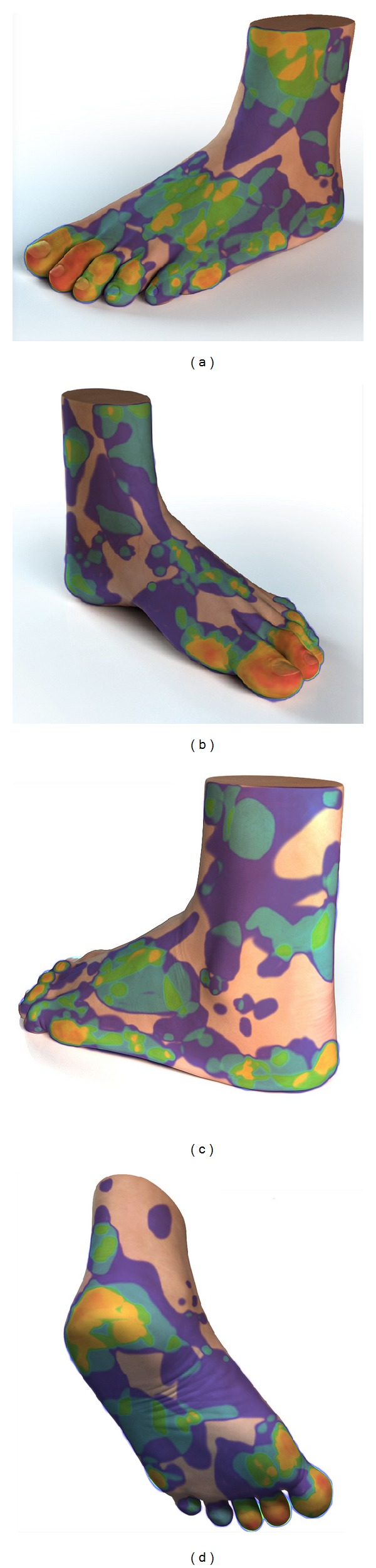
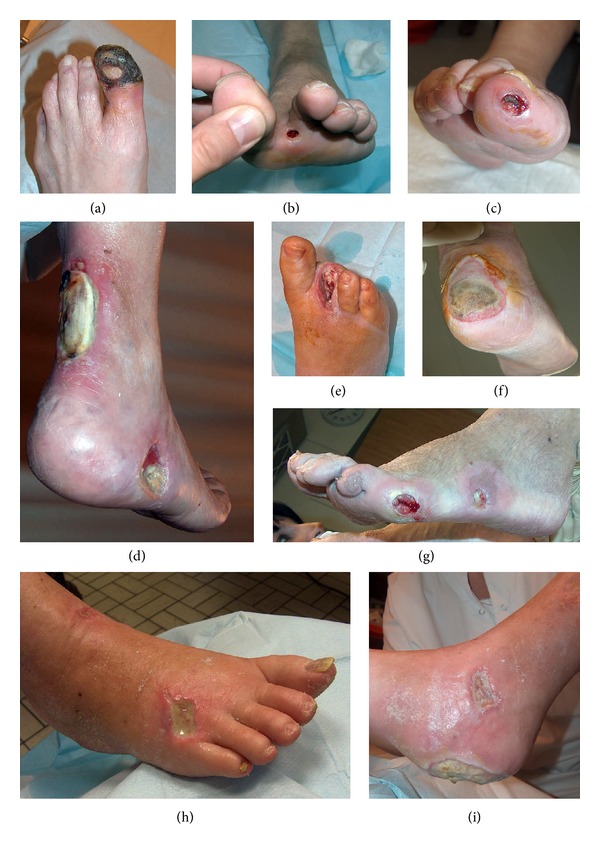
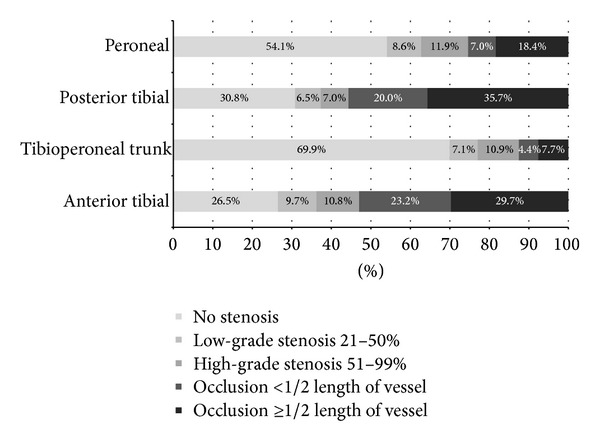
Purpose. Angiosome-guided revascularization is an approach that improves wound healing but requires a surgeon to determine which angiosomes are ischemic. This process can be more difficult than anticipated because diabetic foot (DF) wounds vary greatly in quantity, morphology, and topography. This paper explores to what extent the heterogeneous presentation of DF wounds impedes development of a proper revascularization strategy. Methods. Data was retrieved from a registry of patients scheduled for below-the-knee (BTK) revascularization. Photographs of the foot and historic benchmark diagrams were used to assign wounds to their respective angiosomes. Results. In 185 limbs we detected 345 wounds. Toe wounds (53.9%) could not be designated to a specific angiosome due to dual blood supply. Ambiguity in wound stratification into angiosomes was highest at the heel, achilles tendon, and lateral/medial side of the foot and lowest for malleolar wounds. In 18.4% of the DF, at least some wounds could not confidently be categorized. Proximal wounds (coinciding with toe wounds) further steered revascularization strategy in 63.6%. Multiple wounds required multiple BTK revascularization in 8.6%. Conclusion. The heterogeneous presentation in diabetic foot wounds hampers unambiguous identification of ischemic angiosomes, and as such diminishes the capacity of the angiosome model to optimize revascularization strategy.
目的。血管体引导的血运重建是一种可促进伤口愈合的方法,但需要外科医生确定哪些血管体存在缺血情况。这一过程可能比预期更困难,因为糖尿病足(DF)伤口在数量、形态和部位上差异很大。本文探讨了DF伤口的异质性表现对制定合适的血运重建策略的阻碍程度。方法。从计划进行膝下(BTK)血运重建的患者登记处获取数据。利用足部照片和历史基准图将伤口分配到各自的血管体。结果。在185条肢体中,我们检测到345处伤口。由于双重血供,脚趾伤口(53.9%)无法指定到特定的血管体。伤口分层到血管体的模糊性在足跟、跟腱以及足部外侧/内侧最高,而踝部伤口最低。在18.4%的DF病例中,至少有一些伤口无法确切分类。近端伤口(与脚趾伤口一致)在63.6%的情况下进一步指导了血运重建策略。8.6%的多处伤口需要多次BTK血运重建。结论。糖尿病足伤口的异质性表现妨碍了对缺血血管体的明确识别,从而削弱了血管体模型优化血运重建策略的能力。