Liu Jia, Wu Ning, Ma Leina, Liu Ming, Liu Ge, Zhang Yuyan, Lin Xiukun
Institutes of Oceanology, Chinese Academy of Sciences, Qingdao, China; Graduate School, University of Chinese Academy of Sciences, Beijing, China.
Institutes of Oceanology, Chinese Academy of Sciences, Qingdao, China.
PLoS One. 2014 Mar 13;9(3):e91606. doi: 10.1371/journal.pone.0091606. eCollection 2014.
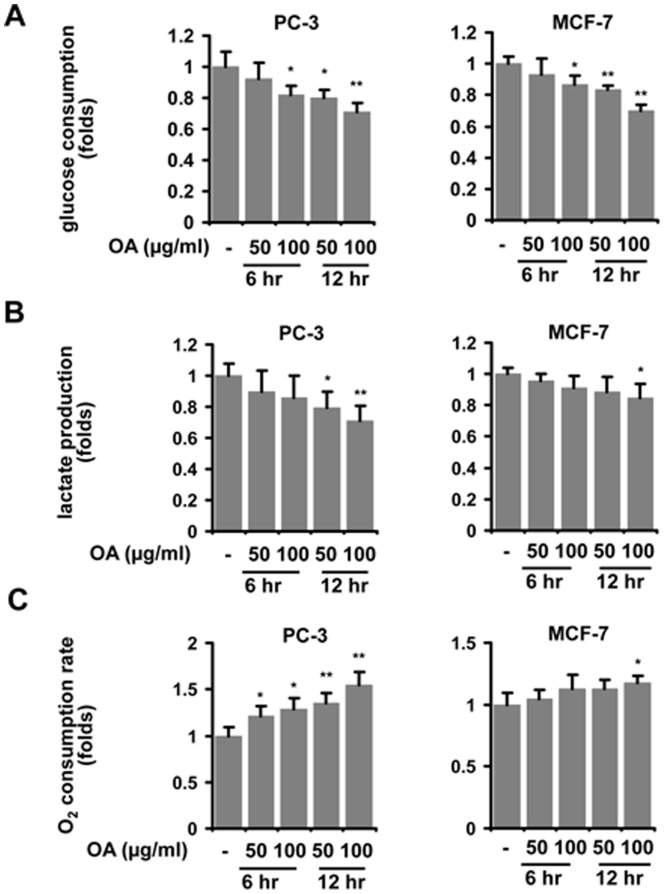
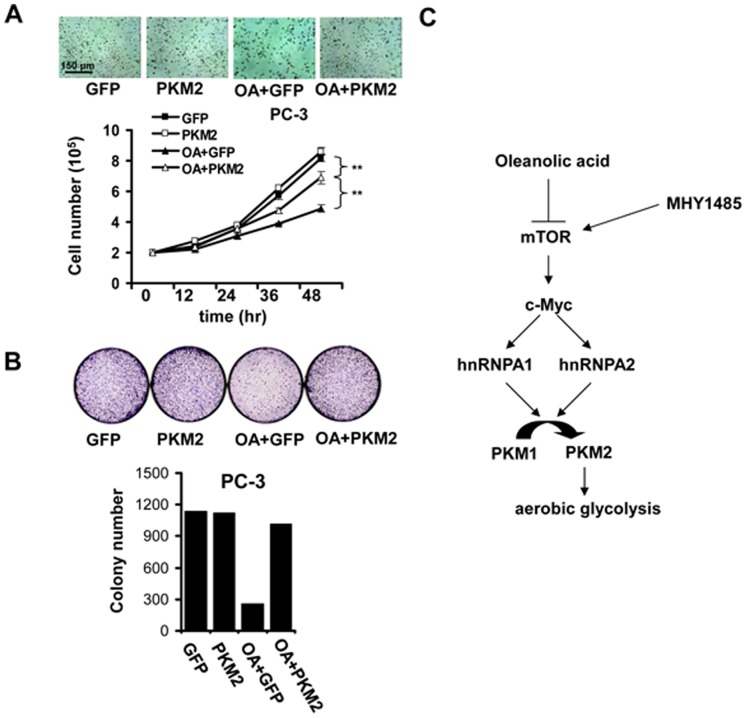
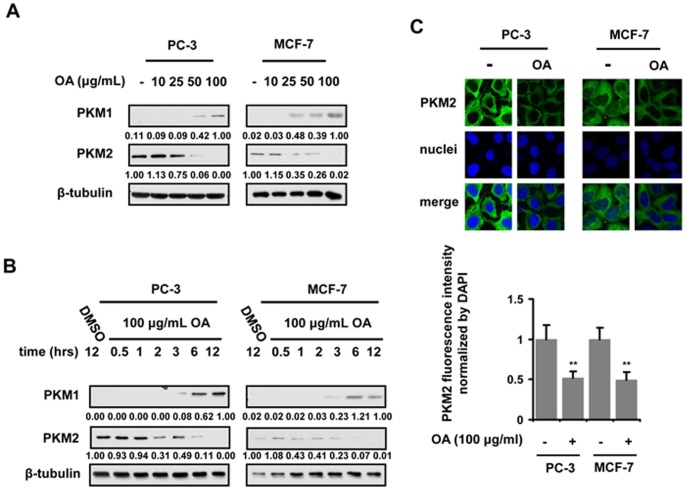
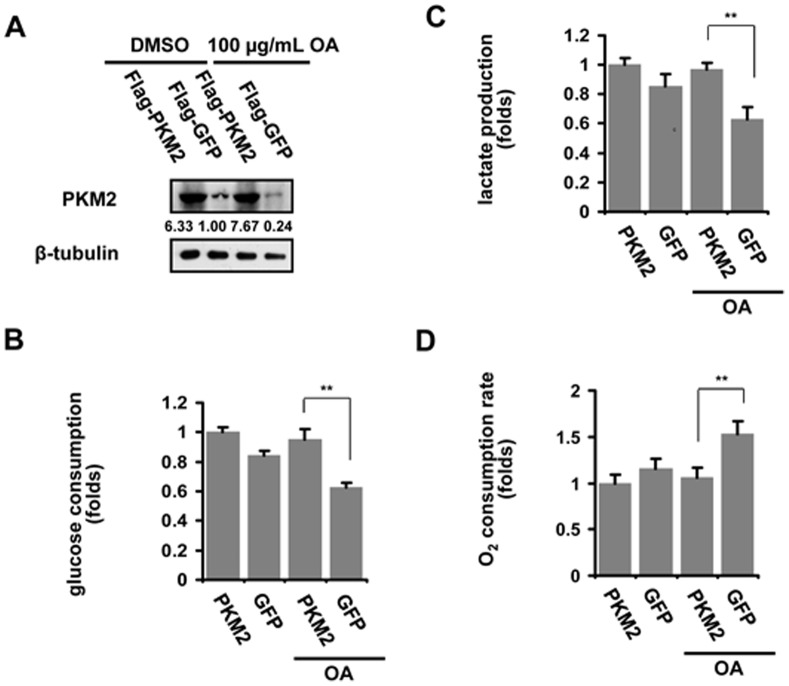
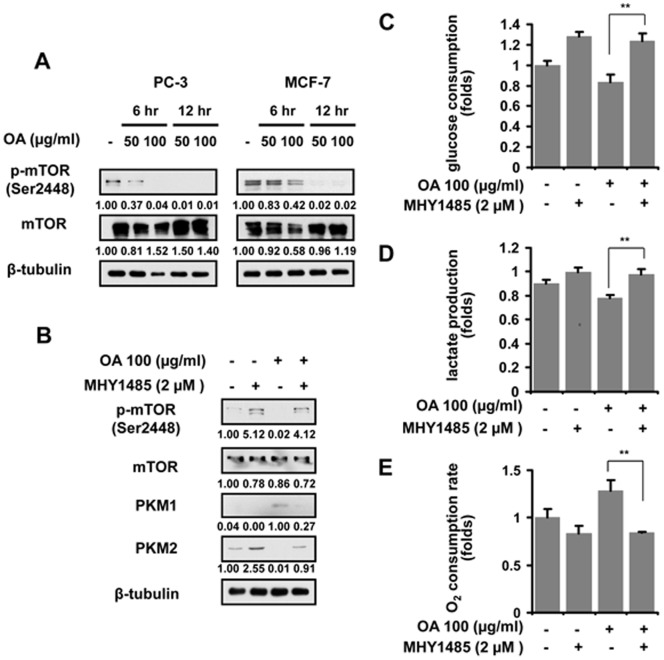
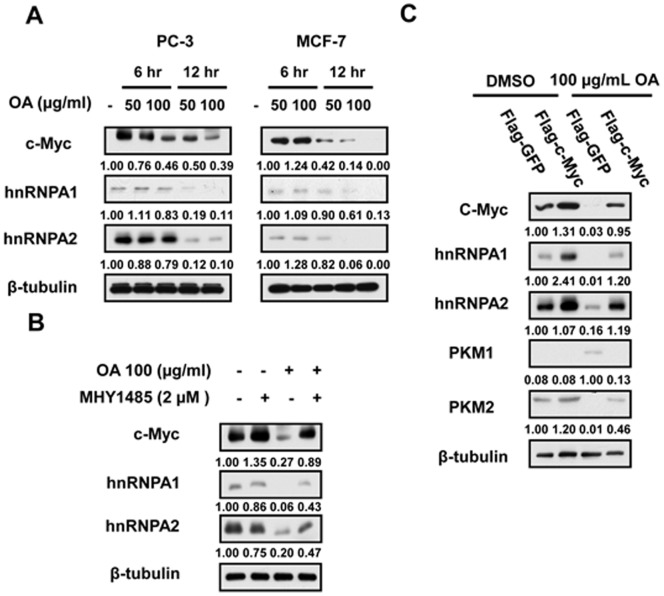
Warburg effect, one of the hallmarks for cancer cells, is characterized by metabolic switch from mitochondrial oxidative phosphorylation to aerobic glycolysis. In recent years, increased expression level of pyruvate kinase M2 (PKM2) has been found to be the culprit of enhanced aerobic glycolysis in cancer cells. However, there is no agent inhibiting aerobic glycolysis by targeting PKM2. In this study, we found that Oleanolic acid (OA) induced a switch from PKM2 to PKM1, and consistently, abrogated Warburg effect in cancer cells. Suppression of aerobic glycolysis by OA is mediated by PKM2/PKM1 switch. Furthermore, mTOR signaling was found to be inactivated in OA-treated cancer cells, and mTOR inhibition is required for the effect of OA on PKM2/PKM1 switch. Decreased expression of c-Myc-dependent hnRNPA1 and hnRNPA1 was responsible for OA-induced switch between PKM isoforms. Collectively, we identified that OA is an antitumor compound that suppresses aerobic glycolysis in cancer cells and there is potential that PKM2 may be developed as an important target in aerobic glycolysis pathway for developing novel anticancer agents.
瓦伯格效应是癌细胞的特征之一,其特点是代谢从线粒体氧化磷酸化转变为有氧糖酵解。近年来,已发现丙酮酸激酶M2(PKM2)表达水平升高是癌细胞有氧糖酵解增强的罪魁祸首。然而,尚无通过靶向PKM2来抑制有氧糖酵解的药物。在本研究中,我们发现齐墩果酸(OA)可诱导PKM2向PKM1转变,并且一致地消除了癌细胞中的瓦伯格效应。OA对有氧糖酵解的抑制作用是由PKM2/PKM1转变介导的。此外,发现mTOR信号在OA处理的癌细胞中失活,并且OA对PKM2/PKM1转变的作用需要抑制mTOR。c-Myc依赖性hnRNPA1和hnRNPA1表达降低是OA诱导PKM亚型之间转变的原因。总体而言,我们确定OA是一种抑制癌细胞有氧糖酵解的抗肿瘤化合物,并且PKM2有可能被开发为有氧糖酵解途径中开发新型抗癌药物的重要靶点。