Institute and Policlinic of Occupational and Social Medicine (IPAS), Technische Universität Dresden, Dresden, Germany.
J Occup Med Toxicol. 2014 Mar 14;9(1):10. doi: 10.1186/1745-6673-9-10.
To analyze the association between psychosocial working conditions and burnout and its core component emotional exhaustion, a systematic literature review was undertaken including cohort studies, case-control studies, and randomized controlled trials.
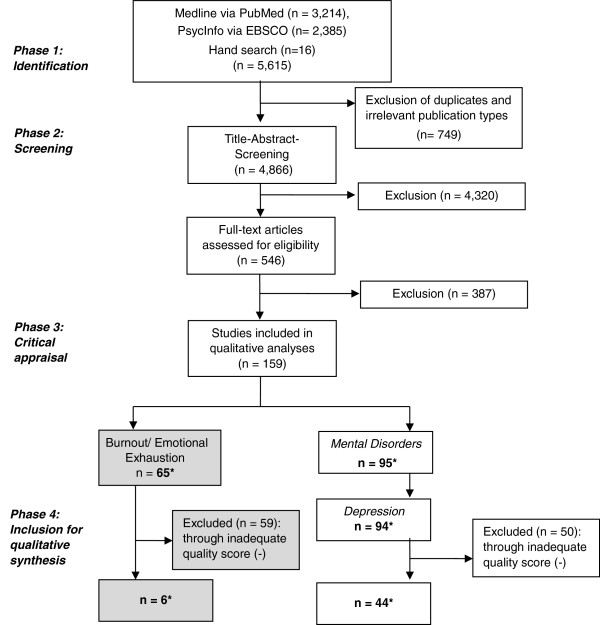
The literature search in Medline and PsycInfo was based on a defined search string and strict exclusion and inclusion criteria. Evaluation of the 5,599 initially identified search hits by two independent reviewers and a detailed quality assessment resulted in six methodologically adequate cohort studies considering the relationship between psychosocial working conditions and burnout (one study) as well as the burnout core component emotional exhaustion (five studies).
The results of our systematic review point to a relationship between psychosocial working conditions and the development of emotional exhaustion/burnout. Particularly high job demands seem to play a role in the development of emotional exhaustion. However, strong intercorrelations between workplace factors, as a matter of principle, make the identification of a single psychosocial workplace factor (being associated with an especially high or low risk of burnout) difficult.
Multidimensional approaches including reduction of work demands, enhancement of decision latitude and improving the social climate might be promising for preventing burnout and emotional exhaustion. However, methodologically adequate intervention studies are urgently needed to prove the effectiveness of workplace interventions.
分析心理社会工作条件与倦怠及其核心组成部分情绪耗竭之间的关联,为此进行了一项系统文献综述,纳入了队列研究、病例对照研究和随机对照试验。
在 Medline 和 PsycInfo 上进行文献检索,依据的是一个明确的检索词和严格的排除和纳入标准。最初确定的 5599 个检索结果由两名独立的评审员进行评估,并进行了详细的质量评估,最终纳入了六项方法学上充分的队列研究,这些研究考虑了心理社会工作条件与倦怠(一项研究)以及倦怠的核心组成部分情绪耗竭(五项研究)之间的关系。
我们的系统综述结果表明,心理社会工作条件与情绪耗竭/倦怠的发展之间存在关联。较高的工作要求似乎特别容易导致情绪耗竭。然而,由于工作场所因素之间存在很强的相互关联,因此很难确定单个心理社会工作场所因素(与倦怠风险特别高或特别低相关)。
包括降低工作要求、增强决策自主权和改善社会氛围在内的多维方法可能对预防倦怠和情绪耗竭具有前景。然而,迫切需要进行方法学上充分的干预研究,以证明工作场所干预的有效性。