Department of Nanobiotechnology and Nanomedicine, Fraunhofer Institute for Biomedical Engineering (IBMT), Branch Potsdam, Am Muehlenberg 13, 14476 Potsdam-Golm, Germany.
Malar J. 2014 Mar 15;13:99. doi: 10.1186/1475-2875-13-99.
Nucleic acid amplification is the most sensitive and specific method to detect Plasmodium falciparum. However the polymerase chain reaction remains laboratory-based and has to be conducted by trained personnel. Furthermore, the power dependency for the thermocycling process and the costly equipment necessary for the read-out are difficult to cover in resource-limited settings. This study aims to develop and evaluate a combination of isothermal nucleic acid amplification and simple lateral flow dipstick detection of the malaria parasite for point-of-care testing.
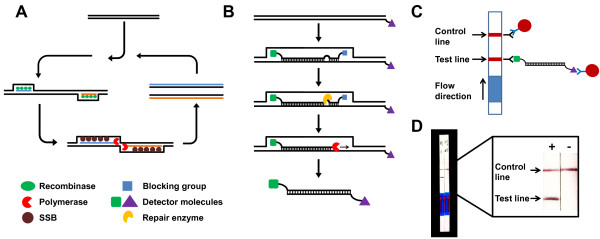
A specific fragment of the 18S rRNA gene of P. falciparum was amplified in 10 min at a constant 38°C using the isothermal recombinase polymerase amplification (RPA) method. With a unique probe system added to the reaction solution, the amplification product can be visualized on a simple lateral flow strip without further labelling. The combination of these methods was tested for sensitivity and specificity with various Plasmodium and other protozoa/bacterial strains, as well as with human DNA. Additional investigations were conducted to analyse the temperature optimum, reaction speed and robustness of this assay.
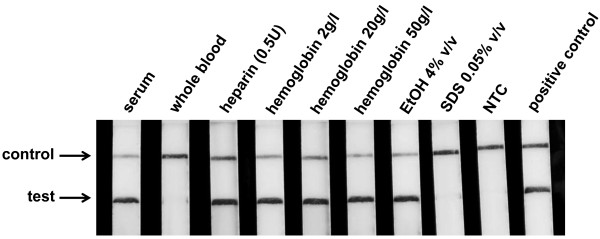
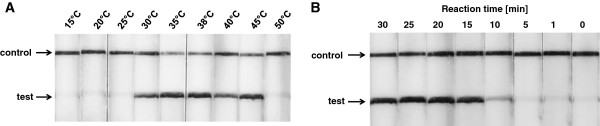
The lateral flow RPA (LF-RPA) assay exhibited a high sensitivity and specificity. Experiments confirmed a detection limit as low as 100 fg of genomic P. falciparum DNA, corresponding to a sensitivity of approximately four parasites per reaction. All investigated P. falciparum strains (n=77) were positively tested while all of the total 11 non-Plasmodium samples, showed a negative test result. The enzymatic reaction can be conducted under a broad range of conditions from 30-45°C with high inhibitory concentration of known PCR inhibitors. A time to result of 15 min from start of the reaction to read-out was determined.
Combining the isothermal RPA and the lateral flow detection is an approach to improve molecular diagnostic for P. falciparum in resource-limited settings. The system requires none or only little instrumentation for the nucleic acid amplification reaction and the read-out is possible with the naked eye. Showing the same sensitivity and specificity as comparable diagnostic methods but simultaneously increasing reaction speed and dramatically reducing assay requirements, the method has potential to become a true point-of-care test for the malaria parasite.
核酸扩增是检测恶性疟原虫最敏感和特异的方法。然而聚合酶链反应仍然是基于实验室的,并且必须由经过培训的人员进行。此外,热循环过程对电力的依赖性以及读取所需的昂贵设备在资源有限的环境中难以覆盖。本研究旨在开发和评估一种组合等温核酸扩增和简单横向流动试纸检测疟原虫寄生虫的即时检测方法。
使用等温重组酶聚合酶扩增(RPA)方法,在 38°C 的恒定温度下 10 分钟即可扩增恶性疟原虫 18S rRNA 基因的特定片段。通过向反应溶液中添加独特的探针系统,可以在简单的横向流动条上可视化扩增产物,而无需进一步标记。使用各种疟原虫和其他原生动物/细菌菌株以及人 DNA 对这些方法的组合进行了敏感性和特异性测试。进行了额外的研究来分析该测定的最佳温度、反应速度和稳健性。
横向流动 RPA(LF-RPA)检测法表现出很高的灵敏度和特异性。实验证实,检测限低至 100 fg 恶性疟原虫基因组 DNA,相当于每个反应约 4 个寄生虫。所有检测的恶性疟原虫菌株(n=77)均呈阳性,而所有 11 种非疟原虫样本均呈阴性。酶反应可在 30-45°C 的宽范围内进行,具有已知 PCR 抑制剂的高抑制浓度。从反应开始到读取结果的时间为 15 分钟。
将等温 RPA 和横向流动检测相结合是一种改善资源有限环境中恶性疟原虫分子诊断的方法。该系统无需或仅需少量仪器进行核酸扩增反应,并且可以通过肉眼进行读取。该方法具有与可比诊断方法相同的灵敏度和特异性,但同时提高了反应速度并大大降低了检测要求,有可能成为疟原虫寄生虫的真正即时检测方法。