Sun Qi, Cornelis Marilyn C, Townsend Mary K, Tobias Deirdre K, Eliassen A Heather, Franke Adrian A, Hauser Russ, Hu Frank B
Channing Division of Network Medicine, Department of Medicine, Brigham and Women's Hospital and Harvard Medical School, Boston, Massachusetts, USA.
Environ Health Perspect. 2014 Jun;122(6):616-23. doi: 10.1289/ehp.1307201. Epub 2014 Mar 14.
Prospective evidence regarding associations for exposures to bisphenol A (BPA) and phthalates with type 2 diabetes (T2D) is lacking.
We prospectively examined urinary concentrations of BPA and phthalate metabolites with T2D risk.
We measured BPA and eight major phthalate metabolites among 971 incident T2D case-control pairs from the Nurses' Health Study (NHS) (mean age, 65.6 years) and NHSII (mean age, 45.6 years).
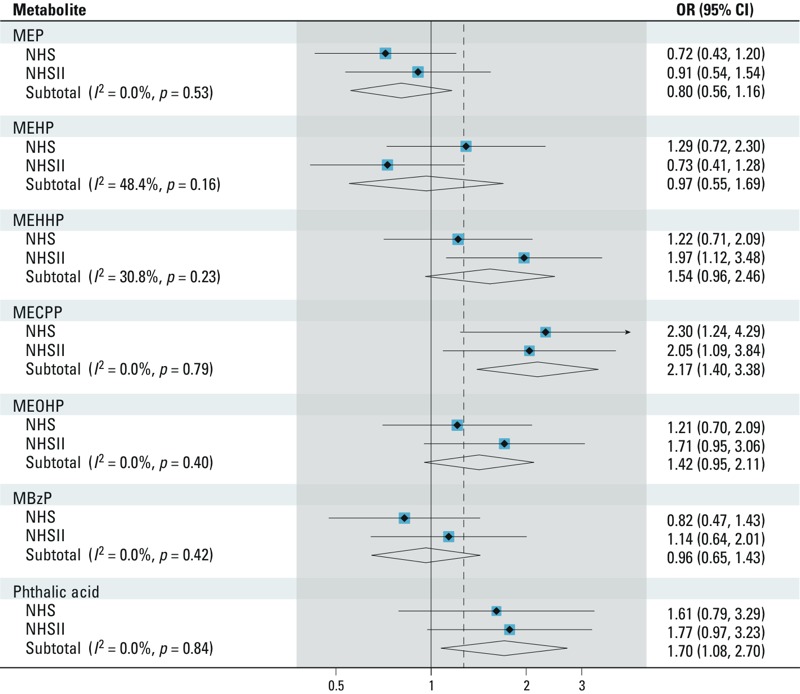
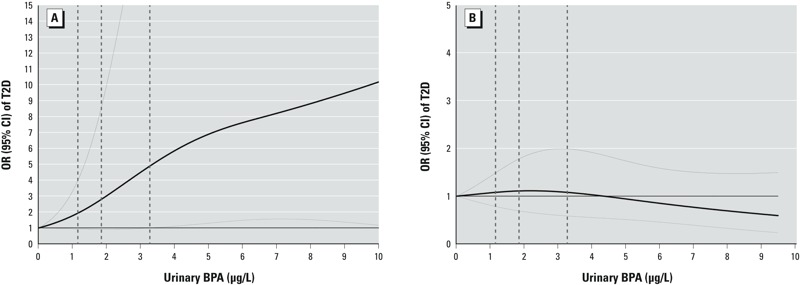
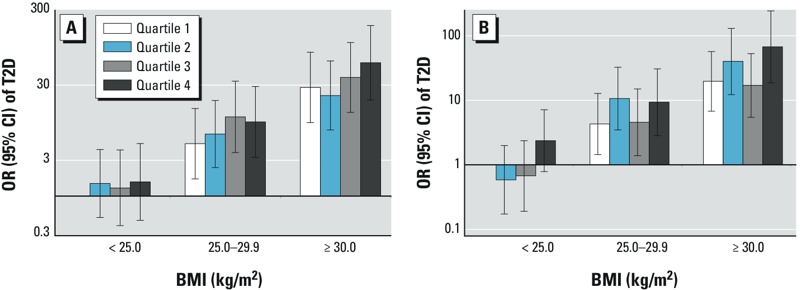
In the NHSII, BPA levels were not associated with incident T2D in multivariate-adjusted analysis until body mass index was adjusted: odds ratio (OR) comparing extreme BPA quartiles increased from 1.40 (95% CI: 0.91, 2.15) to 2.08 (95% CI: 1.17, 3.69; p(trend) = 0.02) with such an adjustment. In contrast, BPA concentrations were not associated with T2D in the NHS (OR = 0.81; 95% CI: 0.48, 1.38; p(trend) = 0.45). Likewise, urinary concentrations of total phthalate metabolites were associated with T2D in the NHSII (OR comparing extreme quartiles = 2.14; 95% CI: 1.19, 3.85; p(trend) = 0.02), but not in the NHS (OR = 0.87; 95% CI: 0.49, 1.53; p(trend) = 0.29). Summed metabolites of butyl phthalates or di-(2-ethylhexyl) phthalates were significantly associated with T2D only in the NHSII; ORs comparing extreme quartiles were 3.16 (95% CI: 1.68, 5.95; p(trend) = 0.0002) and 1.91 (95% CI: 1.04, 3.49; p(trend) = 0.20), respectively.
These results suggest that BPA and phthalate exposures may be associated with the risk of T2D among middle-aged, but not older, women. The divergent findings between the two cohorts might be explained by menopausal status or simply by chance. Clearly, these results need to be interpreted with caution and should be replicated in future studies, ideally with multiple urine samples collected prospectively to improve the measurement of these exposures with short half-lives.
关于双酚A(BPA)和邻苯二甲酸盐暴露与2型糖尿病(T2D)之间关联的前瞻性证据不足。
我们前瞻性地研究了BPA和邻苯二甲酸酯代谢物的尿浓度与T2D风险的关系。
我们在护士健康研究(NHS)(平均年龄65.6岁)和NHSII(平均年龄45.6岁)的971对新发T2D病例对照中测量了BPA和八种主要邻苯二甲酸酯代谢物。
在NHSII中,多变量调整分析中,在调整体重指数之前,BPA水平与新发T2D无关:比较BPA极端四分位数的优势比(OR)从1.40(95%CI:0.91,2.15)增加到2.08(95%CI:1.17,3.69;p趋势=0.02)。相比之下,NHS中BPA浓度与T2D无关(OR=0.81;95%CI:0.48,1.38;p趋势=0.45)。同样,总邻苯二甲酸酯代谢物的尿浓度在NHSII中与T2D相关(比较极端四分位数的OR=2.14;95%CI:1.19,3.85;p趋势=0.02),但在NHS中不相关(OR=0.87;95%CI:0.49,1.53;p趋势=0.29)。仅在NHSII中,邻苯二甲酸丁酯或邻苯二甲酸二(2-乙基己基)酯的总和代谢物与T2D显著相关;比较极端四分位数的OR分别为3.16(95%CI:1.68,5.95;p趋势=0.0002)和1.91(95%CI:1.04,3.49;p趋势=0.20)。
这些结果表明,BPA和邻苯二甲酸盐暴露可能与中年女性而非老年女性的T2D风险相关。两个队列之间的不同结果可能由绝经状态或仅仅是偶然因素解释。显然,这些结果需要谨慎解释,并且应该在未来的研究中重复验证,理想情况下前瞻性地收集多个尿液样本,以改善对这些半衰期短的暴露的测量。