Division of HIV/AIDS Prevention, National Center for HIV/AIDS, Viral Hepatitis, STD and TB Prevention, Centers for Disease Control and Prevention, 1600 Clifton Rd, MS-D21, 30333, Atlanta, Georgia,
AIDS Behav. 2014 Jun;18(6):997-1006. doi: 10.1007/s10461-014-0724-0.
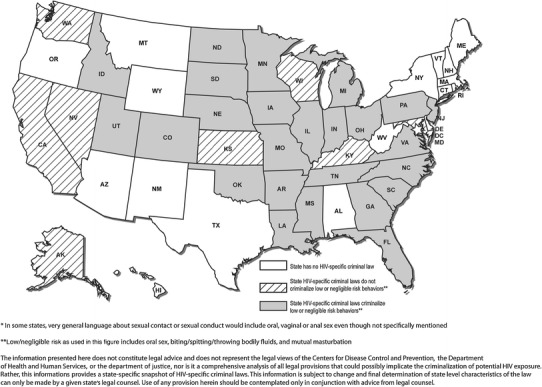
For the past three decades, legislative approaches to prevent HIV transmission have been used at the national, state, and local levels. One punitive legislative approach has been enactment of laws that criminalize behaviors associated with HIV exposure (HIV-specific criminal laws). In the USA, HIV-specific criminal laws have largely been shaped by state laws. These laws impose criminal penalties on persons who know they have HIV and subsequently engage in certain behaviors, most commonly sexual activity without prior disclosure of HIV-positive serostatus. These laws have been subject to intense public debate. Using public health law research methods, data from the legal database WestlawNext© were analyzed to describe the prevalence and characteristics of laws that criminalize potential HIV exposure in the 50 states (plus the District of Columbia) and to examine the implications of these laws for public health practice. The first state laws were enacted in 1986; as of 2011 a total of 67 laws had been enacted in 33 states. By 1995, nearly two-thirds of all laws had been enacted; by 2000, 85 % of laws had been enacted; and since 2000, an additional 10 laws have been enacted. Twenty-four states require persons who are aware that they have HIV to disclose their status to sexual partners and 14 states require disclosure to needle-sharing partners. Twenty-five states criminalize one or more behaviors that pose a low or negligible risk for HIV transmission. Nearly two-thirds of states in the USA have legislation that criminalizes potential HIV exposure. Many of these laws criminalize behaviors that pose low or negligible risk for HIV transmission. The majority of laws were passed before studies showed that antiretroviral therapy (ART) reduces HIV transmission risk and most laws do not account for HIV prevention measures that reduce transmission risk, such as condom use, ART, or pre-exposure prophylaxis. States with HIV-specific criminal laws are encouraged to use the findings of this paper to re-examine those laws, assess the laws' alignment with current evidence regarding HIV transmission risk, and consider whether the laws are the best vehicle to achieve their intended purposes.
在过去的三十年中,国家、州和地方各级都采取了立法措施来预防艾滋病毒传播。一种惩罚性的立法措施是制定将与艾滋病毒暴露相关的行为定为犯罪的法律(艾滋病毒特定刑法)。在美国,艾滋病毒特定刑法主要由州法律塑造。这些法律对明知自己患有艾滋病毒且随后从事某些行为的人(最常见的是在没有事先披露艾滋病毒阳性血清状况的情况下进行性行为)施加刑事处罚。这些法律一直是激烈的公众辩论的主题。使用公共卫生法研究方法,分析来自 WestlawNext©法律数据库的数据,以描述在 50 个州(加上哥伦比亚特区)将潜在的艾滋病毒暴露定为犯罪的法律的流行程度和特征,并研究这些法律对公共卫生实践的影响。第一批州法律于 1986 年颁布;截至 2011 年,已有 33 个州颁布了总共 67 项法律。到 1995 年,近三分之二的法律已经颁布;到 2000 年,颁布了 85%的法律;自 2000 年以来,又颁布了 10 项法律。24 个州要求明知自己患有艾滋病毒的人向性伴侣披露其状况,14 个州要求向共用针头的伴侣披露。25 个州将一种或多种对艾滋病毒传播构成低或可忽略风险的行为定为犯罪。美国有近三分之二的州有立法将潜在的艾滋病毒暴露定为犯罪。这些法律中的许多将对艾滋病毒传播构成低或可忽略风险的行为定为犯罪。大多数法律都是在研究表明抗逆转录病毒疗法 (ART) 降低艾滋病毒传播风险之后通过的,而且大多数法律都没有考虑到降低传播风险的艾滋病毒预防措施,例如使用避孕套、ART 或暴露前预防。鼓励有艾滋病毒特定刑法的州利用本文的研究结果重新审查这些法律,评估这些法律与关于艾滋病毒传播风险的现行证据是否一致,并考虑这些法律是否是实现其预期目的的最佳手段。