Margaritelis N V, Kyparos A, Paschalis V, Theodorou A A, Panayiotou G, Zafeiridis A, Dipla K, Nikolaidis M G, Vrabas I S
Exercise Physiology and Biochemistry Laboratory, Department of Physical Education and Sports Science at Serres, Aristotle University of Thessaloniki, Agios Ioannis, Serres 62110, Greece.
Department of Physical Education and Sports Science, University of Thessaly, Karies, Trikala 42100, Greece ; Laboratory of Exercise, Health and Human Performance, Research Center, European University of Cyprus, Nicosia, Cyprus.
Redox Biol. 2014 Feb 19;2:520-8. doi: 10.1016/j.redox.2014.02.003. eCollection 2014.
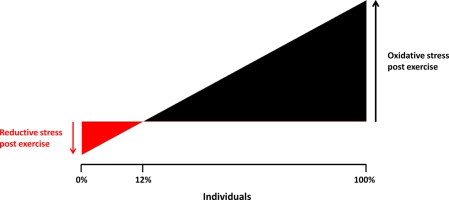
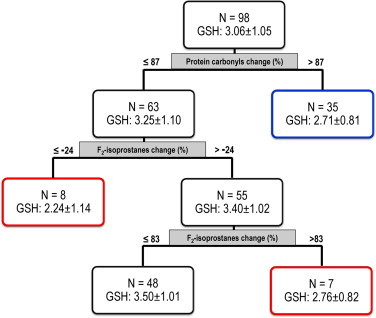
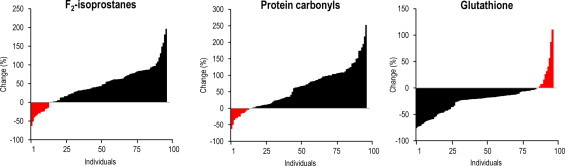
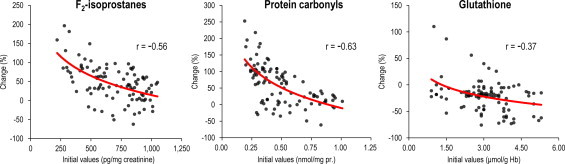
Exercise has been consistently used as an oxidant stimulus in redox biology studies. However, previous studies have focused on group differences and did not examine individual differences. As a result, it remains untested whether all individuals experience oxidative stress after acute exercise. Therefore, the main aim of the present study was to investigate whether some individuals exhibit unexpected responses after an acute eccentric (i.e., muscle-damaging) exercise session. Ninety eight (N = 98) young men performed an isokinetic eccentric exercise bout with the knee extensors. Plasma, erythrocytes and urine samples were collected immediately before and 2 days post-exercise. Three commonly used redox biomarkers (F2-isoprostanes, protein carbonyls and glutathione) were assayed. As expected, the two oxidant biomarkers (F2-isoprostanes and protein carbonyls) significantly increased 2 days after exercise (46% and 61%, respectively); whereas a significant decrease in glutathione levels (by -21%) was observed after exercise. A considerable number of the participants exhibited changes in the levels of biomarkers in the opposite, unexpected direction than the group average. More specifically, 13% of the participants exhibited a decrease in F2-isoprostanes and protein carbonyls and 10% of the participants exhibited an increase in glutathione levels. Furthermore, more than 1 out of 3 individuals exhibited either unexpected or negligible (from 0% to ± 5%) responses to exercise in at least one redox biomarker. It was also observed that the initial values of redox biomarkers are important predictors of the responses to exercise. In conclusion, although exercise induces oxidative stress in the majority of individuals, it can induce reductive stress or negligible stress in a considerable number of people. The data presented herein emphasize that the mean response to a redox stimulus can be very misleading. We believe that the wide variability (including the cases of reductive stress) described is not limited to the oxidant stimulus used and the biomarkers selected.
在氧化还原生物学研究中,运动一直被用作一种氧化刺激因素。然而,以往的研究主要关注群体差异,并未考察个体差异。因此,急性运动后是否所有个体都会经历氧化应激仍未得到验证。所以,本研究的主要目的是调查在进行急性离心(即肌肉损伤性)运动后,是否有个体表现出意外的反应。98名年轻男性对膝关节伸肌进行了等速离心运动。在运动前即刻以及运动后2天采集血浆、红细胞和尿液样本。检测了三种常用的氧化还原生物标志物(F2-异前列腺素、蛋白质羰基和谷胱甘肽)。正如预期的那样,两种氧化生物标志物(F2-异前列腺素和蛋白质羰基)在运动后2天显著增加(分别增加46%和61%);而运动后谷胱甘肽水平显著下降(下降21%)。相当一部分参与者的生物标志物水平变化方向与群体平均值相反,出乎意料。更具体地说,13%的参与者F2-异前列腺素和蛋白质羰基水平下降,10%的参与者谷胱甘肽水平升高。此外,超过三分之一的个体在至少一种氧化还原生物标志物上对运动表现出意外或可忽略不计(从0%到±5%)的反应。还观察到氧化还原生物标志物的初始值是运动反应的重要预测指标。总之,虽然运动在大多数个体中会诱发氧化应激,但在相当一部分人中也可能诱发还原应激或可忽略不计的应激。本文所呈现的数据强调,对氧化还原刺激的平均反应可能极具误导性。我们认为,所描述的广泛变异性(包括还原应激情况)并不局限于所使用的氧化刺激因素和所选择的生物标志物。