Zhao Qi, Xiao Jianzhong, He Jiang, Zhang Xuelian, Hong Jing, Kong Xiaomu, Mills Katherine T, Weng Jianping, Jia Weiping, Yang Wenying
Department of Epidemiology, Tulane University School of Public Health and Tropical Medicine, New Orleans, Louisiana, United States of America.
Department of Endocrinology, China-Japan Friendship Hospital, Beijing, China.
PLoS One. 2014 Mar 17;9(3):e91790. doi: 10.1371/journal.pone.0091790. eCollection 2014.
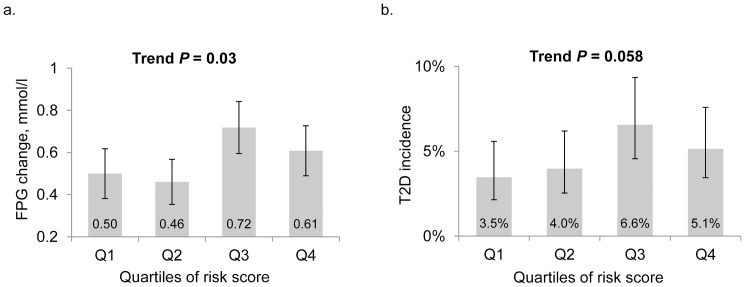
This study aimed to examine genomic loci of type 2 diabetes (T2D) initially identified by genome-wide association studies in populations of European ancestry for their associations with T2D and quantitative glycemic traits, as well as their effects on longitudinal change in fasting plasma glucose (FPG) and T2D development, in the Chinese population. Single nucleotide polymorphisms (SNP) from 25 loci were genotyped in a large case-control sample of 10,001 subjects (5,338 T2D cases and 4,663 controls) and a prospective cohort of 1,881 Chinese. In the case-control sample, 8 SNPs in or near WFS1, CDKAL1, CDKN2A/2B, CDC123, HHEX, TCF7L2, KCNQ1, and MTNR1B were significantly associated with T2D (P<0.05). Thirteen SNPs were associated with quantitative glycemic traits. For example, the most significant SNP, rs10811661 near CDKN2A/2B (P = 1.11×10(-8) for T2D), was also associated with 2-h glucose level of an oral glucose tolerance test (P = 9.11×10(-3)) and insulinogenic index (P = 2.71×10(-2)). In the cohort study, individuals carrying more risk alleles of the replicated SNPs had greater FPG increase and T2D incidence in a 7.5-year follow-up period, with each quartile increase in the number of risk alleles being associated with a 0.06 mmol/l greater increase in FPG (P = 0.03) and 19% higher odds of developing T2D (P = 0.058). Our study identified the associations of several established T2D-loci in Europeans with T2D and quantitative glycemic traits in the Chinese population. The prospective data also suggest their potential role in the risk prediction of T2D in the Chinese population.
本研究旨在检测2型糖尿病(T2D)的基因组位点,这些位点最初是在欧洲血统人群的全基因组关联研究中确定的,研究其与中国人群中T2D和血糖定量性状的关联,以及它们对空腹血糖(FPG)纵向变化和T2D发生发展的影响。在一个由10001名受试者(5338例T2D病例和4663例对照)组成的大型病例对照样本以及1881名中国人的前瞻性队列中,对来自25个位点的单核苷酸多态性(SNP)进行了基因分型。在病例对照样本中,WFS1、CDKAL1、CDKN2A/2B、CDC123、HHEX、TCF7L2、KCNQ1和MTNR1B内或附近的8个SNP与T2D显著相关(P<0.05)。13个SNP与血糖定量性状相关。例如,最显著的SNP,CDKN2A/2B附近的rs10811661(T2D的P = 1.11×10(-8)),也与口服葡萄糖耐量试验的2小时血糖水平(P = 9.11×10(-3))和胰岛素生成指数(P = 2.71×10(-2))相关。在队列研究中,在7.5年的随访期内,携带更多重复SNP风险等位基因的个体FPG升高幅度更大且T2D发病率更高,风险等位基因数量每增加一个四分位数,FPG升高幅度就增加0.06 mmol/l(P = 0.03),发生T2D的几率就高出19%(P = 0.058)。我们的研究确定了欧洲人中几个已确定的T2D位点与中国人群中T2D和血糖定量性状的关联。前瞻性数据还表明了它们在中国人群T2D风险预测中的潜在作用。