Keller Kresten Krarup, Thomsen Jesper Skovhus, Stengaard-Pedersen Kristian, Hauge Ellen-Margrethe
Department of Rheumatology, Aarhus University Hospital, Aarhus, Denmark.
Department of Biomedicine - Anatomy, Aarhus University, Aarhus, Denmark.
PLoS One. 2014 Mar 17;9(3):e92359. doi: 10.1371/journal.pone.0092359. eCollection 2014.
Local bone erosions and osteoporosis in rheumatoid arthritis (RA) are the result of a more pronounced bone resorption than bone formation. Present treatment strategies for RA inhibit inflammation, but do not directly target bone erosions. The aim of the study was in experimental arthritis to investigate the juxtaarticular and systemic effects of simultaneous osteoclast inhibition with zoledronate (ZLN) and osteoblast stimulation with parathyroid hormone (PTH).
Arthritis was induced in 36 SKG mice. The mice were randomized to three treatment groups and an untreated group: ZLN, PTH, PTH+ZLN, and untreated. Arthritis score and ankle width measurements were performed. Histological sections were cut from the right hind paw, and design-based stereological estimators were used to quantify histological variables of bone volume and bone formation and resorption. The femora were DXA- and μCT-scanned, and the bone strength was determined at the femoral neck and mid-diaphysis.
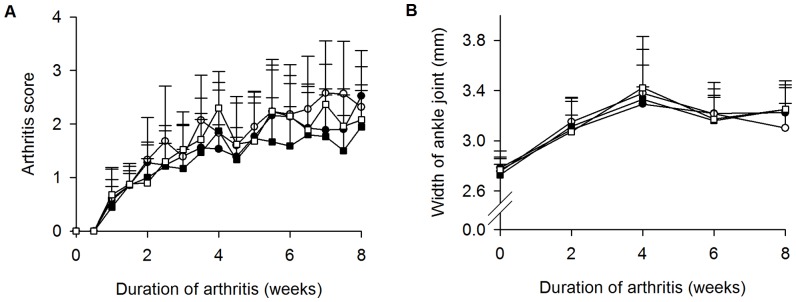
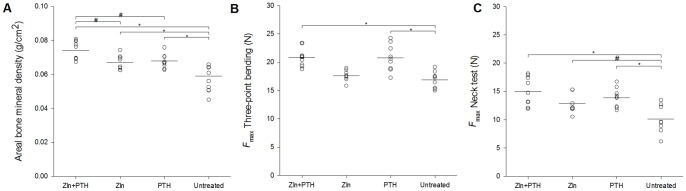
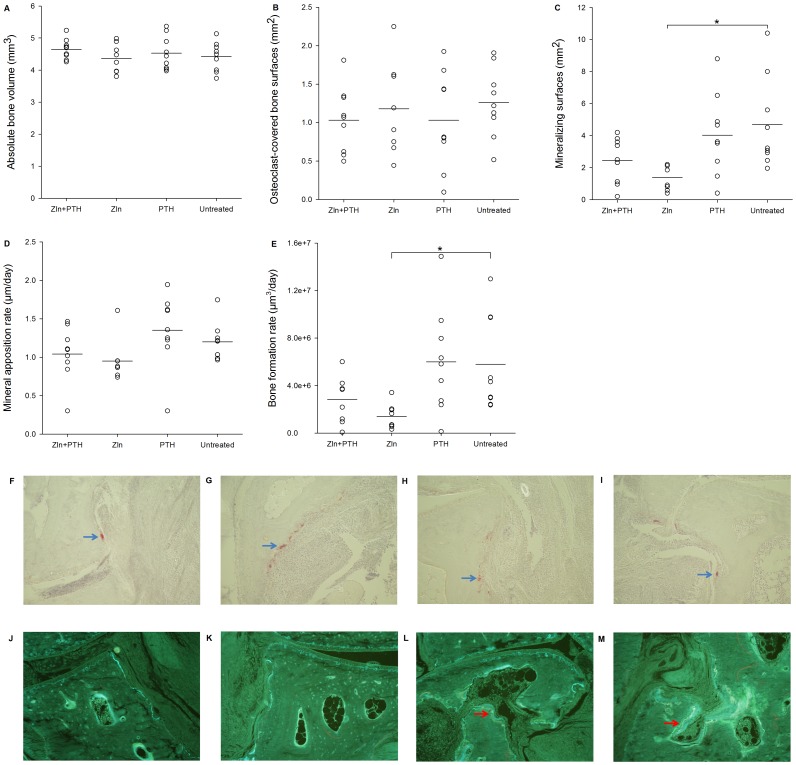
Locally, we found no differences in arthritis score or ankle width throughout the study. Similarly, none of the treatments inhibited bone erosions or stimulated bone formation in the paw. Systemically, all treatments improved bone mineral density, strength of the femoral neck and mid-diaphysis, and μCT parameters of both cortical and trabecular bone. In addition, there was an additive effect of combination treatment compared with single treatments for most trabecular parameters including bone mineral density and bone volume fraction.
No local effect on bone was found by the combined action of inhibiting bone resorption and stimulating bone formation. However, a clear systemic effect of the combination treatment was demonstrated.
类风湿关节炎(RA)中的局部骨侵蚀和骨质疏松是骨吸收比骨形成更为显著的结果。目前RA的治疗策略可抑制炎症,但不能直接针对骨侵蚀。本研究的目的是在实验性关节炎中,研究唑来膦酸(ZLN)抑制破骨细胞与甲状旁腺激素(PTH)刺激成骨细胞同时作用时对关节周围和全身的影响。
对36只SKG小鼠诱导关节炎。将小鼠随机分为三个治疗组和一个未治疗组:ZLN组、PTH组、PTH + ZLN组和未治疗组。进行关节炎评分和踝关节宽度测量。从右后爪切取组织学切片,并使用基于设计的体视学估计器来量化骨体积、骨形成和骨吸收的组织学变量。对股骨进行双能X线吸收测定(DXA)和显微计算机断层扫描(μCT),并测定股骨颈和骨干中部的骨强度。
在局部,我们发现在整个研究过程中关节炎评分或踝关节宽度没有差异。同样,没有一种治疗方法能抑制爪部的骨侵蚀或刺激骨形成。在全身,所有治疗方法均改善了骨矿物质密度、股骨颈和骨干中部的强度以及皮质骨和小梁骨的μCT参数。此外,与单一治疗相比,联合治疗对大多数小梁参数(包括骨矿物质密度和骨体积分数)具有累加效应。
抑制骨吸收和刺激骨形成的联合作用未发现对骨有局部影响。然而,联合治疗显示出明显的全身效应。