Ejeby Kersti, Savitskij Ruslan, Ost Lars-Göran, Ekbom Anders, Brandt Lena, Ramnerö Jonas, Asberg Marie, Backlund Lars G
Department of Neurobiology, Care Sciences and Society, Centre for Family Medicine, Karolinska Institutet, Stockholm,
CEO Innernet, Research & Development Centre, Nacka.
Fam Pract. 2014 Jun;31(3):273-80. doi: 10.1093/fampra/cmu006. Epub 2014 Mar 18.
The purpose was to test the effectiveness of two transdiagnostic group interventions compared to care as usual (CAU) for patients with anxiety, depressive or stress-related disorders within a primary health care context.
To compare the effects of cognitive-based-behavioural therapy (CBT) and multimodal intervention (MMI) on the quality of life and relief of psychological symptoms of patients with common mental disorders or problems attending primary health care centre.
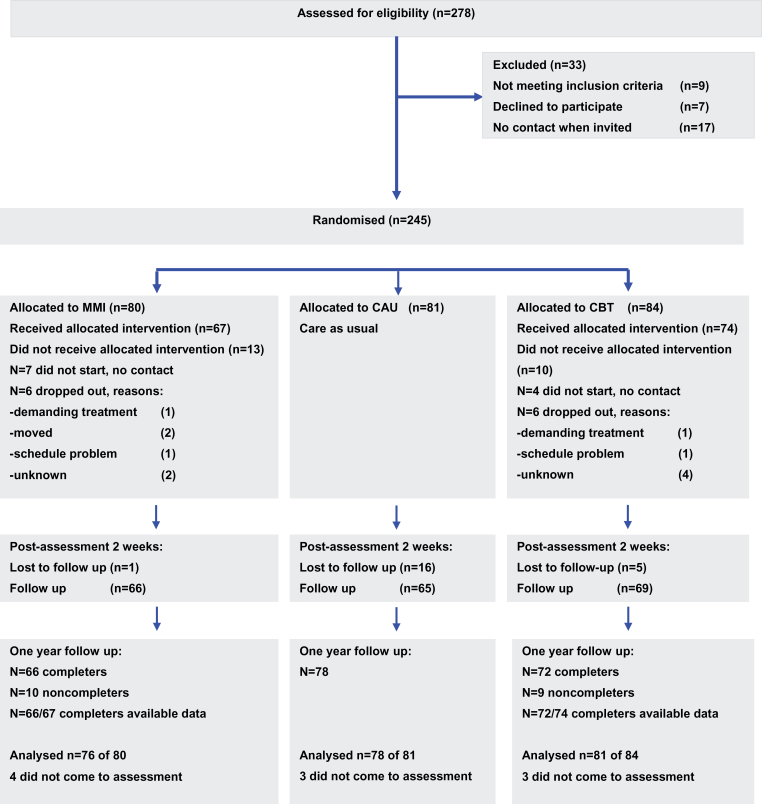
Patients (n = 278), aged 18-65 years, were referred to the study by the GPs and 245 were randomized to CAU or one of two group interventions in addition to CAU: (i) group CBT administered by psychologists and (ii) group MMI administered by assistant nurses. The primary outcome measure was the Mental Component Summary score of short form 36. Secondary outcome measures were Perceived Stress Scale and Self-Rating Scale for Affective Syndromes. The data were analysed using intention-to-treat with a linear mixed model.
On the primary outcome measure, the mean improvement based on mixed model analyses across post- and follow-up assessment was significantly larger for the MMI group than for the CBT (4.0; P = 0.020) and CAU (7.5; P = .001) groups. Participants receiving CBT were significantly more improved than those in the CAU group. On four of the secondary outcome measures, the MMI group was significantly more improved than the CBT and CAU groups. The course of improvement did not differ between the CBT group and the CAU group on these measures.
Transdiagnostic group treatment can be effective for patients with common mental disorders when delivered in a primary care setting. The group format and transdiagnostic approach fit well with the requirements of primary care.
本研究旨在测试在初级卫生保健环境中,两种跨诊断团体干预措施相较于常规护理(CAU)对焦虑、抑郁或与压力相关障碍患者的有效性。
比较基于认知行为疗法(CBT)和多模式干预(MMI)对在初级卫生保健中心就诊的常见精神障碍或问题患者的生活质量和心理症状缓解的影响。
年龄在18 - 65岁之间的患者(n = 278)由全科医生转诊至本研究,245名患者被随机分配至常规护理组或除常规护理外的两种团体干预措施之一:(i)由心理学家实施的团体CBT;(ii)由助理护士实施的团体MMI。主要结局指标是简短健康调查问卷36项简表的心理成分总分。次要结局指标是感知压力量表和情感综合征自评量表。数据采用意向性分析,使用线性混合模型进行分析。
在主要结局指标上,基于混合模型分析,在干预后和随访评估中,MMI组的平均改善幅度显著大于CBT组(4.0;P = 0.020)和常规护理组(7.5;P = 0.001)。接受CBT的参与者比常规护理组的改善更为显著。在四项次要结局指标上,MMI组的改善显著大于CBT组和常规护理组。在这些指标上,CBT组和常规护理组的改善过程没有差异。
在初级保健环境中,跨诊断团体治疗对常见精神障碍患者可能有效。团体形式和跨诊断方法很适合初级保健的要求。