Instituto Superior de Investigaciones Biológicas, INSIBIO (CONICET-UNT) and Instituto de Química Biológica "Dr Bernabé Bloj", Facultad de Bioquímica, Química y Farmacia (UNT), Chacabuco 461 CP T4000ILI, Tucumán, Argentina.
BMC Microbiol. 2014 Mar 19;14:72. doi: 10.1186/1471-2180-14-72.
Metal tolerance in bacteria has been related to polyP in a model in which heavy metals stimulate the polymer hydrolysis, forming metal-phosphate complexes that are exported. As previously described in our laboratory, Escherichia coli cells grown in media containing a phosphate concentration >37 mM maintained an unusually high polyphosphate (polyP) level in stationary phase. The aim of the present work was to evaluate the influence of polyP levels as the involvement of low-affinity inorganic phosphate transport (Pit) system in E. coli copper tolerance.
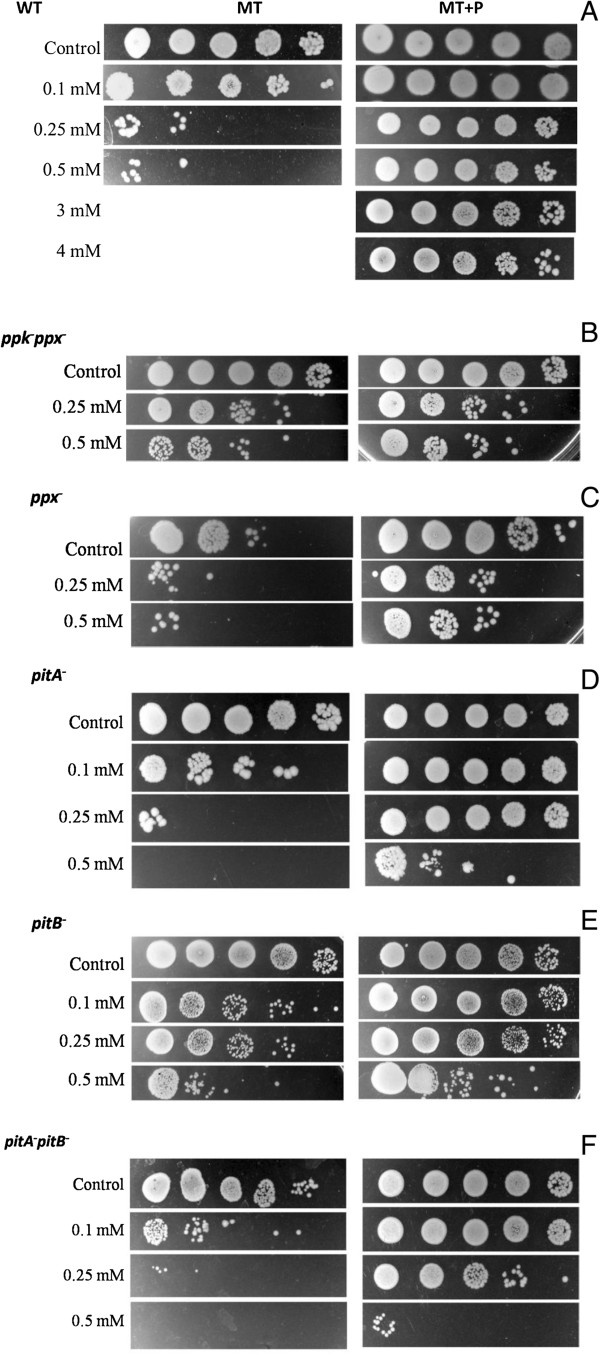
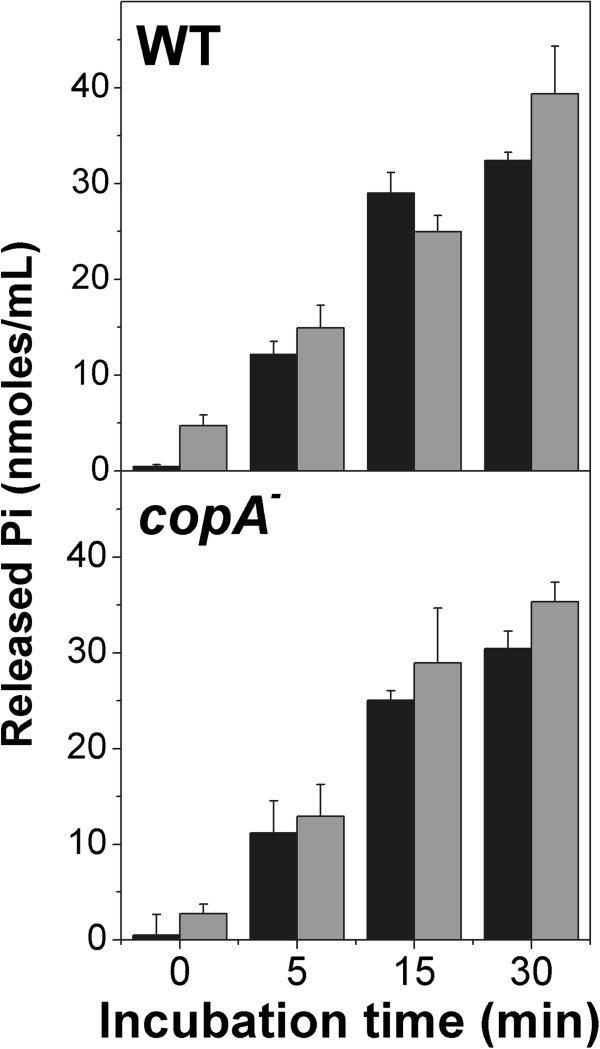
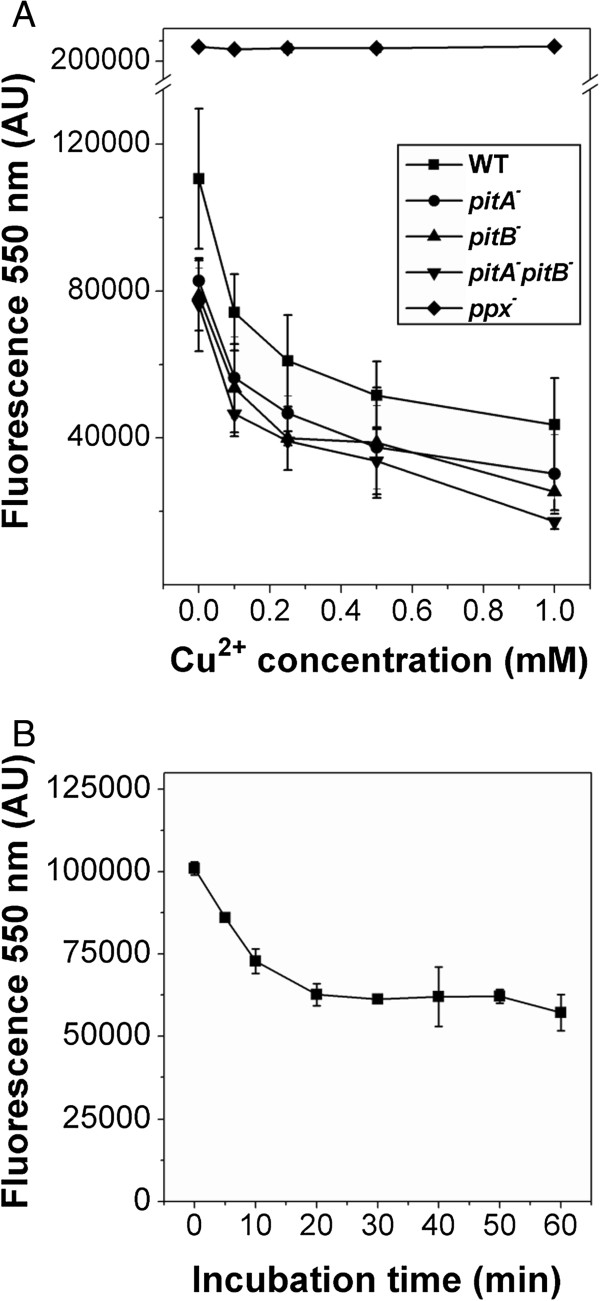
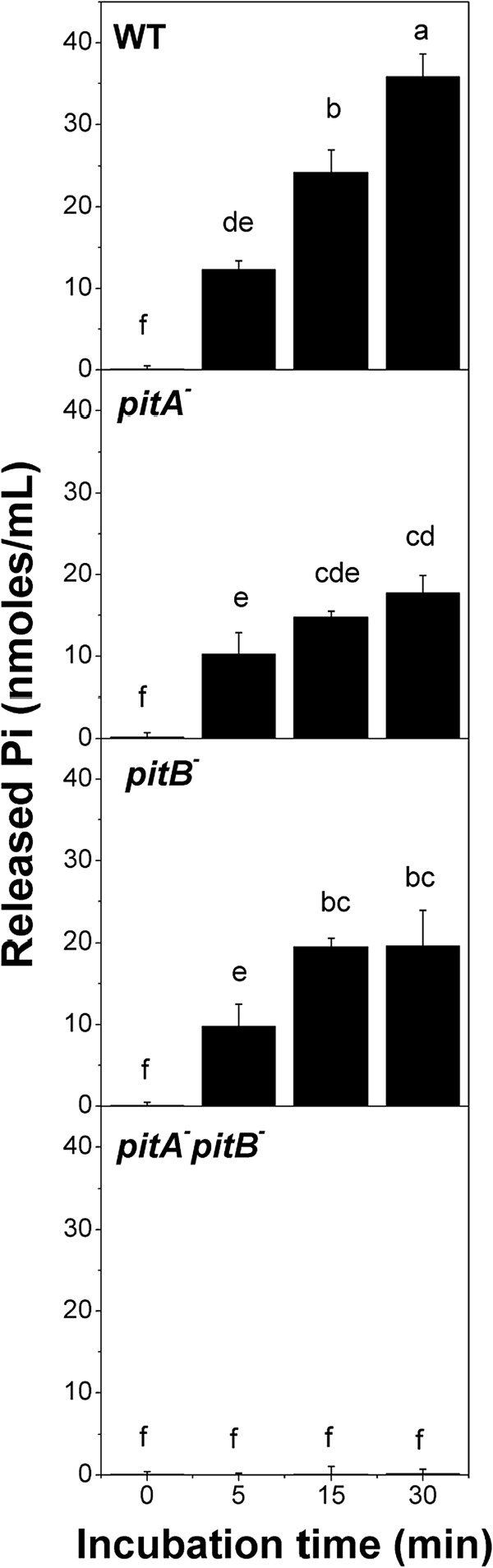
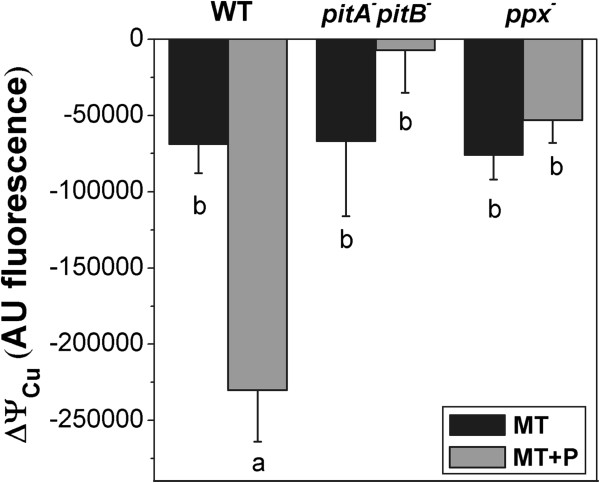
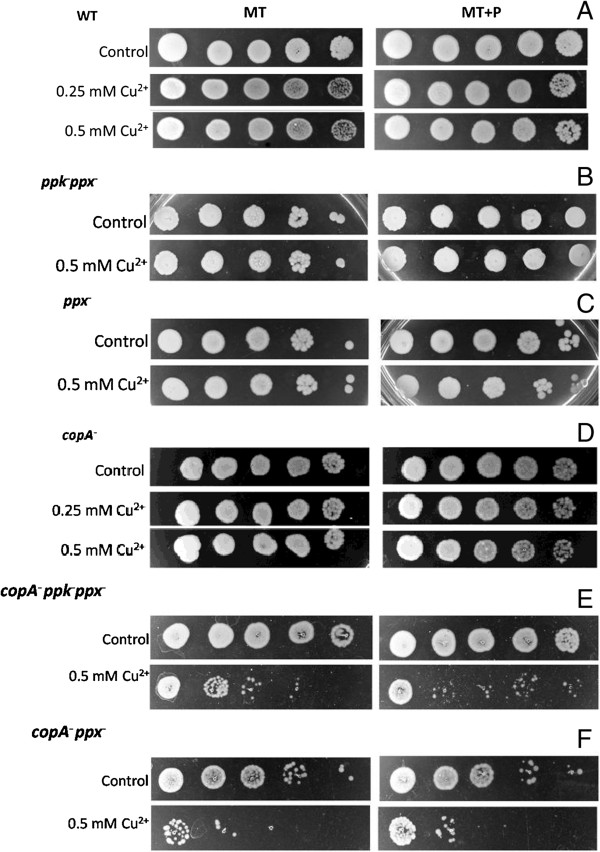
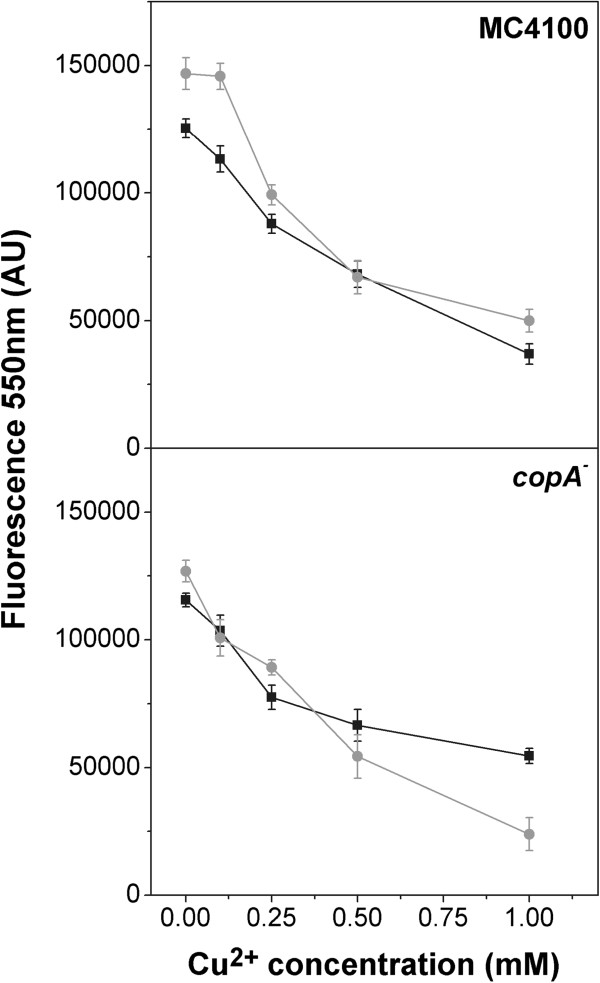
PolyP levels were modulated by the media phosphate concentration and/or using mutants in polyP metabolism. Stationary phase wild-type cells grown in high phosphate medium were significantly more tolerant to copper than those grown in sufficient phosphate medium. Copper addition to tolerant cells induced polyP degradation by PPX (an exopolyphosphatase), phosphate efflux and membrane polarization. ppk-ppx- (unable to synthesize/degrade polyP), ppx- (unable to degrade polyP) and Pit system mutants were highly sensitive to metal even in high phosphate media. In exponential phase, CopA and polyP-Pit system would act simultaneously to detoxify the metal or one could be sufficient to safeguard the absence of the other.
Our results support a mechanism for copper detoxification in exponential and stationary phases of E. coli, involving Pit system and degradation of polyP. Data reflect the importance of the environmental phosphate concentration in the regulation of the microbial physiological state.
在一个模型中,细菌对金属的耐受性与多聚磷酸盐(polyP)有关,在该模型中,重金属会刺激聚合物水解,形成金属-磷酸盐复合物,然后被输出。正如我们实验室之前所描述的,在含有磷酸盐浓度>37mM 的培养基中生长的大肠杆菌细胞在静止期保持异常高的多聚磷酸盐(polyP)水平。本研究的目的是评估多聚磷酸盐水平的影响,以及低亲和力无机磷酸盐转运(Pit)系统在大肠杆菌铜耐受性中的参与情况。
多聚磷酸盐水平可通过培养基磷酸盐浓度的调节和/或使用多聚磷酸盐代谢突变体来调节。在高磷酸盐培养基中生长的静止期野生型细胞比在足够磷酸盐培养基中生长的细胞对铜的耐受性显著更高。向耐受细胞中添加铜会诱导 PPX(一种外多聚磷酸盐酶)降解多聚磷酸盐、磷酸盐外排和膜极化。ppk-ppx-(不能合成/降解多聚磷酸盐)、ppx-(不能降解多聚磷酸盐)和 Pit 系统突变体即使在高磷酸盐培养基中也对金属高度敏感。在指数生长期,CopA 和多聚磷酸盐-Pit 系统将同时协同作用以解毒金属,或者其中一种足以保障另一种的不存在。
我们的结果支持大肠杆菌指数生长期和静止期铜解毒的一种机制,涉及 Pit 系统和多聚磷酸盐的降解。数据反映了环境磷酸盐浓度在调节微生物生理状态方面的重要性。