Post-Graduate Program in Medical Sciences, School of Medicine, Universidade Federal do Rio Grande do Sul, Porto Alegre, Brazil.
BMC Neurosci. 2014 Mar 19;15:42. doi: 10.1186/1471-2202-15-42.
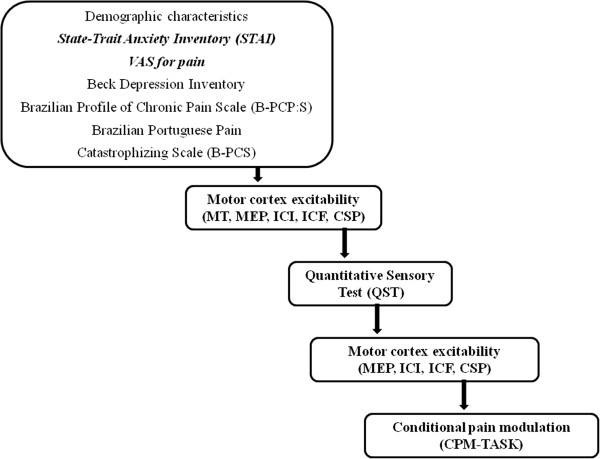
This study aimed to answer three questions related to chronic myofascial pain syndrome (MPS): 1) Is the motor cortex excitability, as assessed by transcranial magnetic stimulation parameters (TMS), related to state-trait anxiety? 2) Does anxiety modulate corticospinal excitability changes after evoked pain by Quantitative Sensory Testing (QST)? 3) Does the state-trait anxiety predict the response to pain evoked by QST if simultaneously receiving a heterotopic stimulus [Conditional Pain Modulation (CPM)]? We included females with chronic MPS (n = 47) and healthy controls (n = 11), aged 19 to 65 years. Motor cortex excitability was assessed by TMS, and anxiety was assessed based on the State-Trait Anxiety Inventory. The disability related to pain (DRP) was assessed by the Profile of Chronic Pain scale for the Brazilian population (B:PCP:S), and the psychophysical pain measurements were measured by the QST and CPM.
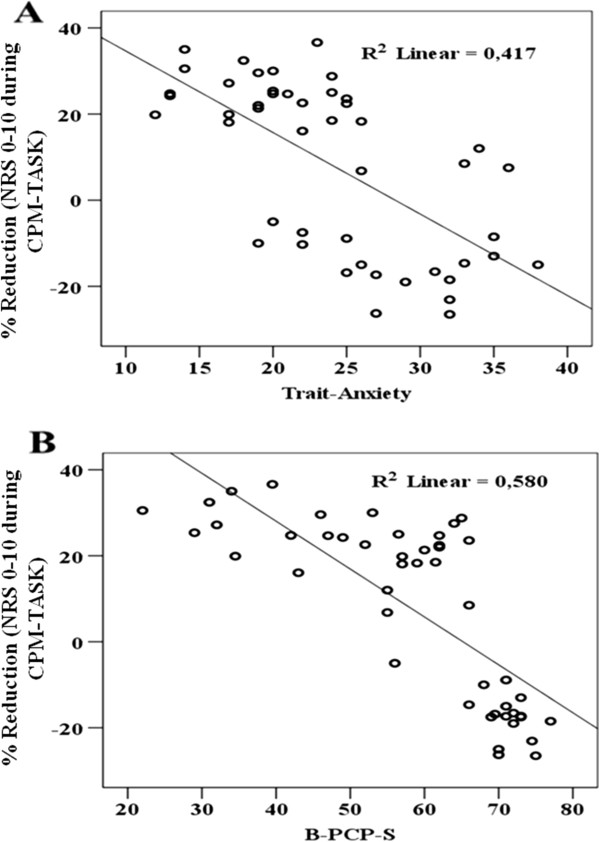
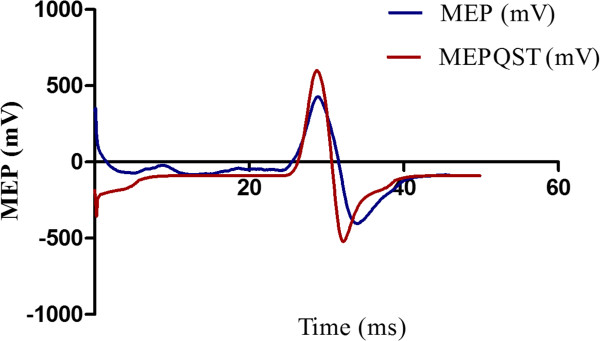
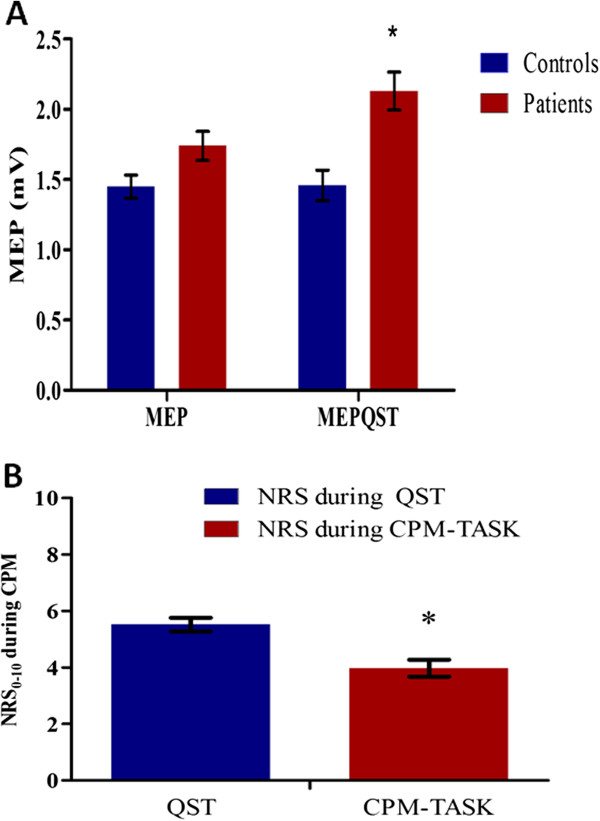
In patients, trait-anxiety was positively correlated to intracortical facilitation (ICF) at baseline and after QST evoked pain (β = 0.05 and β = 0.04, respectively) and negatively correlated to the cortical silent period (CSP) (β = -1.17 and β = -1.23, respectively) (P <0.05 for all comparisons). After QST evoked pain, the DRP was positively correlated to ICF (β = 0.02) (P < 0.05). Pain scores during CPM were positively correlated with trait-anxiety when it was concurrently with high DRP (β = 0.39; P = 0.02). Controls' cortical excitability remained unchanged after QST.
These findings suggest that, in chronic MPS, the imbalance between excitatory and inhibitory descending systems of the corticospinal tract is associated with higher trait-anxiety concurrent with higher DRP.
本研究旨在回答与慢性肌筋膜疼痛综合征(MPS)相关的三个问题:1)经颅磁刺激参数(TMS)评估的运动皮层兴奋性是否与状态-特质焦虑有关?2)焦虑是否调节定量感觉测试(QST)诱发疼痛后的皮质脊髓兴奋性变化?3)如果同时接受异源性刺激[条件性疼痛调制(CPM)],状态-特质焦虑是否预测 QST 诱发疼痛的反应?我们纳入了年龄在 19 至 65 岁之间的慢性 MPS 女性患者(n=47)和健康对照组(n=11)。通过 TMS 评估运动皮层兴奋性,根据状态-特质焦虑量表评估焦虑。疼痛相关残疾(DRP)通过巴西人群慢性疼痛简表(B:PCP:S)评估,通过 QST 和 CPM 评估心理物理疼痛测量。
在患者中,特质焦虑与基线时和 QST 诱发疼痛后的皮质内易化(ICF)呈正相关(β=0.05 和β=0.04),与皮质静息期(CSP)呈负相关(β=-1.17 和β=-1.23)(所有比较均 P<0.05)。QST 诱发疼痛后,DRP 与 ICF 呈正相关(β=0.02)(P<0.05)。CPM 期间的疼痛评分与特质焦虑呈正相关,当同时存在高 DRP 时(β=0.39;P=0.02)。QST 后对照组皮质兴奋性无变化。
这些发现表明,在慢性 MPS 中,皮质脊髓束兴奋性和抑制性下行系统之间的失衡与更高的特质焦虑和更高的 DRP 同时存在相关。