
翻译起始因子 4E 或其同工型的特定需求驱动植物宿主对烟草蚀纹病毒的易感性。
Specific requirement for translation initiation factor 4E or its isoform drives plant host susceptibility to Tobacco etch virus.
机构信息
INRA-UR1052, Genetics and Breeding of Fruits and Vegetables, Dom, St Maurice, CS 60094, Montfavet Cedex F-84143, France.
出版信息
BMC Plant Biol. 2014 Mar 19;14:67. doi: 10.1186/1471-2229-14-67.
BACKGROUND
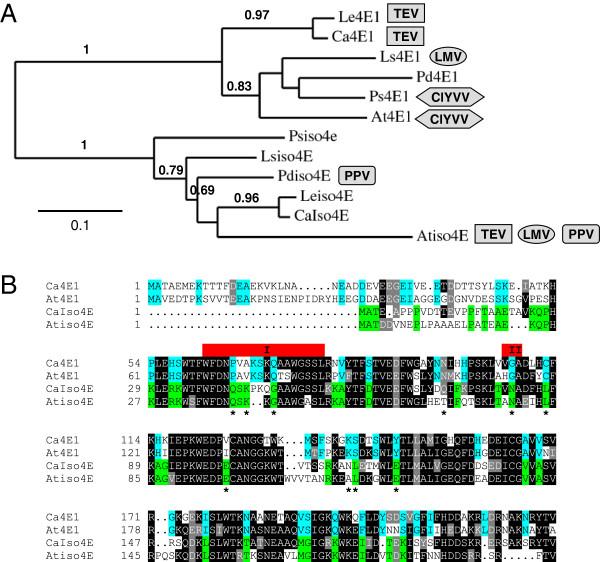
In plants, eIF4E translation initiation factors and their eIFiso4E isoforms are essential susceptibility factors for many RNA viruses, including potyviruses. Mutations altering these factors are a major source of resistance to the viruses. The eIF4E allelic series is associated with specific resistance spectra in crops such as Capsicum annum. Genetic evidence shows that potyviruses have a specific requirement for a given 4E isoform that depends on the host plant. For example, Tobacco etch virus (TEV) uses eIF4E1 to infect Capsicum annuum but uses eIFiso4E to infect Arabidopsis thaliana. Here, we investigated how TEV exploits different translation initiation factor isoforms to infect these two plant species.
RESULTS
A complementation system was set up in Arabidopsis to test the restoration of systemic infection by TEV. Using this system, Arabidopsis susceptibility to TEV was complemented with a susceptible pepper eIF4E1 allele but not with a resistant allele. Therefore, in Arabidopsis, TEV can use the pepper eIF4E1 instead of the endogenous eIFiso4E isoform so is able to switch between translation initiation factor 4E isoform to infect the same host. Moreover, we show that overexpressing the pepper eIF4E1 alleles is sufficient to make Arabidopsis susceptible to an otherwise incompatible TEV strain. Lastly, we show that the resistant eIF4E1 allele is similarly overcome by a resistance-breaking TEV strain as in pepper, confirming that this Arabidopsis TEV-susceptibility complementation system is allele-specific.
CONCLUSION
We report here a complementation system in Arabidopsis that makes it possible to assess the role of pepper pvr2-eIF4E alleles in susceptibility to TEV. Heterologous complementation experiments showed that the idiosyncratic properties of the 4E and iso4E proteins create a major checkpoint for viral infection of different hosts. This system could be used to screen natural or induced eIF4E alleles to find and study alleles of interest for plant breeding.
背景
在植物中,eIF4E 翻译起始因子及其 eIFiso4E 同工型是许多 RNA 病毒(包括马铃薯 Y 病毒属病毒)的重要易感性因素。改变这些因子的突变是对病毒产生抗性的主要来源。eIF4E 等位基因系列与作物(如辣椒)的特定抗性谱有关。遗传证据表明,马铃薯 Y 病毒属病毒对特定 4E 同工型有特定的需求,这取决于宿主植物。例如,烟草蚀纹病毒(TEV)利用 eIF4E1 感染辣椒,但利用 eIFiso4E 感染拟南芥。在这里,我们研究了 TEV 如何利用不同的翻译起始因子同工型来感染这两种植物。
结果
我们在拟南芥中建立了一个互补系统来测试 TEV 系统感染的恢复。使用该系统,用易感辣椒的 eIF4E1 等位基因而非抗性等位基因互补了拟南芥对 TEV 的易感性。因此,在拟南芥中,TEV 可以利用辣椒的 eIF4E1 代替内源性的 eIFiso4E 同工型,从而能够在感染同一宿主时在翻译起始因子 4E 同工型之间切换。此外,我们表明,过表达辣椒的 eIF4E1 等位基因足以使拟南芥易受原本不兼容的 TEV 株系的感染。最后,我们表明,抗性 eIF4E1 等位基因也像在辣椒中那样被抗性打破的 TEV 株系克服,这证实了该拟南芥 TEV 易感性互补系统是等位基因特异性的。
结论
我们在这里报告了一个在拟南芥中的互补系统,该系统使评估辣椒 pvr2-eIF4E 等位基因在 TEV 易感性中的作用成为可能。异源互补实验表明,4E 和 iso4E 蛋白的特有性质为不同宿主的病毒感染创造了一个主要的检查点。该系统可用于筛选天然或诱导的 eIF4E 等位基因,以发现和研究对植物育种感兴趣的等位基因。



 Zotero 插件