GAFL, INRAE, Montfavet, France.
Mol Plant Pathol. 2021 Mar;22(3):334-347. doi: 10.1111/mpp.13031. Epub 2020 Dec 29.
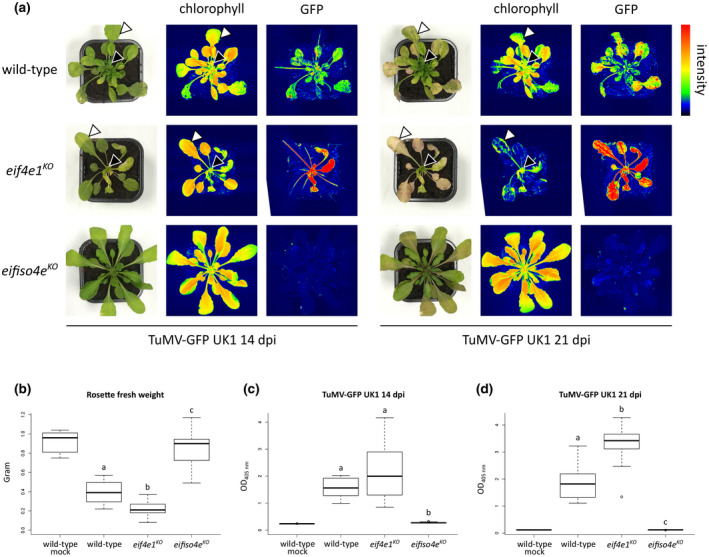
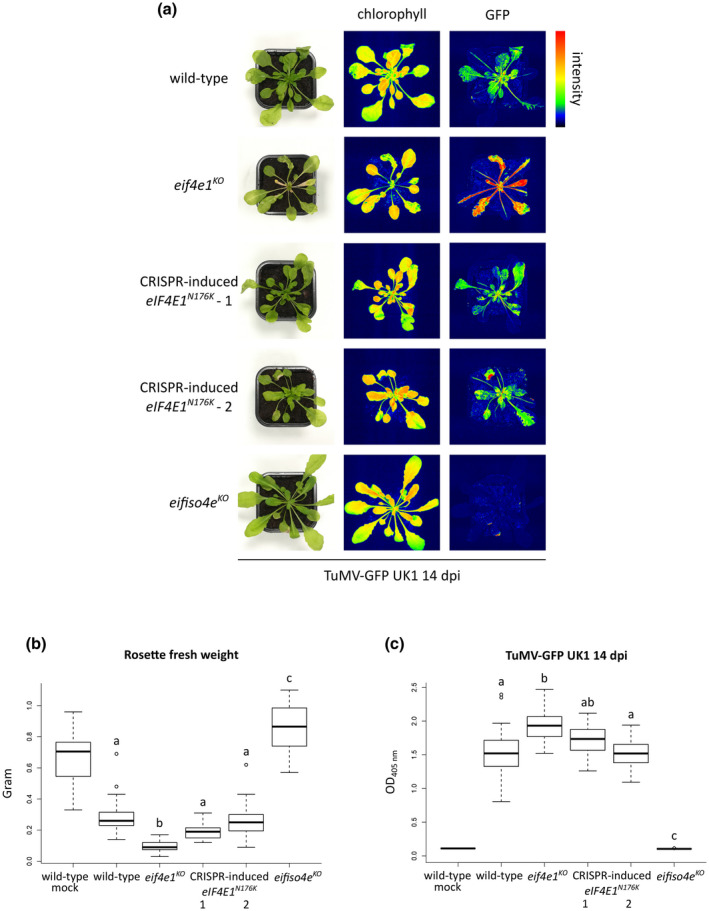
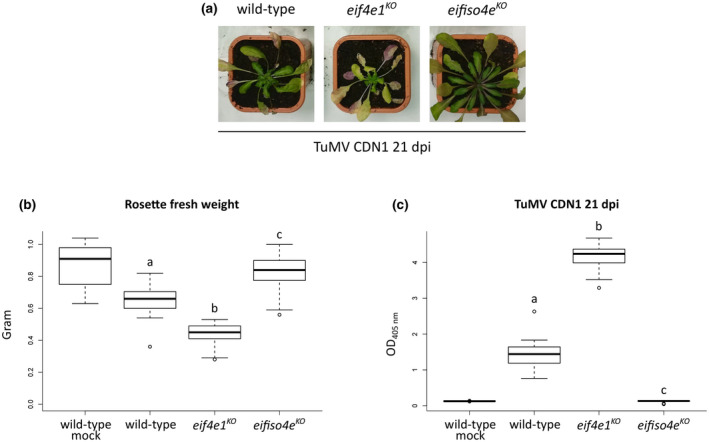
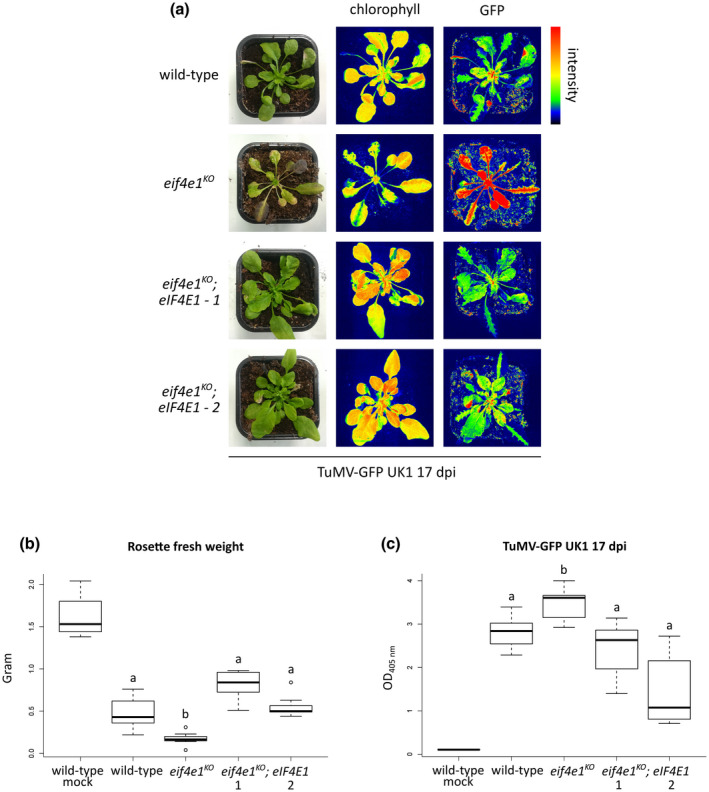
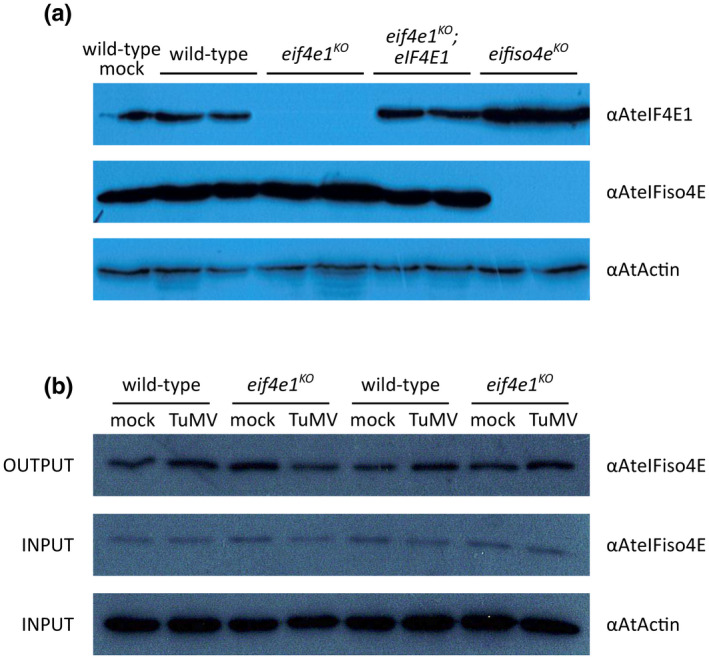
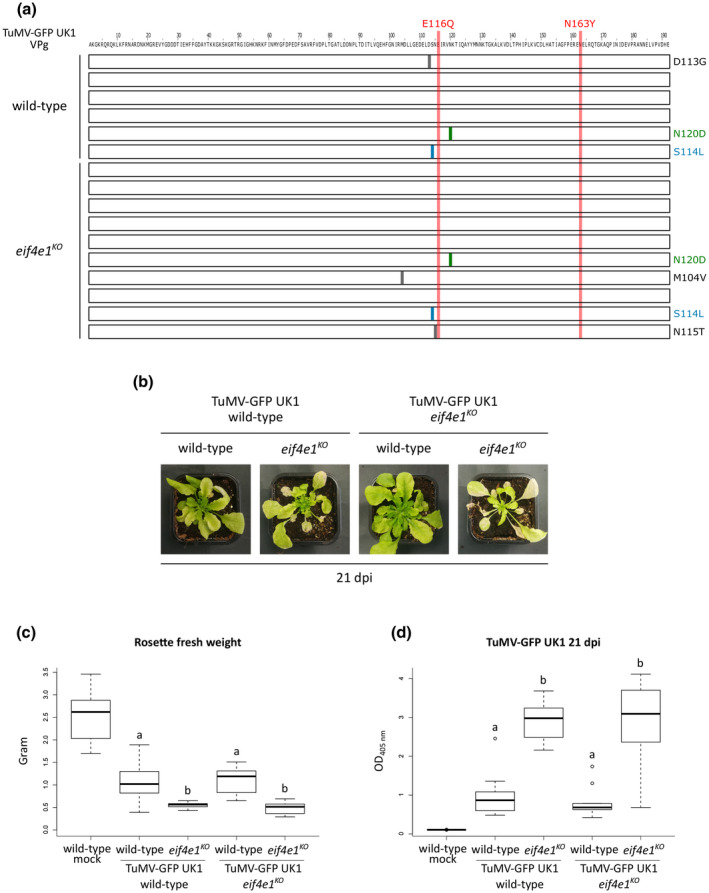
The translation initiation factors 4E are a small family of major susceptibility factors to potyviruses. It has been suggested that knocking out these genes could provide genetic resistance in crops when natural resistance alleles, which encode functional eIF4E proteins, are not available. Here, using the well-characterized Arabidopsis thaliana-potyvirus pathosystem, we evaluate the resistance spectrum of plants knocked out for eIF4E1, the susceptibility factor to clover yellow vein virus (ClYVV). We show that besides resistance to ClYVV, the eIF4E1 loss of function is associated with hypersusceptibility to turnip mosaic virus (TuMV), a potyvirus known to rely on the paralog host factor eIFiso4E. On TuMV infection, plants knocked out for eIF4E1 display striking developmental defects such as early senescence and primordia development stoppage. This phenotype is coupled with a strong TuMV overaccumulation throughout the plant, while remarkably the levels of the viral target eIFiso4E remain uninfluenced. Our data suggest that this hypersusceptibility cannot be explained by virus evolution leading to a gain of TuMV aggressiveness. Furthermore, we report that a functional eIF4E1 resistance allele engineered by CRISPR/Cas9 base-editing technology successfully circumvents the increase of TuMV susceptibility conditioned by eIF4E1 disruption. These findings in Arabidopsis add to several previous findings in crops suggesting that resistance based on knocking out eIF4E factors should be avoided in plant breeding, as it could also expose the plant to the severe threat of potyviruses able to recruit alternative eIF4E copies. At the same time, it provides a simple model that can help understanding of the homeostasis among eIF4E proteins in the plant cell and what makes them available to potyviruses.
翻译起始因子 4E 是植物弹状病毒的主要易感性因子小家族。有人提出,当缺乏天然抗性等位基因(编码功能性 eIF4E 蛋白)时,敲除这些基因可能会为作物提供遗传抗性。在这里,我们利用已被充分研究的拟南芥-马铃薯 Y 病毒体系来评估敲除易感性因子 eIF4E1 对三叶草黄脉病毒(ClYVV)的抗性谱。结果表明,除了对 ClYVV 的抗性外,eIF4E1 功能丧失还与对芜菁花叶病毒(TuMV)的超敏性有关,后者是一种依赖于宿主因子 eIFiso4E 同源物的马铃薯 Y 病毒。在 TuMV 感染时,敲除 eIF4E1 的植物表现出明显的发育缺陷,如早期衰老和原基发育停止。这种表型与 TuMV 在整个植物中的过度积累有关,而令人惊讶的是,病毒靶标 eIFiso4E 的水平没有受到影响。我们的数据表明,这种超敏性不能用病毒进化导致 TuMV 侵袭性增强来解释。此外,我们报告称,通过 CRISPR/Cas9 碱基编辑技术构建的功能性 eIF4E1 抗性等位基因成功规避了由 eIF4E1 缺失引起的 TuMV 易感性增加。这些在拟南芥中的发现增加了先前在作物中的几项发现,表明基于敲除 eIF4E 因子的抗性在植物育种中应避免使用,因为这也可能使植物面临能够招募替代 eIF4E 拷贝的马铃薯 Y 病毒的严重威胁。同时,它提供了一个简单的模型,可以帮助理解植物细胞中 eIF4E 蛋白的动态平衡以及是什么使它们能够被马铃薯 Y 病毒利用。