Social Cognition Cologne, University of Cologne, Cologne, Germany; Cognitive Ethology Laboratory, German Primate Center, Göttingen, Germany; Courant Research Centre "Evolution of Social Behaviour", Georg-August-University Göttingen, Göttingen, Germany.
Cognitive Ethology Laboratory, German Primate Center, Göttingen, Germany; Courant Research Centre "Evolution of Social Behaviour", Georg-August-University Göttingen, Göttingen, Germany.
PLoS One. 2014 Mar 19;9(3):e91348. doi: 10.1371/journal.pone.0091348. eCollection 2014.
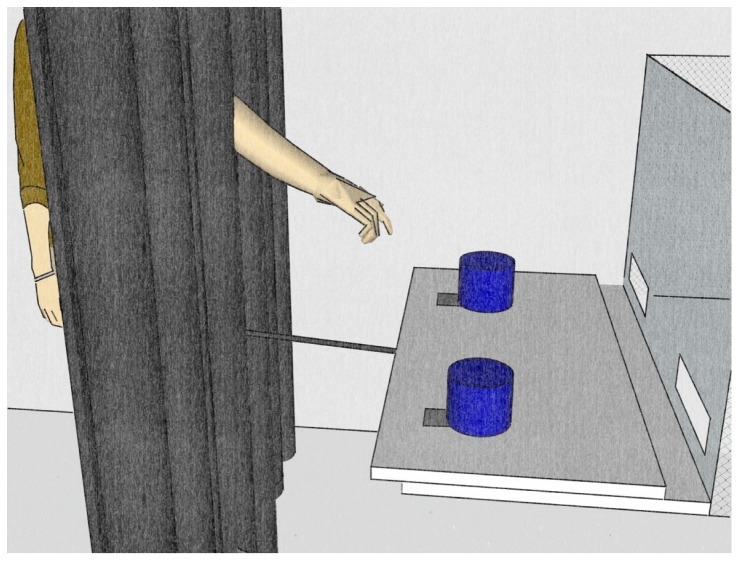
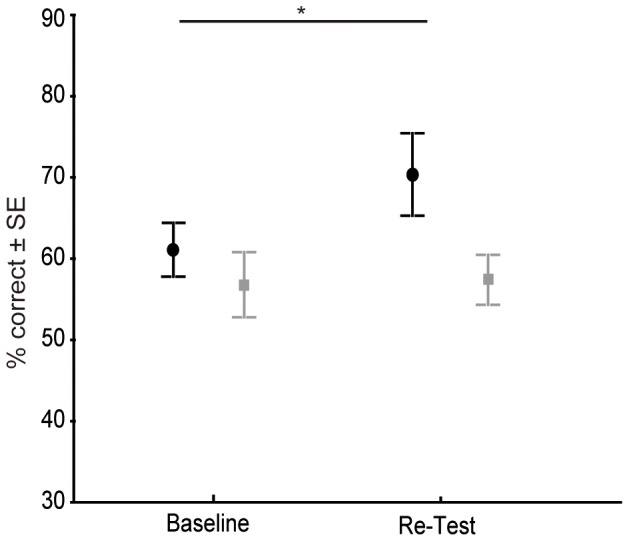
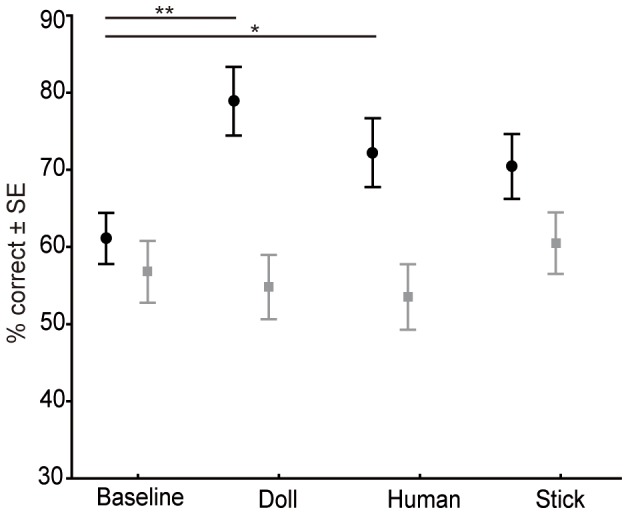
Methodological variations in experimental conditions can strongly influence animals' performances in cognitive tests. Specifically, the procedure of the so-called object-choice task has been controversially discussed; here, a human experimenter indicates the location of hidden food by pointing or gazing at one of two or more containers. Whereas dogs usually succeed, results for nonhuman primates are ambiguous. In the standard version of the task the majority of subjects do not respond appropriately to human pointing. However, modifying the task setup, such as placing the containers further apart, seems to improve subjects' performances, suggesting that cue salience may be an important variable. Here we investigated whether the visibility of the experimenter inhibits long-tailed macaques' (Macaca fascicularis) usage of the pointing cue. In our baseline condition, with the experimenter fully visible, the monkeys chose the correct container in 61% of the trials. The performance increased significantly, however, when the experimenter was hidden behind a curtain and only the arm of the experimenter, a doll's arm, or a stick was visible. Furthermore, the monkeys performed significantly better when the tip of the pointing finger or device was close to the target compared to the more distant condition. Intriguingly, after these experiments the monkeys' performance was also significantly improved in the baseline condition (70%). Apparently, the monkeys were first distracted by the presence of the experimenter, but then learned to use the cue. These findings highlight the importance of the test conditions, and question some of the assumptions about species-specific differences in the object-choice task.
实验条件的方法学差异会强烈影响动物在认知测试中的表现。具体来说,所谓的物体选择任务的程序一直存在争议;在这里,人类实验者通过指向或注视两个或更多容器中的一个来指示隐藏食物的位置。而狗通常能成功完成任务,但非人类灵长类动物的结果则不明确。在任务的标准版本中,大多数实验对象不能对人类的指示做出适当的反应。然而,通过修改任务设置,例如将容器放置得更远,似乎可以提高实验对象的表现,这表明线索的显著性可能是一个重要的变量。在这里,我们研究了实验者的可见性是否会抑制长尾猕猴(Macaca fascicularis)对指示线索的使用。在我们的基线条件下,实验者完全可见,猴子在 61%的试验中选择了正确的容器。然而,当实验者被隐藏在窗帘后面,只有实验者的手臂、一个娃娃的手臂或一根棍子可见时,猴子的表现显著增加。此外,当指示手指或指示设备的尖端靠近目标时,猴子的表现明显优于距离较远的情况。有趣的是,在这些实验之后,猴子在基线条件下的表现也显著提高(70%)。显然,猴子最初被实验者的存在分散了注意力,但后来学会了使用线索。这些发现强调了测试条件的重要性,并对物体选择任务中物种特异性差异的一些假设提出了质疑。