Departamento de Química-ICET, Universidad Autónoma de Guadalajara, Zapopan Jalisco, Mexico; Departamento de Bioquímica, Instituto de Química, Universidade de São Paulo, São Paulo, SP, Brazil.
Departamento de Bioquímica, Instituto de Química, Universidade de São Paulo, São Paulo, SP, Brazil.
PLoS One. 2014 Mar 19;9(3):e91616. doi: 10.1371/journal.pone.0091616. eCollection 2014.
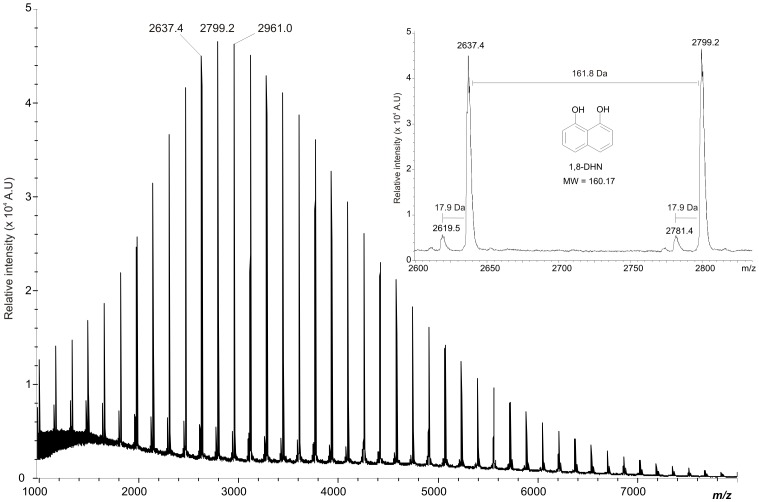
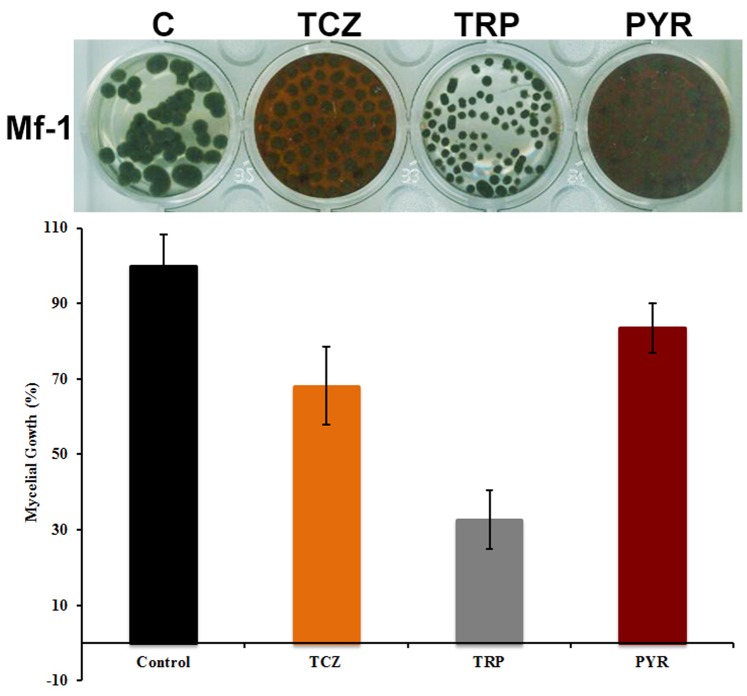
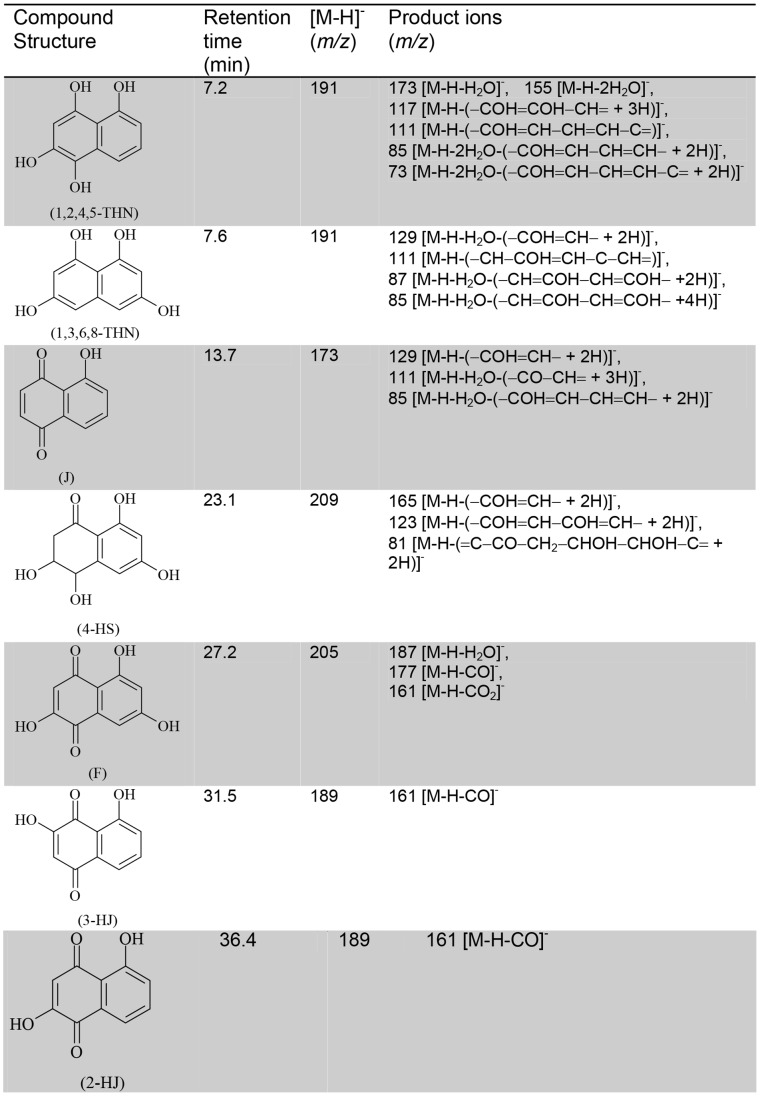
In pathogenic fungi, melanin contributes to virulence, allowing tissue invasion and inactivation of the plant defence system, but has never been implicated as a factor for host cell death, or as a light-activated phytotoxin. Our research shows that melanin synthesized by the fungal banana pathogen Mycosphaerella fijiensis acts as a virulence factor through the photogeneration of singlet molecular oxygen O2 (1Δg). Using analytical tools, including elemental analysis, ultraviolet/infrared absorption spectrophometry and MALDI-TOF mass spectrometry analysis, we characterized both pigment content in mycelia and secreted to the culture media as 1,8-dihydroxynaphthalene (DHN)-melanin type compound. This is sole melanin-type in M. fijiensis. Isolated melanins irradiated with a Nd:YAG laser at 532 nm produced monomol light emission at 1270 nm, confirming generation of O2 (1Δg), a highly reactive oxygen specie (ROS) that causes cellular death by reacting with all cellular macromolecules. Intermediary polyketides accumulated in culture media by using tricyclazole and pyroquilon (two inhibitors of DHN-melanin synthesis) were identified by ESI-HPLC-MS/MS. Additionally, irradiation at 532 nm of that mixture of compounds and whole melanized mycelium also generated O2 (1Δg). A pigmented-strain generated more O2 (1Δg) than a strain with low melanin content. Banana leaves of cultivar Cavendish, naturally infected with different stages of black Sigatoka disease, were collected from field. Direct staining of the naturally infected leaf tissues showed the presence of melanin that was positively correlated to the disease stage. We also found hydrogen peroxide (H2O2) but we cannot distinguish the source. Our results suggest that O2 (1Δg) photogenerated by DHN-melanin may be involved in the destructive effects of Mycosphaerella fijiensis on banana leaf tissues. Further studies are needed to fully evaluate contributions of melanin-mediated ROS to microbial pathogenesis.
在病原真菌中,黑色素有助于毒力的发挥,使组织能够侵入并使植物防御系统失活,但黑色素从未被认为是宿主细胞死亡的一个因素,也不是一种光激活的植物毒素。我们的研究表明,由香蕉病原菌墨疫病菌(Mycosphaerella fijiensis)合成的黑色素通过单重态氧(O2(1Δg))的光生成来发挥毒力因子的作用。使用包括元素分析、紫外/红外吸收光谱法和 MALDI-TOF 质谱分析在内的分析工具,我们对菌丝体和分泌到培养基中的色素含量进行了表征,发现其为 1,8-二羟基萘(DHN)-黑色素型化合物。这是 M. fijiensis 中唯一的黑色素类型。用 Nd:YAG 激光在 532nm 下照射分离出的黑色素,在 1270nm 处产生单分子光发射,证实了 O2(1Δg)的生成,O2(1Δg)是一种高反应性氧物质(ROS),它通过与所有细胞大分子反应导致细胞死亡。通过使用三唑酮和敌菌酮(DHN-黑色素合成的两种抑制剂)在培养基中积累的中间聚酮类化合物通过 ESI-HPLC-MS/MS 进行了鉴定。此外,对该化合物混合物和整个黑色素化菌丝体进行 532nm 照射也产生了 O2(1Δg)。与黑色素含量低的菌株相比,色素菌株产生的 O2(1Δg)更多。从田间收集了受不同阶段黑星病菌感染的 Cavendish 香蕉叶片。对自然感染叶片组织的直接染色显示存在黑色素,且与疾病阶段呈正相关。我们还发现了过氧化氢(H2O2),但无法区分来源。我们的研究结果表明,DHN-黑色素光生成的 O2(1Δg)可能参与了墨疫病菌对香蕉叶片组织的破坏作用。需要进一步研究以充分评估黑色素介导的 ROS 对微生物发病机制的贡献。