Centre for Respiratory Infections, Respiratory Infections Section, National Heart and Lung Institute, Faculty of Medicine, Imperial College London, London, United Kingdom.
J Virol. 2014 Jun;88(11):6128-36. doi: 10.1128/JVI.00333-14. Epub 2014 Mar 19.
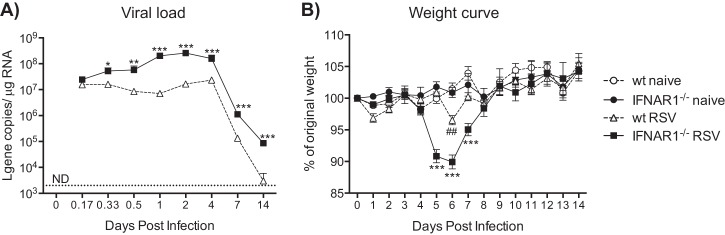
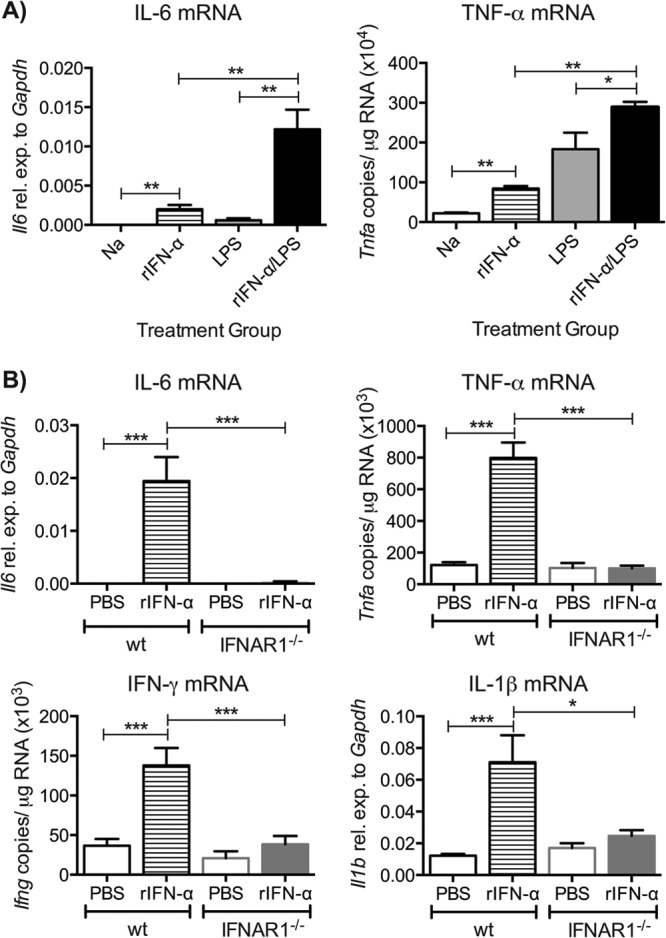
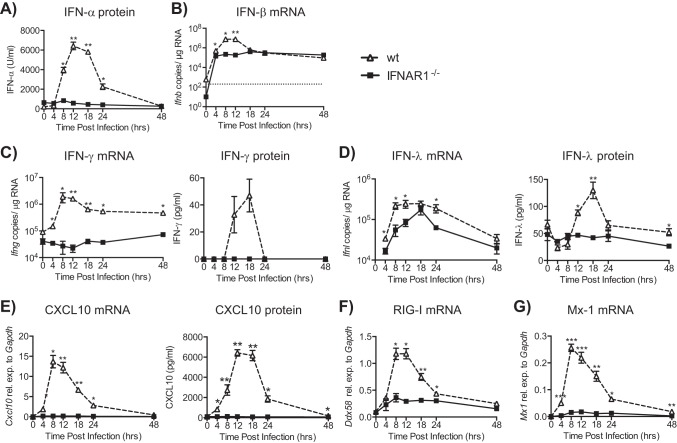
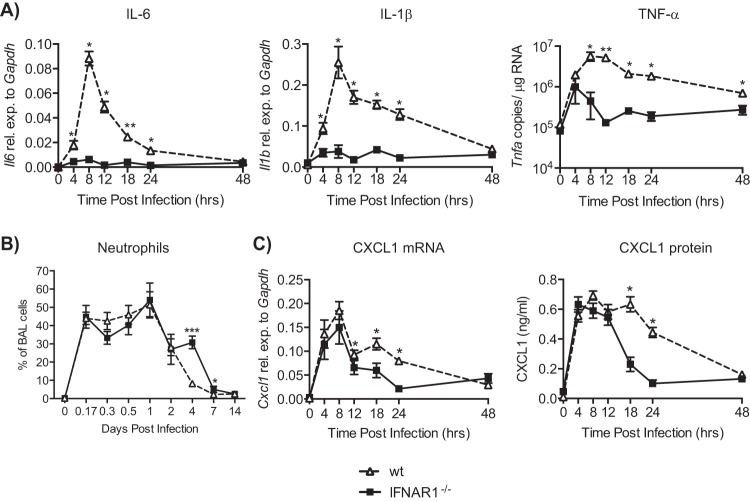
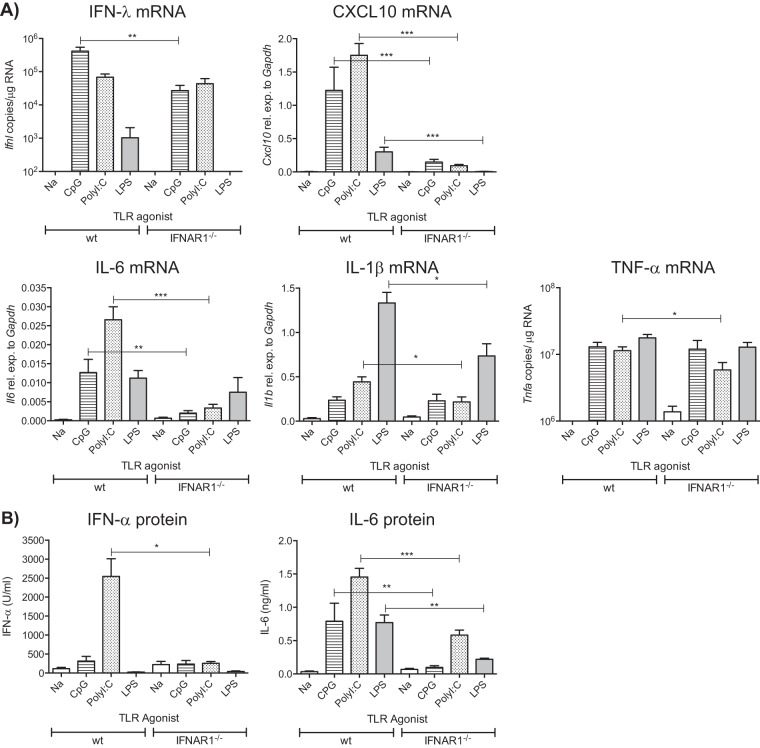
Type I interferons (IFNs) are produced early upon virus infection and signal through the alpha/beta interferon (IFN-α/β) receptor (IFNAR) to induce genes that encode proteins important for limiting viral replication and directing immune responses. To investigate the extent to which type I IFNs play a role in the local regulation of inflammation in the airways, we examined their importance in early lung responses to infection with respiratory syncytial virus (RSV). IFNAR1-deficient (IFNAR1(-/-)) mice displayed increased lung viral load and weight loss during RSV infection. As expected, expression of IFN-inducible genes was markedly reduced in the lungs of IFNAR1(-/-) mice. Surprisingly, we found that the levels of proinflammatory cytokines and chemokines in the lungs of RSV-infected mice were also greatly reduced in the absence of IFNAR signaling. Furthermore, low levels of proinflammatory cytokines were also detected in the lungs of IFNAR1(-/-) mice challenged with noninfectious innate immune stimuli such as selected Toll-like receptor (TLR) agonists. Finally, recombinant IFN-α was sufficient to potentiate the production of inflammatory mediators in the lungs of wild-type mice challenged with innate immune stimuli. Thus, in addition to its well-known role in antiviral resistance, type I IFN receptor signaling acts as a central driver of early proinflammatory responses in the lung. Inhibiting the effects of type I IFNs may therefore be useful in dampening inflammation in lung diseases characterized by enhanced inflammatory cytokine production.
The initial response to viral infection is characterized by the production of interferons (IFNs). One group of IFNs, the type I IFNs, are produced early upon virus infection and signal through the IFN-α/β receptor (IFNAR) to induce proteins important for limiting viral replication and directing immune responses. Here we examined the importance of type I IFNs in early responses to respiratory syncytial virus (RSV). Our data suggest that type I IFN production and IFNAR receptor signaling not only induce an antiviral state but also serve to amplify proinflammatory responses in the respiratory tract. We also confirm this conclusion in another model of acute inflammation induced by noninfectious stimuli. Our findings are of relevance to human disease, as RSV is a major cause of infant bronchiolitis and polymorphisms in the IFN system are known to impact disease severity.
I 型干扰素 (IFNs) 在病毒感染后早期产生,并通过 α/β 干扰素 (IFN-α/β) 受体 (IFNAR) 信号传导,诱导编码对限制病毒复制和指导免疫反应至关重要的蛋白质的基因。为了研究 I 型 IFNs 在呼吸道局部炎症调节中的作用,我们研究了它们在呼吸道合胞病毒 (RSV) 感染时早期肺部反应中的重要性。IFNAR1 缺陷 (IFNAR1(-/-)) 小鼠在 RSV 感染期间肺部病毒载量增加和体重减轻。正如预期的那样,IFNAR1(-/-) 小鼠肺部 IFN 诱导基因的表达明显减少。令人惊讶的是,我们发现 RSV 感染小鼠肺部促炎细胞因子和趋化因子的水平在缺乏 IFNAR 信号传导时也大大降低。此外,在接受非传染性先天免疫刺激物(如选定的 Toll 样受体 (TLR) 激动剂)挑战的 IFNAR1(-/-) 小鼠肺部也检测到低水平的促炎细胞因子。最后,重组 IFN-α足以增强野生型小鼠用先天免疫刺激物挑战时肺部炎症介质的产生。因此,除了其在抗病毒抵抗中的已知作用外,I 型 IFN 受体信号传导还作为肺部早期促炎反应的中央驱动因素。因此,抑制 I 型 IFNs 的作用可能有助于减轻以增强炎症细胞因子产生为特征的肺部疾病中的炎症。
病毒感染的初始反应特征是干扰素 (IFNs) 的产生。IFNs 中的一组,I 型 IFNs,在病毒感染后早期产生,并通过 IFN-α/β 受体 (IFNAR) 信号传导,诱导对限制病毒复制和指导免疫反应至关重要的蛋白质。在这里,我们研究了 I 型 IFNs 在呼吸道合胞病毒 (RSV) 早期反应中的重要性。我们的数据表明,I 型 IFN 产生和 IFNAR 受体信号传导不仅诱导抗病毒状态,而且还有助于放大呼吸道中的促炎反应。我们还在另一种由非传染性刺激物引起的急性炎症模型中证实了这一结论。我们的发现与人类疾病有关,因为 RSV 是婴儿细支气管炎的主要原因,并且 IFN 系统中的多态性已知会影响疾病严重程度。