Tully Erin C, Donohue Meghan Rose, Garcia Sarah E
a Department of Psychology , Georgia State University , Atlanta , GA , USA.
Cogn Emot. 2015;29(1):118-29. doi: 10.1080/02699931.2014.898614. Epub 2014 Mar 21.
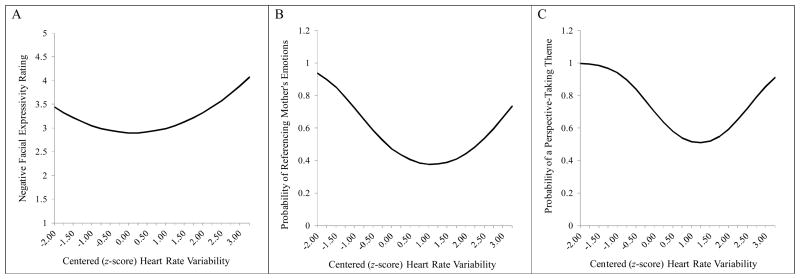
This study investigated children's empathic responses to their mother's distress to provide insight about child factors that contribute to parental socialisation of emotions. Four- to six-year-old children (N = 82) observed their mother's sadness and anger during a simulated emotional phone conversation. Children's facial negative affect was rated and their heart rate variability (HRV) was recorded during the conversation, and their emotion understanding of the conversation was measured through their use of negative emotion words and perspective-taking themes (i.e., discussing the causes or resolution of mother's emotions) in narrative accounts of the conversation. There were positive quadratic relationships between HRV and ratings of facial affect, narrative references to mother's negative emotions and perspective-taking themes. High and low HRV was associated with high facial negative affect, suggesting well-regulated sympathy and poorly regulated personal distress empathic responses, respectively. Moderate HRV was associated with low facial negative affect, suggesting minimal empathic engagement. High and low HRV were associated with the highest probabilities of both emotion understanding indicators, suggesting both sympathy and personal distress responses to mother's distress facilitate understanding of mother's emotions. Personal distress may motivate attempts to understand mother's emotions as a self-soothing strategy, whereas sympathy-related attempts to understand may be motivated by altruism.
本研究调查了儿童对母亲痛苦的共情反应,以深入了解有助于父母进行情感社会化的儿童因素。82名4至6岁的儿童在模拟的情感电话交谈中观察母亲的悲伤和愤怒。在交谈过程中对儿童的面部负面情绪进行评分,并记录他们的心率变异性(HRV),通过他们在交谈的叙述中使用负面情绪词汇和观点采择主题(即讨论母亲情绪的原因或解决方法)来测量他们对交谈的情绪理解。HRV与面部情绪评分、对母亲负面情绪的叙述提及以及观点采择主题之间存在正二次关系。高HRV和低HRV分别与高面部负面影响相关,表明同情调节良好和个人痛苦共情反应调节不良。中等HRV与低面部负面影响相关,表明共情参与程度最低。高HRV和低HRV与两种情绪理解指标的最高概率相关,表明对母亲痛苦的同情和个人痛苦反应都有助于理解母亲的情绪。个人痛苦可能会促使儿童试图理解母亲的情绪,作为一种自我安慰策略,而与同情相关的理解尝试可能是出于利他主义。