Department of Orthopaedics and Trauma Surgery, University Hospital Heidelberg, Schlierbacher Landstrasse 200a, 69118 Heidelberg, Germany.
J Transl Med. 2014 Mar 21;12:74. doi: 10.1186/1479-5876-12-74.
Metal-on-metal implants are a special form of hip endoprostheses that despite many advantages can entail serious complications due to release of wear particles from the implanted material. Metal wear particles presumably activate local host defence mechanisms, which causes a persistent inflammatory response with destruction of bone followed by a loosening of the implant. To better characterize this inflammatory response and to link inflammation to bone degradation, the local generation of proinflammatory and osteoclast-inducing cytokines was analysed, as was systemic T cell activation.
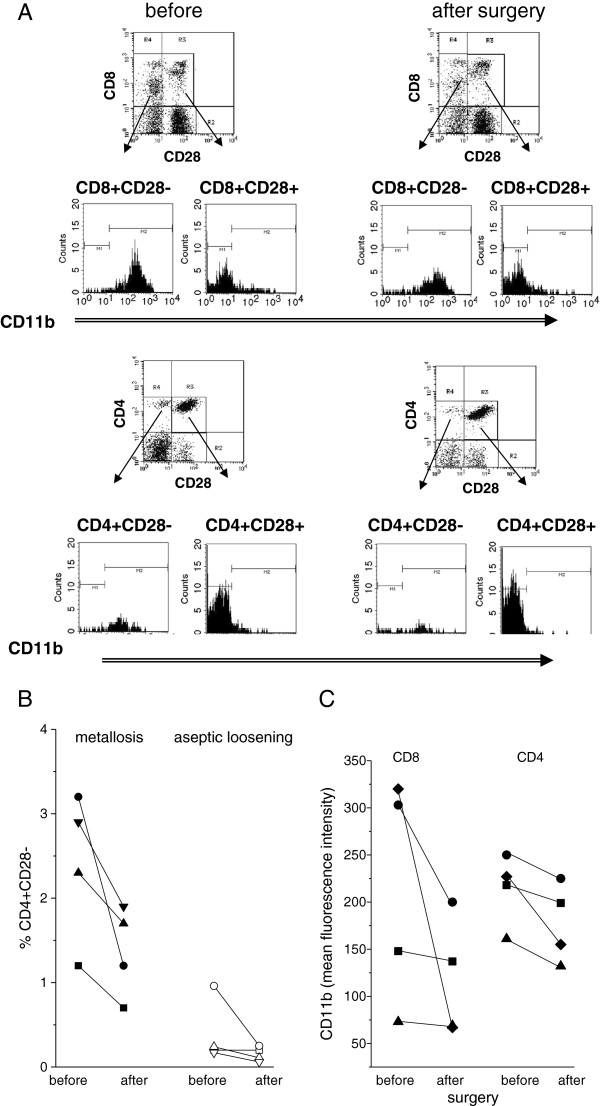
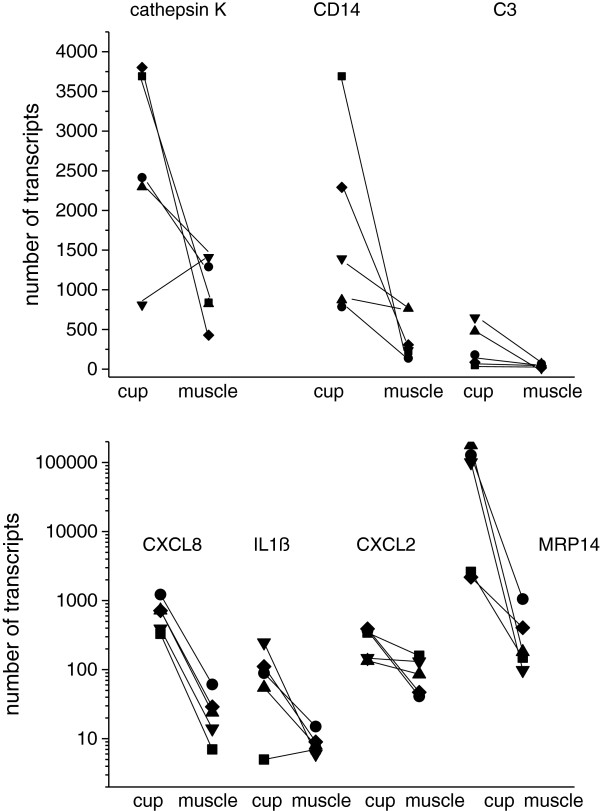
By quantitative RT-PCR, gene expression of cytokines and markers for T lymphocytes, monocytes/macrophages and osteoclasts, respectively, was analysed in tissue samples obtained intraoperatively during exchange surgery of the loosened implant. Peripheral T cells were characterized by cytofluorometry before surgery and 7 to 10 days thereafter.
At sites of osteolysis, gene expression of cathepsin K, CD14 and CD3 was seen, indicating the generation of osteoclasts, and the presence of monocytes and of T cells, respectively. Also cytokines were highly expressed, including CXCL8, IL-1ß, CXCL2, MRP-14 and CXCL-10. The latter suggest T cell activation, a notion that could be confirmed by detecting a small, though conspicuous population of activated CD4+ cells in the peripheral blood T cells prior to surgery.
Our data support the concept that metallosis is the result of a local inflammatory response, which according to histomorphology and the composition of the cellular infiltrate classifies as an acute phase of a chronic inflammatory disease. The proinflammatory environment, particularly the generation of the osteoclast-inducing cytokines CXCL8 and IL1-ß, promotes bone resorption. Loss of bone results in implant loosening, which then causes the major symptoms of metallosis, pain and reduced range of motion.
金属对金属植入物是一种特殊形式的髋关节假体,尽管有许多优点,但由于植入材料中磨损颗粒的释放,可能会导致严重的并发症。金属磨损颗粒可能会激活局部宿主防御机制,导致持续的炎症反应,破坏骨组织,随后导致植入物松动。为了更好地描述这种炎症反应,并将炎症与骨降解联系起来,分析了局部产生的促炎和破骨细胞诱导细胞因子,以及全身 T 细胞的激活。
通过定量 RT-PCR,分析了在松动植入物更换手术期间术中获得的组织样本中细胞因子和 T 淋巴细胞、单核细胞/巨噬细胞和破骨细胞标志物的基因表达。手术前和术后 7 至 10 天,通过细胞荧光术对外周 T 细胞进行了特征分析。
在骨溶解部位,观察到组织蛋白酶 K、CD14 和 CD3 的基因表达,分别表明破骨细胞的生成、单核细胞的存在和 T 细胞的存在。此外,细胞因子也高度表达,包括 CXCL8、IL-1β、CXCL2、MRP-14 和 CXCL-10。后者表明 T 细胞激活,这一观点可以通过在手术前检测到外周血 T 细胞中一小部分但明显的激活 CD4+细胞来证实。
我们的数据支持这样一种观点,即金属中毒是局部炎症反应的结果,根据组织形态学和细胞浸润的组成,这种炎症反应可归类为慢性炎症疾病的急性期。促炎环境,特别是破骨细胞诱导细胞因子 CXCL8 和 IL1-β 的产生,促进了骨吸收。骨丢失导致植入物松动,从而导致金属中毒的主要症状,即疼痛和运动范围减小。