Women's Health and Perinatology Research Group, Department of Clinical Medicine, Faculty of Health Sciences, University of Tromsø - The Arctic University of Norway, Tromsø N - 9037, Norway.
BMC Oral Health. 2014 Mar 22;14:23. doi: 10.1186/1472-6831-14-23.
Dentists are considered role models by the general population in regards to oral hygiene and oral health behavior. This study aimed to access the oral health status of dentists and laypersons, and compare the dentists' practice of preventive dentistry and oral self-care behaviors to that of the laypersons.
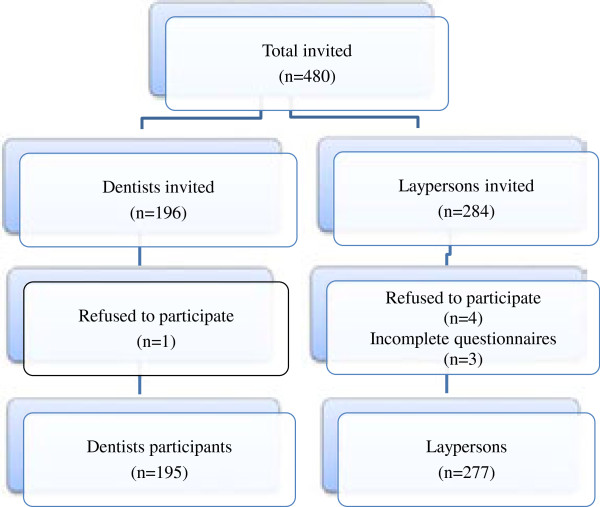
This cross-sectional study recruited 472 participants (195 dentists and 277 laypersons from the general population). Their oral health/hygiene behavior was assessed using a standardized close-ended multiple choice questionnaire. Oral examination was performed to assess caries using Decayed Missed Filled teeth (DMFT) index and periodontal status using Community Periodontal Index of Treatment Needs (CPITN).
Ninety-six percent of dentists brushed their teeth at least once daily, using fluoridated toothpaste and 80.5% twice daily. Although 94% of laypersons brushed their teeth once daily, they seldom used fluoridated toothpaste. Ten percent of participants in each group were caries free. The mean number of teeth present in the oral cavity (27.4 versus 25.4), mean number of teeth with caries (1.8 versus 3.7) and fillings (2.5 versus 0.4) were significantly different (p < 0.0001) between dentists and laypersons, respectively. Regarding the periodontal status, 82% of dentists had CPITN score of 0 whereas 71% of laypersons had the highest score 3 (p = 0.007), and 81% of the laypersons reported tooth mobility compared to 1% of dentists (p < 0.0001).
The participating dentists had better periodontal status and better self-reported oral health behaviors than the laypersons. Despite similar prevalence of caries in the two groups, the prevalence of decayed and unfilled teeth was lower among the dentists.
在口腔卫生和口腔健康行为方面,牙医被公众视为榜样。本研究旨在评估牙医和非专业人士的口腔健康状况,并比较牙医预防牙科实践和口腔自我保健行为与非专业人士的情况。
这项横断面研究招募了 472 名参与者(195 名牙医和 277 名普通人群中的非专业人士)。他们的口腔健康/卫生行为使用标准化的封闭式多项选择问卷进行评估。通过使用 Decayed Missed Filled teeth (DMFT) 指数评估龋齿,使用 Community Periodontal Index of Treatment Needs (CPITN) 评估牙周状况,对口腔进行检查。
96%的牙医每天至少刷牙一次,使用含氟牙膏,80.5%的牙医每天刷牙两次。尽管 94%的非专业人士每天刷牙一次,但他们很少使用含氟牙膏。两组各有 10%的参与者无龋齿。口腔中存在的牙齿平均数(27.4 颗与 25.4 颗)、有龋齿的牙齿平均数(1.8 颗与 3.7 颗)和填充物平均数(2.5 颗与 0.4 颗)在牙医和非专业人士之间存在显著差异(p<0.0001)。关于牙周状况,82%的牙医 CPITN 得分为 0,而 71%的非专业人士得分为最高的 3 分(p=0.007),81%的非专业人士报告牙齿松动,而只有 1%的牙医有此情况(p<0.0001)。
参与研究的牙医在牙周状况和自我报告的口腔健康行为方面优于非专业人士。尽管两组的龋齿患病率相似,但牙医组未填充和龋齿的牙齿患病率较低。