Palliative Care Unit, Division of Cancer Control & Prevention, Incheon Regional Cancer Center, 1198 Guwol-dong, Namdong-gu, Incheon 405-760, Republic of Korea.
BMC Palliat Care. 2014 Mar 21;13(1):14. doi: 10.1186/1472-684X-13-14.
While cancer patients have higher oxidative stress (OS) and lower antioxidant activity, evidence for the association of these parameters with survival in patients with terminally ill cancer is lacking.
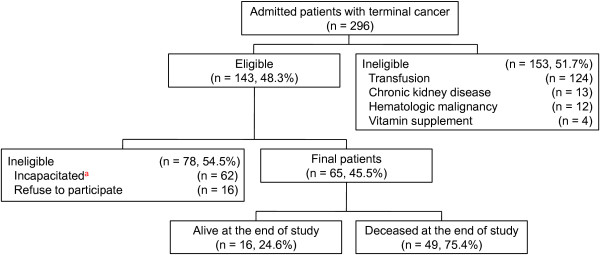
We followed 65 terminal cancer patients prospectively. We assessed their performance status, some symptoms, and serum levels of vitamin C and OS level. The Gehan's generalized Wilcoxon test was used to examine the association between survival times and variables.
Subjects' performance status was very poor and they had a high level of OS and a low level of vitamin C. No significant association of these two parameters with survival time was noted (p-value, 0.637 for high OS and 0.240 for low vitamin C). Poor performance status was independently related to high OS status after adjusting for potential confounders (adjusted OR, 4.45; p-value, 0.031).
In this study, OS was not associated with survival of terminally ill cancer patients and its prognostic role requires further study.
癌症患者的氧化应激(OS)水平较高,抗氧化活性较低,但目前尚缺乏 OS 水平与终末期癌症患者生存状况相关的证据。
我们前瞻性地随访了 65 例终末期癌症患者。我们评估了他们的体能状态、部分症状以及血清维生素 C 和 OS 水平。采用 Gehan 的广义 Wilcoxon 检验来检验生存时间与变量之间的关联。
受试者的体能状态非常差,OS 水平高,维生素 C 水平低。但这两个参数与生存时间之间无显著相关性(OS 水平高的 p 值为 0.637,维生素 C 水平低的 p 值为 0.240)。在调整了潜在混杂因素后,较差的体能状态与高 OS 状态独立相关(调整后的 OR,4.45;p 值,0.031)。
在本研究中,OS 与终末期癌症患者的生存状况无关,其预后作用需要进一步研究。