Greig Fiona H, Nixon Graeme F
School of Medical Sciences, University of Aberdeen, Foresterhill, Aberdeen AB25 2ZD, UK.
School of Medical Sciences, University of Aberdeen, Foresterhill, Aberdeen AB25 2ZD, UK.
Pharmacol Ther. 2014 Sep;143(3):265-74. doi: 10.1016/j.pharmthera.2014.03.006. Epub 2014 Mar 20.
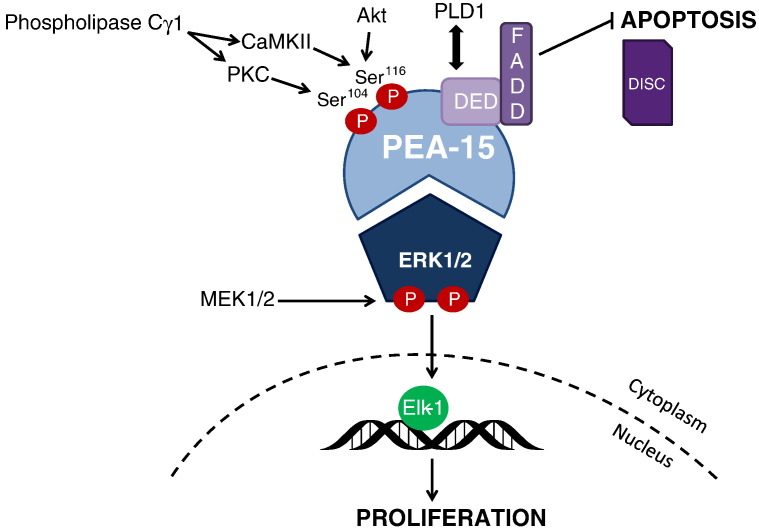
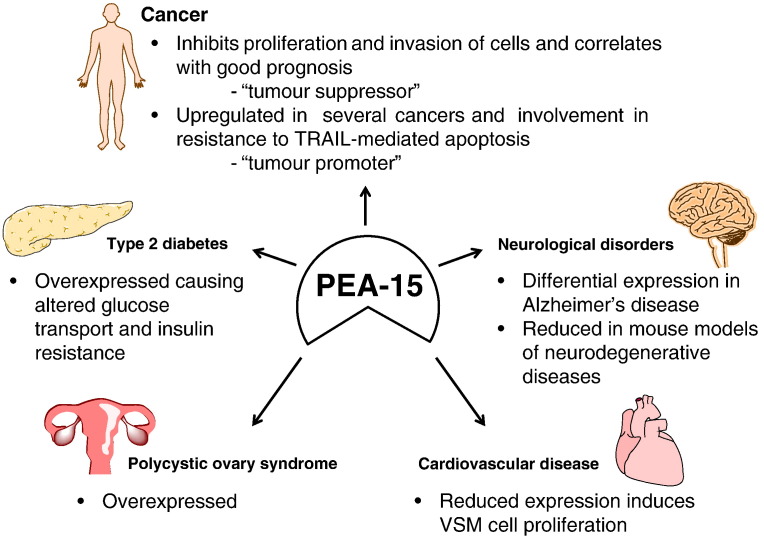
Phosphoprotein enriched in astrocytes-15 (PEA-15) is a cytoplasmic protein that sits at an important junction in intracellular signalling and can regulate diverse cellular processes, such as proliferation and apoptosis, dependent upon stimulation. Regulation of these processes occurs by virtue of the unique interaction of PEA-15 with other signalling proteins. PEA-15 acts as a cytoplasmic tether for the mitogen-activated protein kinases, extracellular signal-regulated kinase 1/2 (ERK1/2) preventing nuclear localisation. In order to release ERK1/2, PEA-15 requires to be phosphorylated via several potential pathways. PEA-15 (and its phosphorylation state) therefore regulates many ERK1/2-dependent processes, including proliferation, via regulating ERK1/2 nuclear translocation. In addition, PEA-15 contains a death effector domain (DED) which allows interaction with other DED-containing proteins. PEA-15 can bind the DED-containing apoptotic adaptor molecule, Fas-associated death domain protein (FADD) which is also dependent on the phosphorylation status of PEA-15. PEA-15 binding of FADD can inhibit apoptosis as bound FADD cannot participate in the assembly of apoptotic signalling complexes. Through these protein-protein interactions, PEA-15-regulated cellular effects have now been investigated in a number of disease-related studies. Changes in PEA-15 expression and regulation have been observed in diabetes mellitus, cancer, neurological disorders and the cardiovascular system. These changes have been suggested to contribute to the pathology related to each of these disease states. As such, new therapeutic targets based around PEA-15 and its associated interactions are now being uncovered and could provide novel avenues for treatment strategies in multiple diseases.
富含星形胶质细胞的磷蛋白15(PEA - 15)是一种细胞质蛋白,处于细胞内信号传导的重要节点,可根据刺激调节多种细胞过程,如增殖和凋亡。这些过程的调节是通过PEA - 15与其他信号蛋白的独特相互作用实现的。PEA - 15作为丝裂原活化蛋白激酶(细胞外信号调节激酶1/2,ERK1/2)的细胞质锚定物,阻止其核定位。为了释放ERK1/2,PEA - 15需要通过几种潜在途径进行磷酸化。因此,PEA - 15(及其磷酸化状态)通过调节ERK1/2的核转位来调节许多ERK1/2依赖性过程,包括增殖。此外,PEA - 15含有一个死亡效应结构域(DED),可与其他含DED的蛋白质相互作用。PEA - 15可结合含DED的凋亡衔接分子,Fas相关死亡结构域蛋白(FADD),这也取决于PEA - 15的磷酸化状态。PEA - 15与FADD的结合可抑制凋亡,因为结合的FADD不能参与凋亡信号复合物的组装。通过这些蛋白质 - 蛋白质相互作用,现已在许多疾病相关研究中对PEA - 15调节的细胞效应进行了研究。在糖尿病、癌症、神经系统疾病和心血管系统中均观察到PEA - 15表达和调节的变化。这些变化被认为与这些疾病状态各自相关的病理学有关。因此,围绕PEA - 15及其相关相互作用的新治疗靶点正在被发现,并可能为多种疾病的治疗策略提供新途径。