Department of Global Health Policy, Graduate School of Medicine, The University of Tokyo, Tokyo, Japan.
Department of Health Policy, National Center for Child Health and Development, Tokyo, Japan.
PLoS One. 2014 Mar 21;9(3):e91198. doi: 10.1371/journal.pone.0091198. eCollection 2014.
Pre-eclampsia has an immense adverse impact on maternal and perinatal health especially in low- and middle-income settings. We aimed to estimate the associations between pre-eclampsia/eclampsia and its risk factors, and adverse maternal and perinatal outcomes.
We performed a secondary analysis of the WHO Global Survey on Maternal and Perinatal Health. The survey was a multi-country, facility-based cross-sectional study. A global sample consisting of 24 countries from three regions and 373 health facilities was obtained via a stratified multi-stage cluster sampling design. Maternal and offspring data were extracted from records using standardized questionnaires. Multi-level logistic regression modelling was conducted with random effects at the individual, facility and country levels.
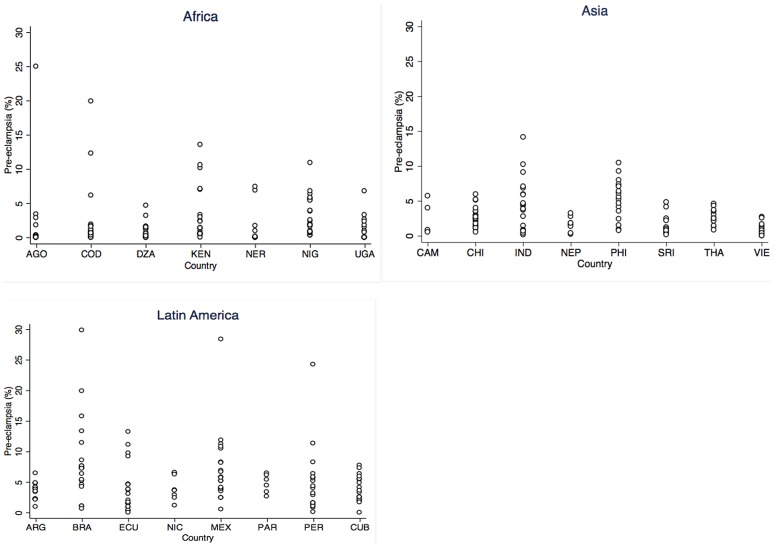
Data for 276,388 mothers and their infants was analysed. The prevalence of pre-eclampsia/eclampsia in the study population was 10,754 (4%). At the individual level, sociodemographic characteristics of maternal age ≥30 years and low educational attainment were significantly associated with higher risk of pre-eclampsia/eclampsia. As for clinical and obstetric variables, high body mass index (BMI), nulliparity (AOR: 2.04; 95%CI 1.92-2.16), absence of antenatal care (AOR: 1.41; 95%CI 1.26-1.57), chronic hypertension (AOR: 7.75; 95%CI 6.77-8.87), gestational diabetes (AOR: 2.00; 95%CI 1.63-2.45), cardiac or renal disease (AOR: 2.38; 95%CI 1.86-3.05), pyelonephritis or urinary tract infection (AOR: 1.13; 95%CI 1.03-1.24) and severe anemia (AOR: 2.98; 95%CI 2.47-3.61) were found to be significant risk factors, while having >8 visits of antenatal care was protective (AOR: 0.90; 95%CI 0.83-0.98). Pre-eclampsia/eclampsia was found to be a significant risk factor for maternal death, perinatal death, preterm birth and low birthweight.
Chronic hypertension, obesity and severe anemia were the highest risk factors of preeclampsia/eclampsia. Implementation of effective interventions prioritizing risk factors, provision of quality health services during pre-pregnancy and during pregnancy for joint efforts in the areas of maternal health are recommended.
子痫前期对母婴健康,尤其是在中低收入国家,有极大的负面影响。我们旨在评估子痫前期/子痫与其危险因素,以及不良母婴结局之间的关联。
我们对世卫组织全球孕产妇和围产儿健康调查进行了二次分析。该调查是一项多国、机构为基础的横断面研究。通过分层多阶段聚类抽样设计,从三个区域的 24 个国家和 373 个卫生机构获得了一个全球样本。使用标准化问卷从记录中提取母婴数据。采用个体、机构和国家三级的随机效应进行多水平逻辑回归建模。
分析了 276388 名母亲及其婴儿的数据。该研究人群中,子痫前期/子痫的患病率为 10754 例(4%)。在个体层面上,母亲年龄≥30 岁和教育程度低等社会人口学特征与子痫前期/子痫的风险增加显著相关。至于临床和产科变量,高体重指数(BMI)、初产(比值比[OR]:2.04;95%置信区间[CI]:1.92-2.16)、无产前保健(OR:1.41;95%CI:1.26-1.57)、慢性高血压(OR:7.75;95%CI:6.77-8.87)、妊娠期糖尿病(OR:2.00;95%CI:1.63-2.45)、心脏或肾脏疾病(OR:2.38;95%CI:1.86-3.05)、肾盂肾炎或尿路感染(OR:1.13;95%CI:1.03-1.24)和严重贫血(OR:2.98;95%CI:2.47-3.61)被发现是显著的危险因素,而产前保健≥8 次是保护因素(OR:0.90;95%CI:0.83-0.98)。子痫前期/子痫是产妇死亡、围产儿死亡、早产和低出生体重的显著危险因素。
慢性高血压、肥胖和严重贫血是子痫前期/子痫的最高危险因素。建议采取有效干预措施,针对危险因素进行优先干预,在妊娠前和妊娠期间提供优质卫生服务,共同努力改善母婴健康。