Vilalta Anna, Brown Guy C
Department of Biochemistry, University of Cambridge, Tennis Court Road, Cambridge CB2 1QW, UK.
J Neuroinflammation. 2014 Mar 26;11:58. doi: 10.1186/1742-2094-11-58.
2-Deoxy-D-glucose is an inhibitor of glycolysis, which is protective in animal models of brain pathology, but the mechanisms of this protection are unclear. We examined whether, when and how deoxyglucose protects neurons in co-culture with astrocytes and microglia. Microglia are brain macrophages, which can damage neurons in inflammatory conditions.
Deoxyglucose was added to primary cultures of microglia and astrocytes from rat cortex, or neurons and glia from rat cerebellum, or the BV-2 microglial cell line, and cell death and cell functions were evaluated.
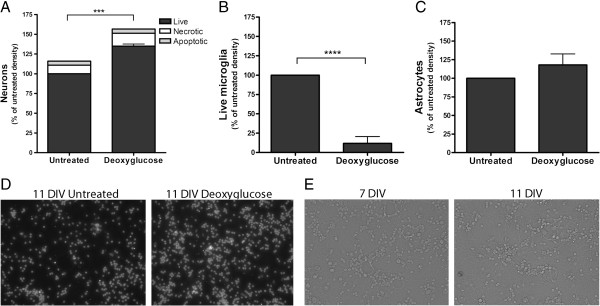
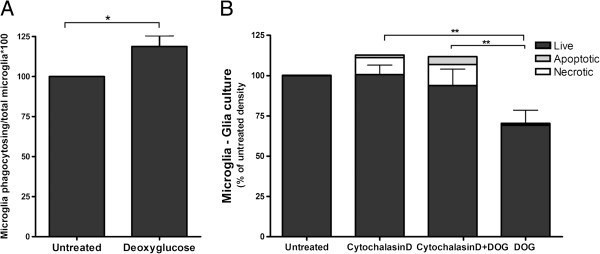
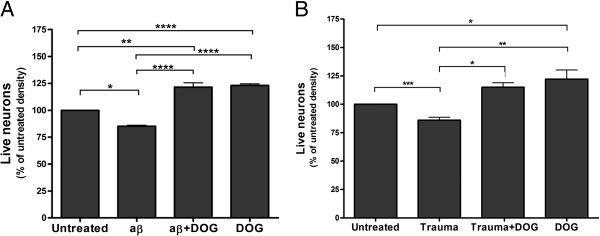
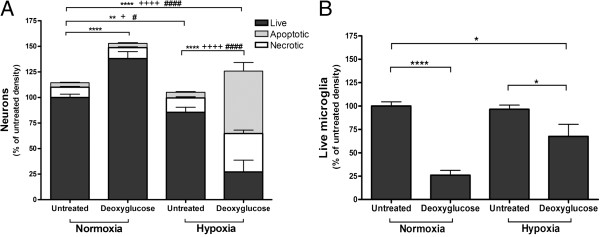
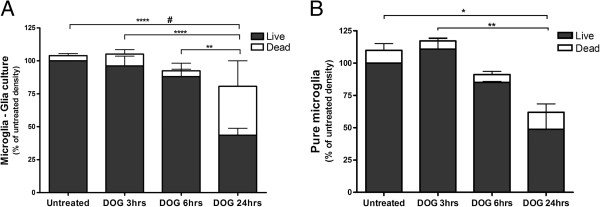
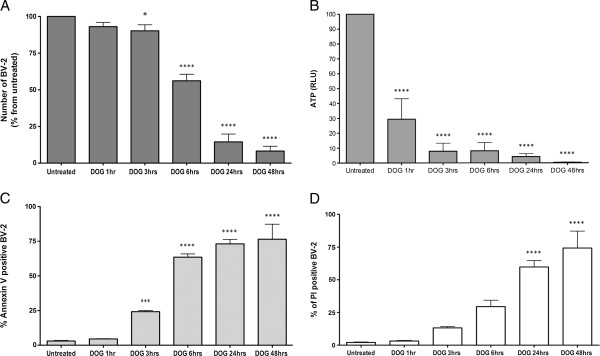
Surprisingly, addition of deoxyglucose induced microglial loss and prevented spontaneous neuronal loss in long-term cultures of neurons and glia, while elimination of microglia by L-leucine-methyl ester prevented the deoxyglucose-induced neuroprotection. Deoxyglucose also prevented neuronal loss induced by addition of amyloid beta or disrupted neurons (culture models of Alzheimer's disease and brain trauma respectively). However, deoxyglucose greatly increased the neuronal death induced by hypoxia. Addition of deoxyglucose to pure microglia induced necrosis and loss, preceded by rapid ATP depletion and followed by phagocytosis of the microglia. Deoxyglucose did not kill astrocytes or neurons.
We conclude that deoxyglucose causes microglial loss by ATP depletion, and this can protect neurons from neurodegeneration, except in conditions of hypoxia. Deoxyglucose may thus be beneficial in brain pathologies mediated by microglia, including brain trauma, but not where hypoxia is involved.
2-脱氧-D-葡萄糖是一种糖酵解抑制剂,在脑病理学动物模型中具有保护作用,但其保护机制尚不清楚。我们研究了脱氧葡萄糖在与星形胶质细胞和小胶质细胞共培养时是否、何时以及如何保护神经元。小胶质细胞是脑巨噬细胞,在炎症条件下可损伤神经元。
将脱氧葡萄糖添加到来自大鼠皮质的小胶质细胞和星形胶质细胞的原代培养物中,或来自大鼠小脑的神经元和神经胶质细胞中,或BV-2小胶质细胞系中,并评估细胞死亡和细胞功能。
令人惊讶的是,添加脱氧葡萄糖可导致小胶质细胞丢失,并防止神经元和神经胶质细胞长期培养中的自发性神经元丢失,而用L-亮氨酸甲酯消除小胶质细胞可阻止脱氧葡萄糖诱导的神经保护作用。脱氧葡萄糖还可防止因添加淀粉样β蛋白或破坏神经元(分别为阿尔茨海默病和脑外伤的培养模型)而导致的神经元丢失。然而,脱氧葡萄糖大大增加了缺氧诱导的神经元死亡。向纯小胶质细胞中添加脱氧葡萄糖会导致坏死和丢失,先是快速的ATP耗竭,随后是小胶质细胞的吞噬作用。脱氧葡萄糖不会杀死星形胶质细胞或神经元。
我们得出结论,脱氧葡萄糖通过ATP耗竭导致小胶质细胞丢失,这可以保护神经元免受神经退行性变,但在缺氧情况下除外。因此,脱氧葡萄糖可能对由小胶质细胞介导的脑部疾病有益,包括脑外伤,但不适用于涉及缺氧的情况。