Segal Kira L, Fleischut Peter M, Kim Charles, Levine Ben, Faggiani Susan L, Banerjee Samprit, Gadalla Farida, Lelli Gary J
Department of Ophthalmology, New York-Presbyterian Hospital, Weill Cornell Medical College, 1305 York Avenue, New York, NY 10065, USA.
Department of Anesthesiology, New York-Presbyterian Hospital, Weill Cornell Medical College, Box 124, New York, NY 10065, USA.
J Ophthalmol. 2014;2014:901901. doi: 10.1155/2014/901901. Epub 2014 Feb 4.
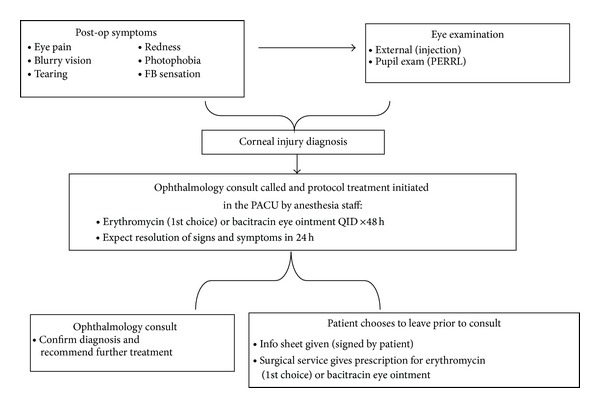
Purpose. To evaluate perioperative risk factors for corneal abrasion (CA) and to determine current care for perioperative CA in a tertiary care setting. Methods. Hospital-based, cross-sectional study. In Operating Room and Post-Anesthesia Care Units patients, a comparison of cases and controls was evaluated to elucidate risk factors, time to treatment, and most common treatments prescribed for corneal abrasions. Results. 86 cases of corneal abrasion and 89 controls were identified from the 78,542 surgical procedures performed over 2 years. Statistically significant risk factors were age (P = 0.0037), general anesthesia (P < 0.001), greater average estimated blood loss (P < 0.001), eyes taped during surgery (P < 0.001), prone position (P < 0.001), trendelenburg position (P < 0.001), and supplemental oxygen en route to and in the Post-Anesthesia Care Units (P < 0.001). Average time to complaint was 129 minutes. 94% of cases had an inpatient ophthalmology consult, with an average time to consult of 164 minutes. The most common treatment was artificial tears alone (40%), followed by combination treatment of antibiotic ointment and artificial tears (35.3%). Conclusions. Trendelenburg positioning is a novel risk factor for CA. Diagnosis and treatment of perioperative corneal abrasions by an ophthalmologist typically require three hours in the tertiary care setting.
目的。评估角膜擦伤(CA)的围手术期风险因素,并确定三级医疗环境中围手术期CA的当前护理情况。方法。基于医院的横断面研究。在手术室和麻醉后护理单元的患者中,对病例和对照进行比较,以阐明角膜擦伤的风险因素、治疗时间以及最常用的治疗方法。结果。在两年内进行的78542例外科手术中,确定了86例角膜擦伤病例和89例对照。具有统计学意义的风险因素包括年龄(P = 0.0037)、全身麻醉(P < 0.001)、平均估计失血量较多(P < 0.001)、手术期间眼睛被粘贴(P < 0.001)、俯卧位(P < 0.001)、特伦德伦伯格卧位(P < 0.001)以及在前往麻醉后护理单元途中及在该单元内使用补充氧气(P < 0.001)。平均投诉时间为129分钟。94%的病例接受了眼科住院会诊,平均会诊时间为164分钟。最常见的治疗方法是单独使用人工泪液(40%),其次是抗生素眼膏和人工泪液联合治疗(35.3%)。结论。特伦德伦伯格卧位是CA的一个新的风险因素。在三级医疗环境中,眼科医生对围手术期角膜擦伤的诊断和治疗通常需要三个小时。