Kozielski Kristen L, Tzeng Stephany Y, De Mendoza Bolivia A Hurtado, Green Jordan J
Department of Biomedical Engineering, the Institute for Nanobiotechnology, and the Translational Tissue Engineering Center, The Johns Hopkins University School of Medicine , 400 North Broadway/Smith Building Room 5017, Baltimore, Maryland 21231, United States .
ACS Nano. 2014 Apr 22;8(4):3232-41. doi: 10.1021/nn500704t. Epub 2014 Apr 3.
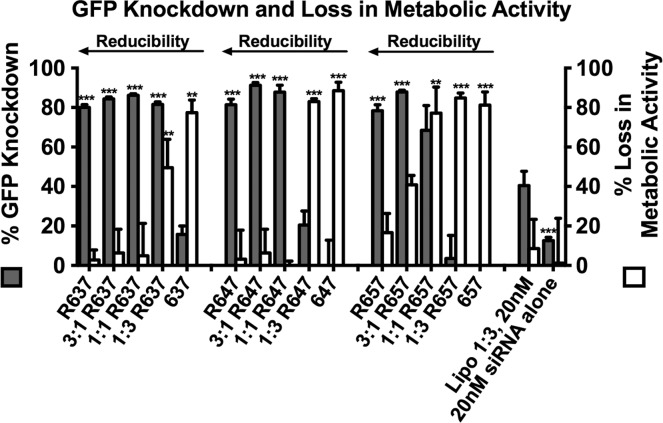
siRNA nanomedicines can potentially treat many human diseases, but safe and effective delivery remains a challenge. DNA delivery polymers such as poly(β-amino ester)s (PBAEs) generally cannot effectively deliver siRNA and require chemical modification to enable siRNA encapsulation and delivery. An optimal siRNA delivery nanomaterial needs to be able to bind and self-assemble with siRNA molecules that are shorter and stiffer than plasmid DNA in order to form stable nanoparticles, and needs to promote efficient siRNA release upon entry to the cytoplasm. To address these concerns, we designed, synthesized, and characterized an array of bioreducible PBAEs that self-assemble with siRNA in aqueous conditions to form nanoparticles of approximately 100 nm and that exhibit environmentally triggered siRNA release upon entering the reducing environment of the cytosol. By tuning polymer properties, including bioreducibility and hydrophobicity, we were able to fabricate polymeric nanoparticles capable of efficient gene knockdown (91 ± 1%) in primary human glioblastoma cells without significant cytotoxicity (6 ± 12%). We were also able to achieve significantly higher knockdown using these polymers with a low dose of 5 nM siRNA (76 ± 14%) compared to commercially available reagent Lipofectamine 2000 with a 4-fold higher dose of 20 nM siRNA (40 ± 7%). These bioreducible PBAEs also enabled 63 ± 16% gene knockdown using an extremely low 1 nM siRNA dose and showed preferential transfection of glioblastoma cells versus noncancer neural progenitor cells, highlighting their potential as efficient and tumor-specific carriers for siRNA-based nanomedicine.
小分子干扰RNA纳米药物有潜力治疗多种人类疾病,但安全有效的递送仍是一项挑战。诸如聚(β-氨基酯)(PBAE)之类的DNA递送聚合物通常无法有效递送小分子干扰RNA,需要进行化学修饰才能实现小分子干扰RNA的封装和递送。一种理想的小分子干扰RNA递送纳米材料需要能够与比质粒DNA更短、更硬的小分子干扰RNA分子结合并自组装,以形成稳定的纳米颗粒,并且需要在进入细胞质后促进小分子干扰RNA的有效释放。为了解决这些问题,我们设计、合成并表征了一系列可生物还原的PBAE,它们在水性条件下与小分子干扰RNA自组装形成约100纳米的纳米颗粒,并在进入胞质溶胶的还原环境后表现出环境触发的小分子干扰RNA释放。通过调节聚合物特性,包括生物还原性和疏水性,我们能够制造出在原代人胶质母细胞瘤细胞中能够有效基因敲低(91±1%)且无明显细胞毒性(6±12%)的聚合物纳米颗粒。与市售试剂Lipofectamine 2000相比,使用这些聚合物以低剂量5 nM小分子干扰RNA(76±14%)时,我们也能够实现显著更高的敲低效果,而Lipofectamine 2000使用的是4倍高剂量20 nM小分子干扰RNA(40±7%)。这些可生物还原的PBAE使用极低的1 nM小分子干扰RNA剂量也能实现63±16%的基因敲低,并显示出对胶质母细胞瘤细胞的优先转染,而非癌性神经祖细胞,突出了它们作为基于小分子干扰RNA的纳米药物的高效且肿瘤特异性载体的潜力。