Rohde G, Message S D, Haas J J, Kebadze T, Parker H, Laza-Stanca V, Khaitov M R, Kon O M, Stanciu L A, Mallia P, Edwards M R, Johnston S L
Department of Respiratory Medicine, National Heart and Lung Institute, MRC and Asthma UK Centre in Allergic Mechanisms of Asthma & Centre for Respiratory Infection, Imperial College London, London, UK; Department of Respiratory Medicine, Maastricht University Medical Centre+, Maastricht, The Netherlands.
Clin Exp Allergy. 2014 Jul;44(7):930-9. doi: 10.1111/cea.12313.
Rhinoviruses (RVs) are the major triggers of asthma exacerbations. We have shown previously that lower respiratory tract symptoms, airflow obstruction, and neutrophilic airway inflammation were increased in experimental RV-induced asthma exacerbations.
We hypothesized that neutrophil-related CXC chemokines and antimicrobial peptides are increased and related to clinical, virologic, and pathologic outcomes in RV-induced exacerbations of asthma.
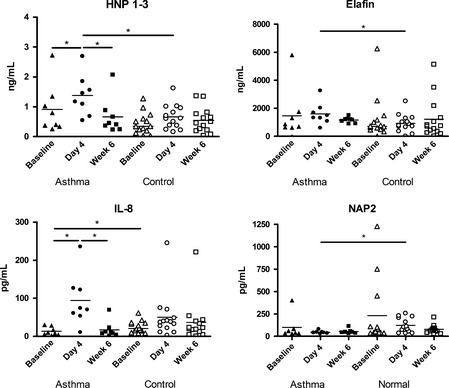
Protein levels of antimicrobial peptides (SLPI, HNP 1-3, elafin, and LL-37) and neutrophil chemokines (CXCL1/GRO-α, CXCL2/GRO-β, CXCL5/ENA-78, CXCL6/GCP-2, CXCL7/NAP-2, and CXCL8/IL-8) were determined in bronchoalveolar lavage (BAL) fluid of 10 asthmatics and 15 normal controls taken before, at day four during and 6 weeks post-experimental infection.
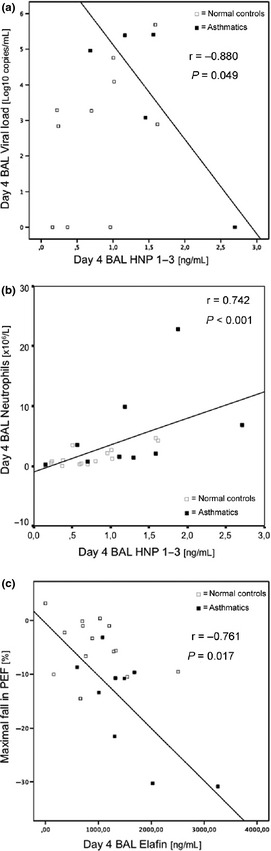
BAL HNP 1-3 and Elafin were higher, CXCL7/NAP-2 was lower in asthmatics compared with controls at day 4 (P = 0.035, P = 0.048, and P = 0.025, respectively). BAL HNP 1-3 and CXCL8/IL-8 were increased during infection (P = 0.003 and P = 0.011, respectively). There was a trend to increased BAL neutrophils at day 4 compared with baseline (P = 0.076). BAL HNP 1-3 was positively correlated with BAL neutrophil numbers at day 4. There were no correlations between clinical parameters and HNP1-3 or IL-8 levels.
We propose that RV infection in asthma leads to increased release of CXCL8/IL-8, attracting neutrophils into the airways where they release HNP 1-3, which further enhances airway neutrophilia. Strategies to inhibit CXCL8/IL-8 may be useful in treatment of virus-induced asthma exacerbations.
鼻病毒(RVs)是哮喘加重的主要诱因。我们之前已经表明,在实验性RV诱发的哮喘加重中,下呼吸道症状、气流阻塞和嗜中性粒细胞气道炎症会增加。
我们假设在RV诱发的哮喘加重中,与嗜中性粒细胞相关的CXC趋化因子和抗菌肽会增加,并且与临床、病毒学和病理学结果相关。
在10名哮喘患者和15名正常对照的支气管肺泡灌洗(BAL)液中,于实验性感染前、感染期间第4天和感染后6周测定抗菌肽(分泌性白细胞蛋白酶抑制因子、人嗜中性粒细胞肽1-3、弹性蛋白酶和LL-37)和嗜中性粒细胞趋化因子(CXCL1/生长调节致癌基因-α、CXCL2/生长调节致癌基因-β、CXCL5/上皮中性粒细胞活化肽-78、CXCL6/粒细胞趋化蛋白-2、CXCL7/血小板碱性蛋白和CXCL8/白细胞介素-8)的蛋白质水平。
与对照组相比,哮喘患者在第4天的BAL液中人嗜中性粒细胞肽1-3和弹性蛋白酶更高,CXCL7/血小板碱性蛋白更低(分别为P = 0.035、P = 0.048和P = 0.025)。感染期间BAL液中人嗜中性粒细胞肽1-3和CXCL8/白细胞介素-8增加(分别为P = 0.003和P = 0.011)。与基线相比,第4天BAL液中嗜中性粒细胞有增加的趋势(P = 0.076)。第4天BAL液中人嗜中性粒细胞肽1-3与BAL嗜中性粒细胞数量呈正相关。临床参数与嗜中性粒细胞肽1-3或白细胞介素-8水平之间无相关性。
我们提出哮喘中的RV感染导致CXCL8/白细胞介素-8释放增加,吸引嗜中性粒细胞进入气道,在气道中它们释放人嗜中性粒细胞肽1-3,这进一步增强了气道嗜中性粒细胞增多。抑制CXCL8/白细胞介素-8的策略可能对治疗病毒诱发的哮喘加重有用。