Sim Joe C H, White Susan M, Fitzpatrick Elizabeth, Wilson Gabrielle R, Gillies Greta, Pope Kate, Mountford Hayley S, Torring Pernille M, McKee Shane, Vulto-van Silfhout Anneke T, Jhangiani Shalini N, Muzny Donna M, Leventer Richard J, Delatycki Martin B, Amor David J, Lockhart Paul J
Bruce Lefroy Centre for Genetic Health Research, Murdoch Childrens Research Institute, Parkville, Victoria 3052, Australia.
Orphanet J Rare Dis. 2014 Mar 27;9:43. doi: 10.1186/1750-1172-9-43.
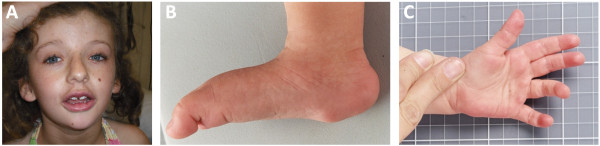
Mutations in genes encoding components of the Brahma-associated factor (BAF) chromatin remodeling complex have recently been shown to contribute to multiple syndromes characterised by developmental delay and intellectual disability. ARID1B mutations have been identified as the predominant cause of Coffin-Siris syndrome and have also been shown to be a frequent cause of nonsyndromic intellectual disability. Here, we investigate the molecular basis of a patient with an overlapping but distinctive phenotype of intellectual disability, plantar fat pads and facial dysmorphism.
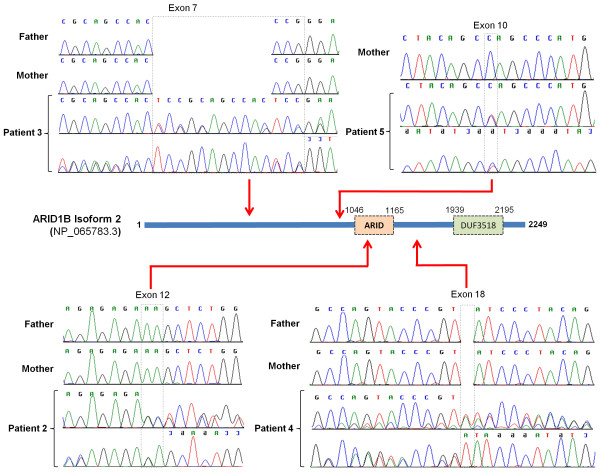
METHODS/RESULTS: High density microarray analysis of the patient demonstrated a heterozygous deletion at 6q25.3, which resulted in the loss of four genes including AT Rich Interactive Domain 1B (ARID1B). Subsequent quantitative real-time PCR analysis revealed ARID1B haploinsufficiency in the patient. Analysis of both patient-derived and ARID1B knockdown fibroblasts after serum starvation demonstrated delayed cell cycle re-entry associated with reduced cell number in the S1 phase. Based on the patient's distinctive phenotype, we ascertained four additional patients and identified heterozygous de novo ARID1B frameshift or nonsense mutations in all of them.
This study broadens the spectrum of ARID1B associated phenotypes by describing a distinctive phenotype including plantar fat pads but lacking the hypertrichosis or fifth nail hypoplasia associated with Coffin-Siris syndrome. We present the first direct evidence in patient-derived cells that alterations in cell cycle contribute to the underlying pathogenesis of syndromes associated with ARID1B haploinsufficiency.
最近研究表明,编码与布拉马相关因子(BAF)染色质重塑复合体组分的基因突变会导致多种以发育迟缓与智力残疾为特征的综合征。ARID1B突变已被确认为科芬-西里斯综合征的主要病因,并且也被证明是散发性智力残疾的常见病因。在此,我们对一名患有智力残疾、足底脂肪垫和面部畸形等重叠但独特表型的患者的分子基础进行研究。
方法/结果:对该患者进行高密度微阵列分析,结果显示其6号染色体长臂25.3区存在杂合性缺失,导致包括富含AT互作结构域1B(ARID1B)在内的4个基因缺失。随后的定量实时PCR分析显示该患者存在ARID1B单倍体不足。对血清饥饿后的患者来源成纤维细胞和ARID1B敲低的成纤维细胞进行分析,结果显示细胞周期重新进入延迟,且S1期细胞数量减少。基于该患者的独特表型,我们又确定了另外4名患者,并在他们所有人中均发现了杂合性新生ARID1B移码或无义突变。
本研究通过描述一种独特的表型,拓宽了ARID1B相关表型的范围,该表型包括足底脂肪垫,但缺乏与科芬-西里斯综合征相关的多毛症或第五指指甲发育不全。我们在患者来源的细胞中提供了首个直接证据,证明细胞周期改变会导致与ARID1B单倍体不足相关综合征的潜在发病机制。