Antony K M, Agrawal A, Arndt M E, Murphy A M, Alapat P M, Guntupalli K K, Aagaard K M
Division of Maternal-Fetal Medicine, Department of Obstetrics and Gynecology, Baylor College of Medicine, Houston, TX, USA.
School of Medicine, University of Texas Health Science Center, Houston, TX, USA.
J Perinatol. 2014 Aug;34(8):587-93. doi: 10.1038/jp.2014.48. Epub 2014 Mar 27.
We sought to ascertain the validity of two screening scales for obstructive sleep apnea (OSA) in pregnancy and to establish the prevalence of OSA in pregnancy.
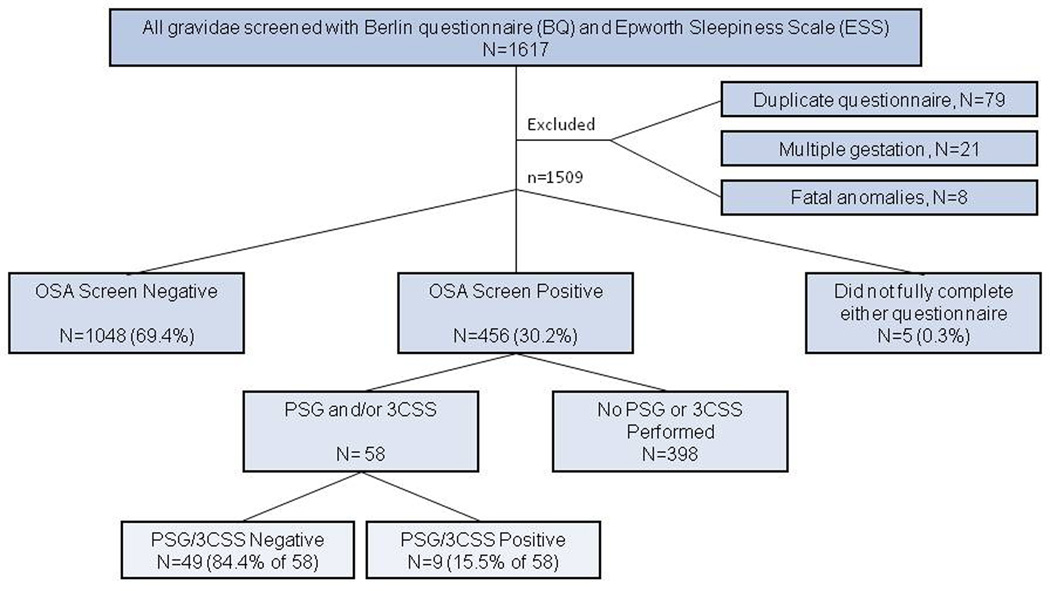
In this prospective observational study, two screening scales were administered. Screen positive subjects were referred for diagnostic polysomnography (PSG); if admitted for antepartum care, screen positive subjects underwent a modified study with a type 3 device (T3D).
A total of 1509 subjects underwent OSA screening; 58 completed diagnostic testing. Neither measure was a reliable diagnostic tool for OSA as determined by T3D or PSG (detection rates of 10.3% and 18.0%, respectively). Among screen positive subjects undergoing PSG or T3D testing, 15.5% ultimately met 'gold standard' OSA diagnostic criteria for an estimated point prevalence of 4.9%.
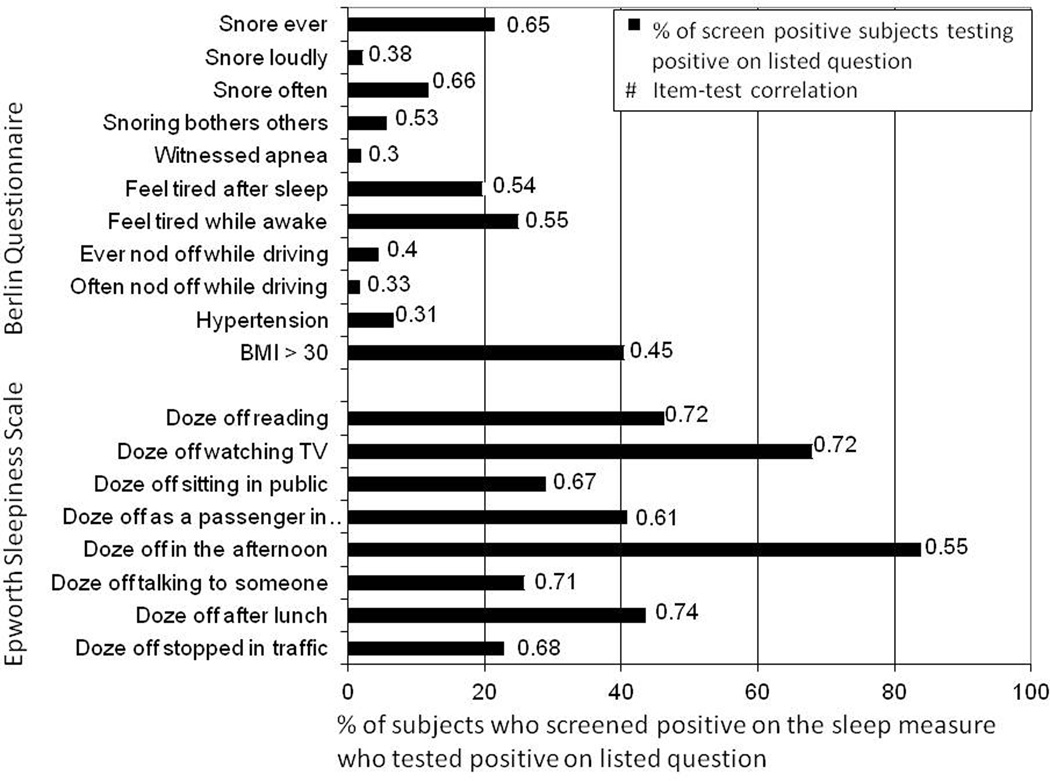
In this prospective trial, screening positive on the Berlin questionnaire or Epworth sleepiness scale was poorly predictive of OSA among gravidae and was associated with a high false referral rate.
我们试图确定两种妊娠期阻塞性睡眠呼吸暂停(OSA)筛查量表的有效性,并确定妊娠期OSA的患病率。
在这项前瞻性观察研究中,采用了两种筛查量表。筛查呈阳性的受试者被转诊进行诊断性多导睡眠图(PSG)检查;如果因产前护理入院,筛查呈阳性的受试者使用3型设备(T3D)进行改良研究。
共有1509名受试者接受了OSA筛查;58人完成了诊断测试。根据T3D或PSG的判定,这两种测量方法都不是OSA的可靠诊断工具(检测率分别为10.3%和18.0%)。在接受PSG或T3D测试的筛查呈阳性的受试者中,15.5%最终符合“金标准”OSA诊断标准,估计时点患病率为4.9%。
在这项前瞻性试验中,柏林问卷或爱泼沃斯思睡量表筛查呈阳性对孕妇OSA的预测性较差,且与高假转诊率相关。