Yilmazel Ucar Elif, Araz Omer, Meral Mehmet, Sonkaya Esin, Saglam Leyla, Kaynar Hasan, Gorguner Ali Metin, Akgun Metin
Department of Pulmonary Diseases, Ataturk University, School of Medicine, Erzurum, Turkey.
Med Sci Monit. 2014 Mar 28;20:513-20. doi: 10.12659/MSM.890210.
The study aimed to compare the efficacy and safety of nebulized steroid (NS) with systemic corticosteroids (SC) and to determine optimal NS dose in the treatment of patients with COPD exacerbations requiring hospitalization.
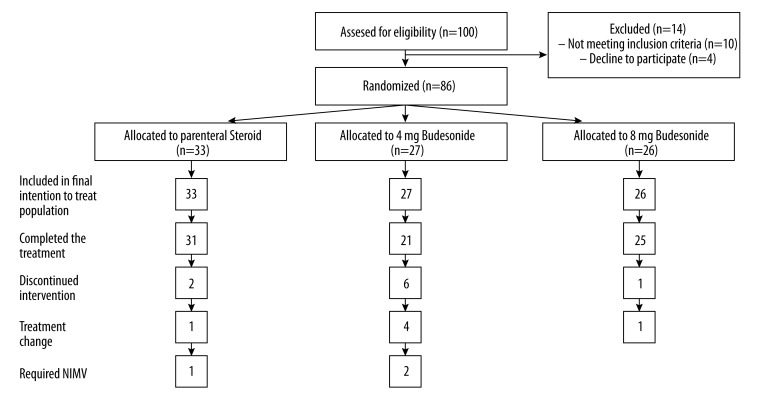
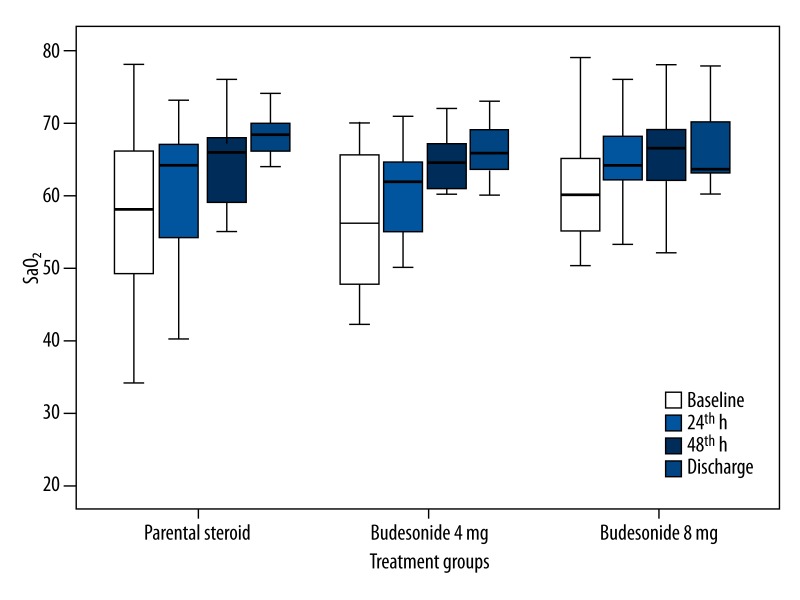
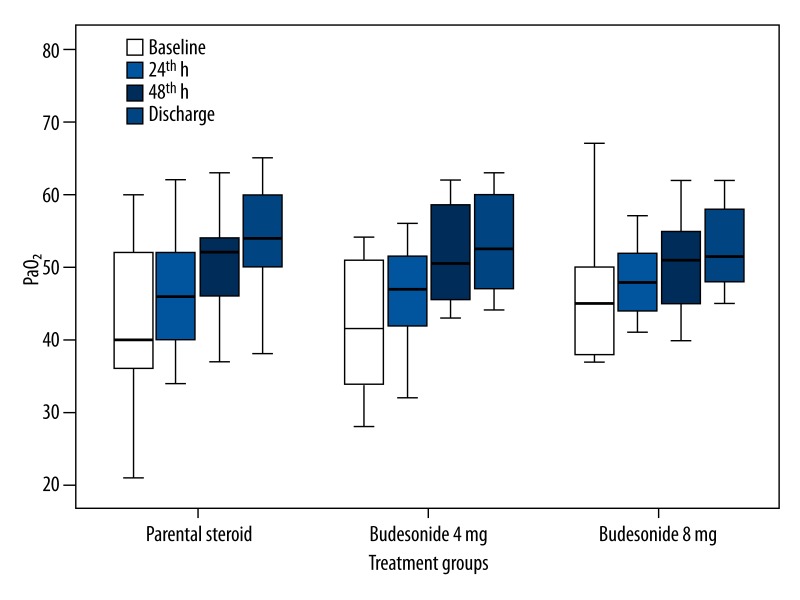
The study was a randomized, parallel design trial. Eligible patients (n=86) were randomly allocated to 1 of the 3 treatment groups: parenteral corticosteroid (PS) (n=33), 4 mg (NB) (n=27), or 8 mg NB (n=26). Partial pressure of arterial oxygen (PaO2), carbon dioxide (PaCO2), pH, and oxygen saturation (SaO2) were evaluated at baseline, 24 h, 48 h, and discharge. Airway obstruction (forced vital capacity [FVC] and forced expiratory volume 1 s [FEV1]) was evaluated at admission and discharge.
There were no significant differences between the groups for all parameters at all time periods, except for higher FEV1 value in the 8-mg NB group at baseline. In groups, significant differences were determined for FVC, FEV1, PaO2, and SaO2 (p<0.001), but not for PaCO2 and pH, in comparison to their baseline values. As adverse events, hyperglycemia and oral moniliasis were observed in the PS group (n=4) and in the NB groups (n=5), respectively, and treatment change was required in 9 patients (2 patients in the PS group and 7 patients in the NB groups) (p=0.57).
Nebulized budesonide may be used as an alternative to SC because of its equal effectiveness and lesser systemic adverse effects. The choice of optimal dosage needs to be evaluated carefully because adverse effect and dropout rates varied according to dosage. However, there is a need for further studies including more severe cases and evaluating long-term outcomes or relapses comparing the 3 arms.
本研究旨在比较雾化吸入类固醇(NS)与全身用皮质类固醇(SC)的疗效和安全性,并确定在治疗需要住院的慢性阻塞性肺疾病(COPD)急性加重患者时NS的最佳剂量。
本研究为随机平行设计试验。符合条件的患者(n = 86)被随机分配到3个治疗组中的1组:肠外皮质类固醇(PS)组(n = 33)、4 mg布地奈德(NB)组(n = 27)或8 mg NB组(n = 26)。在基线、24小时、48小时和出院时评估动脉血氧分压(PaO2)、二氧化碳分压(PaCO2)、pH值和血氧饱和度(SaO2)。在入院时和出院时评估气道阻塞情况(用力肺活量[FVC]和第1秒用力呼气量[FEV1])。
除8 mg NB组在基线时FEV1值较高外,各时间点所有参数在组间均无显著差异。与基线值相比,各组FVC、FEV1、PaO2和SaO2有显著差异(p < 0.001),但PaCO2和pH值无显著差异。作为不良事件,PS组(n = 4)和NB组(n = 5)分别观察到高血糖和口腔念珠菌病,9例患者(PS组2例,NB组7例)需要改变治疗方案(p = 0.57)。
雾化吸入布地奈德因其疗效相当且全身不良反应较少,可作为SC的替代药物。由于不良反应和退出率随剂量而异,需要仔细评估最佳剂量的选择。然而,需要进一步开展研究,纳入更多重症病例,并比较三组的长期结局或复发情况。