Gaze Soraya, Driguez Patrick, Pearson Mark S, Mendes Tiago, Doolan Denise L, Trieu Angela, McManus Donald P, Gobert Geoffrey N, Periago Maria Victoria, Correa Oliveira Rodrigo, Cardoso Fernanda C, Oliveira Guilherme, Nakajima Rie, Jasinskas Al, Hung Chris, Liang Li, Pablo Jozelyn, Bethony Jeffrey M, Felgner Philip L, Loukas Alex
Centre for Biodiscovery and Molecular Development of Therapeutics, Australian Institute of Tropical Health and Medicine, Queensland Tropical Health Alliance Laboratory, James Cook University, Cairns, Queensland, Australia; Instituto Nacional de Ciência e Tecnologia em Doenças Tropicais, Centro de Pesquisas René Rachou, Instituto Fiocruz, Belo Horizonte, Minas Gerais, Brazil.
QIMR Berghofer Medical Research Institute, Brisbane, Queensland, Australia.
PLoS Pathog. 2014 Mar 27;10(3):e1004033. doi: 10.1371/journal.ppat.1004033. eCollection 2014 Mar.
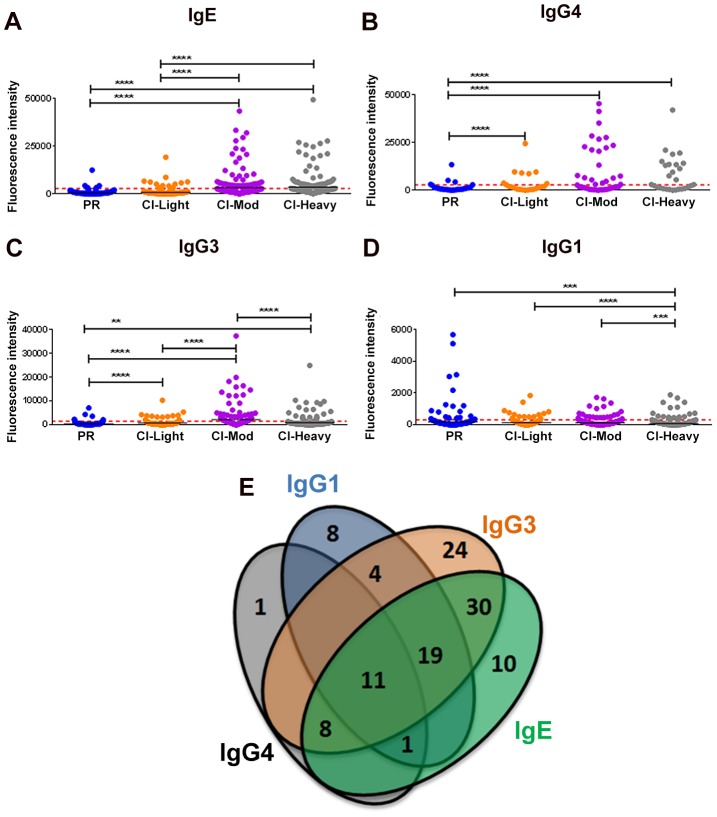
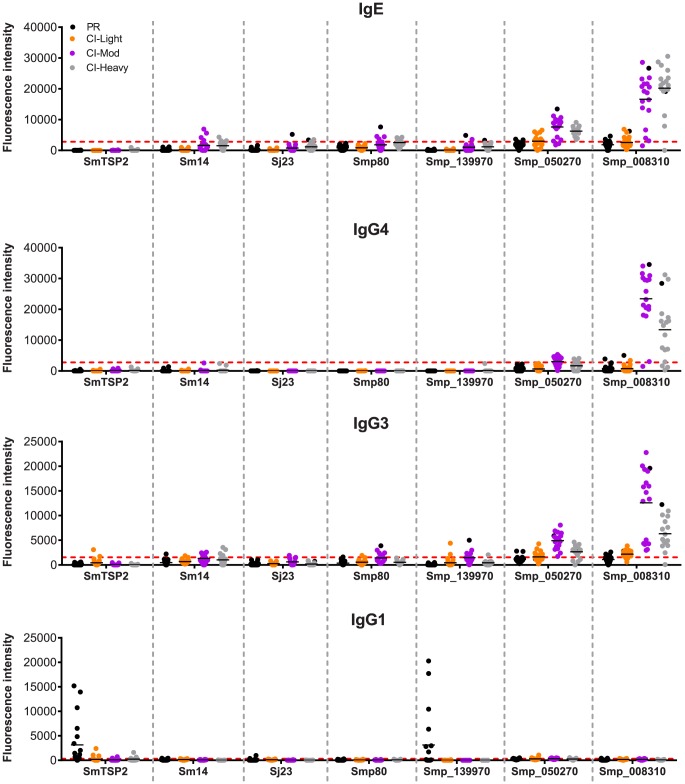
Schistosomiasis is a neglected tropical disease that is responsible for almost 300,000 deaths annually. Mass drug administration (MDA) is used worldwide for the control of schistosomiasis, but chemotherapy fails to prevent reinfection with schistosomes, so MDA alone is not sufficient to eliminate the disease, and a prophylactic vaccine is required. Herein, we take advantage of recent advances in systems biology and longitudinal studies in schistosomiasis endemic areas in Brazil to pilot an immunomics approach to the discovery of schistosomiasis vaccine antigens. We selected mostly surface-derived proteins, produced them using an in vitro rapid translation system and then printed them to generate the first protein microarray for a multi-cellular pathogen. Using well-established Brazilian cohorts of putatively resistant (PR) and chronically infected (CI) individuals stratified by the intensity of their S. mansoni infection, we probed arrays for IgG subclass and IgE responses to these antigens to detect antibody signatures that were reflective of protective vs. non-protective immune responses. Moreover, probing for IgE responses allowed us to identify antigens that might induce potentially deleterious hypersensitivity responses if used as subunit vaccines in endemic populations. Using multi-dimensional cluster analysis we showed that PR individuals mounted a distinct and robust IgG1 response to a small set of newly discovered and well-characterized surface (tegument) antigens in contrast to CI individuals who mounted strong IgE and IgG4 responses to many antigens. Herein, we show the utility of a vaccinomics approach that profiles antibody responses of resistant individuals in a high-throughput multiplex approach for the identification of several potentially protective and safe schistosomiasis vaccine antigens.
血吸虫病是一种被忽视的热带疾病,每年导致近30万例死亡。全球范围内使用大规模药物治疗(MDA)来控制血吸虫病,但化疗无法预防血吸虫的再次感染,因此仅靠MDA不足以消除该疾病,还需要一种预防性疫苗。在此,我们利用系统生物学的最新进展以及巴西血吸虫病流行地区的纵向研究,试点采用免疫组学方法来发现血吸虫病疫苗抗原。我们主要选择了表面来源的蛋白质,使用体外快速翻译系统进行生产,然后将其打印出来,生成了针对多细胞病原体的首个蛋白质微阵列。我们利用巴西既定的队列,这些队列根据曼氏血吸虫感染强度分为假定抗性(PR)个体和慢性感染(CI)个体,我们检测这些阵列中针对这些抗原的IgG亚类和IgE反应,以检测反映保护性与非保护性免疫反应的抗体特征。此外,检测IgE反应使我们能够识别如果作为流行人群中的亚单位疫苗使用可能会引发潜在有害超敏反应的抗原。通过多维聚类分析,我们发现与CI个体对许多抗原产生强烈的IgE和IgG4反应不同,PR个体对一小部分新发现且特征明确的表面(皮层)抗原产生了独特而强烈的IgG1反应。在此,我们展示了一种疫苗组学方法的实用性,该方法以高通量多重方法分析抗性个体的抗体反应,以识别几种潜在的保护性和安全性血吸虫病疫苗抗原。