Cao Pei-Hua, Wang Xin, Fang Shi-Song, Cheng Xiao-Wen, Chan King-Pan, Wang Xi-Ling, Lu Xing, Wu Chun-Li, Tang Xiu-Juan, Zhang Ren-Li, Ma Han-Wu, Cheng Jin-Quan, Wong Chit-Ming, Yang Lin
School of Public Health, The University of Hong Kong, Hong Kong Special Administrative Region, China.
Shenzhen Center for Disease Control and Prevention, Shenzhen, China.
PLoS One. 2014 Mar 27;9(3):e92945. doi: 10.1371/journal.pone.0092945. eCollection 2014.
Influenza has been associated with heavy burden of mortality and morbidity in subtropical regions. However, timely forecast of influenza epidemic in these regions has been hindered by unclear seasonality of influenza viruses. In this study, we developed a forecasting model by integrating multiple sentinel surveillance data to predict influenza epidemics in a subtropical city Shenzhen, China.
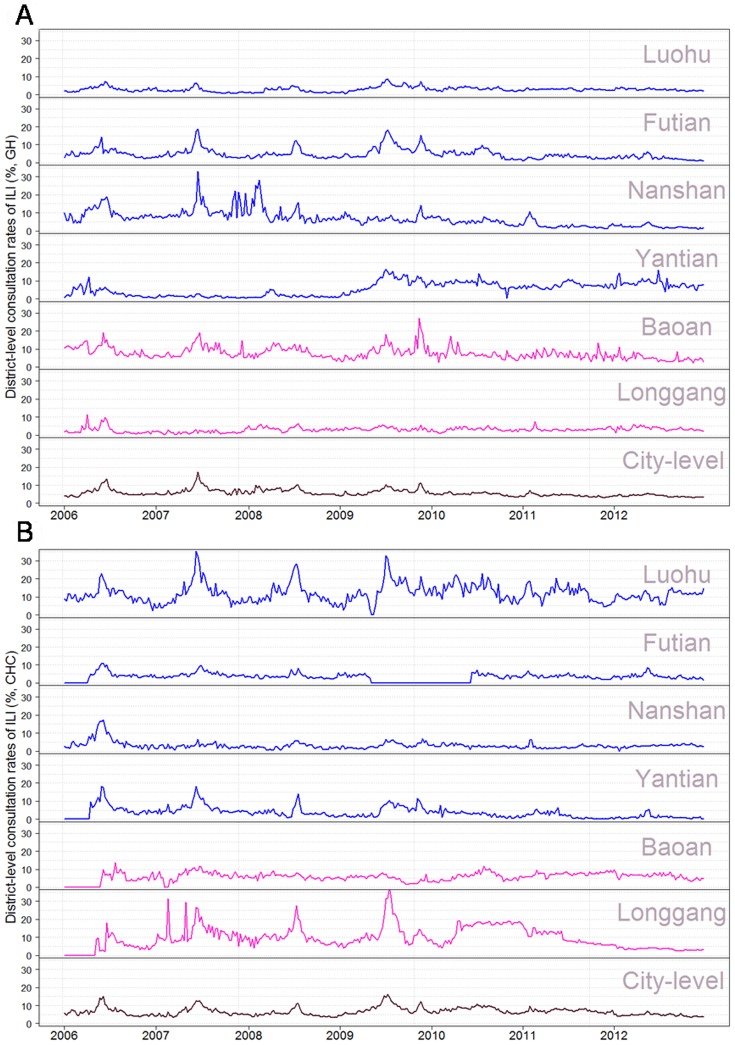
Dynamic linear models with the predictors of single or multiple surveillance data for influenza-like illness (ILI) were adopted to forecast influenza epidemics from 2006 to 2012 in Shenzhen. Temporal coherence of these surveillance data with laboratory-confirmed influenza cases was evaluated by wavelet analysis and only the coherent data streams were entered into the model. Timeliness, sensitivity and specificity of these models were also evaluated to compare their performance.
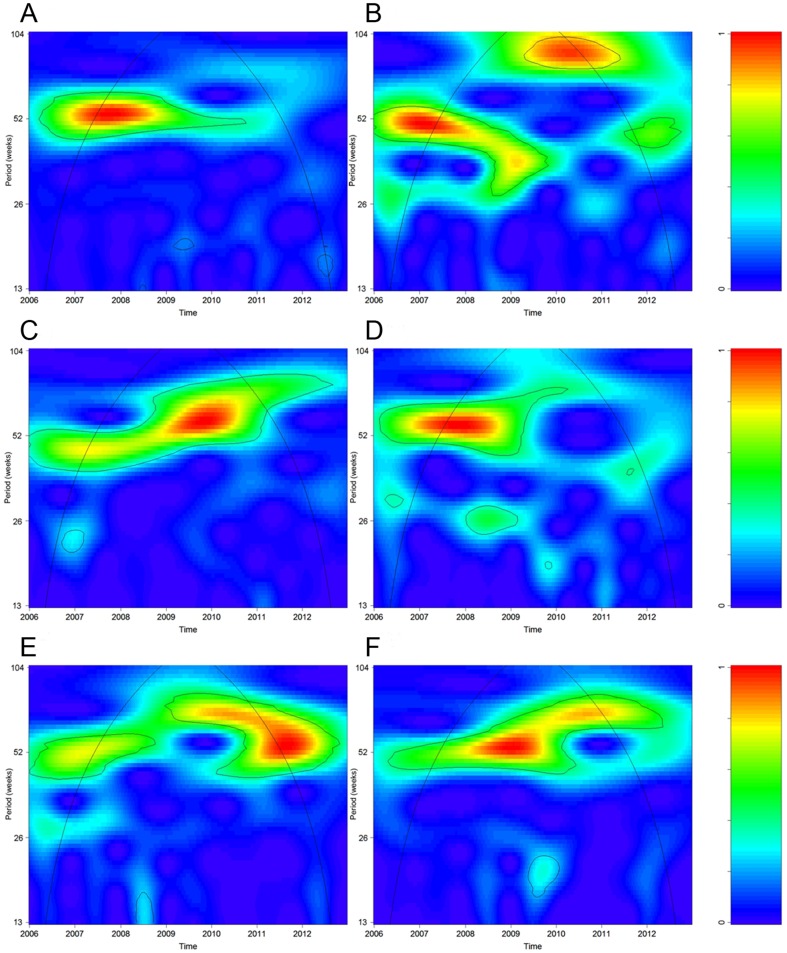
Both influenza virology data and ILI consultation rates in Shenzhen demonstrated a significant annual seasonal cycle (p<0.05) during the entire study period, with occasional deviations observed in some data streams. The forecasting models that combined multi-stream ILI surveillance data generally outperformed the models with single-stream ILI data, by providing more timely, sensitive and specific alerts.
Forecasting models that combine multiple sentinel surveillance data can be considered to generate timely alerts for influenza epidemics in subtropical regions like Shenzhen.
在亚热带地区,流感已造成沉重的死亡和发病负担。然而,这些地区流感病毒季节性不明确,阻碍了对流感疫情的及时预测。在本研究中,我们通过整合多个哨点监测数据,开发了一个预测模型,以预测中国亚热带城市深圳的流感疫情。
采用具有流感样疾病(ILI)单或多监测数据预测因子的动态线性模型,对深圳2006年至2012年的流感疫情进行预测。通过小波分析评估这些监测数据与实验室确诊流感病例的时间一致性,只有具有一致性的数据流才被纳入模型。还评估了这些模型的及时性、敏感性和特异性,以比较它们的性能。
在整个研究期间,深圳的流感病毒学数据和ILI会诊率均呈现出显著的年度季节性周期(p<0.05),部分数据流偶尔出现偏差。结合多数据流ILI监测数据的预测模型通常比单数据流ILI数据模型表现更好,能提供更及时、敏感和特异的预警。
结合多个哨点监测数据的预测模型可用于为深圳等亚热带地区的流感疫情及时发出预警。