Department of Epidemiology, College of Preventive Medicine, Army Medical University (Third Military Medical University), Chongqing, People's Republic of China; Chongqing Municipal Center for Disease Control and Prevention, Chongqing, People's Republic of China.
Ping An Technology (Shenzhen) Co., Ltd, Shenzhen, People's Republic of China.
EBioMedicine. 2019 Sep;47:284-292. doi: 10.1016/j.ebiom.2019.08.024. Epub 2019 Aug 30.
Early detection of influenza activity followed by timely response is a critical component of preparedness for seasonal influenza epidemic and influenza pandemic. However, most relevant studies were conducted at the regional or national level with regular seasonal influenza trends. There are few feasible strategies to forecast influenza activity at the local level with irregular trends.
Multi-source electronic data, including historical percentage of influenza-like illness (ILI%), weather data, Baidu search index and Sina Weibo data of Chongqing, China, were collected and integrated into an innovative Self-adaptive AI Model (SAAIM), which was constructed by integrating Seasonal Autoregressive Integrated Moving Average model and XGBoost model using a self-adaptive weight adjustment mechanism. SAAIM was applied to ILI% forecast in Chongqing from 2017 to 2018, of which the performance was compared with three previously available models on forecasting.
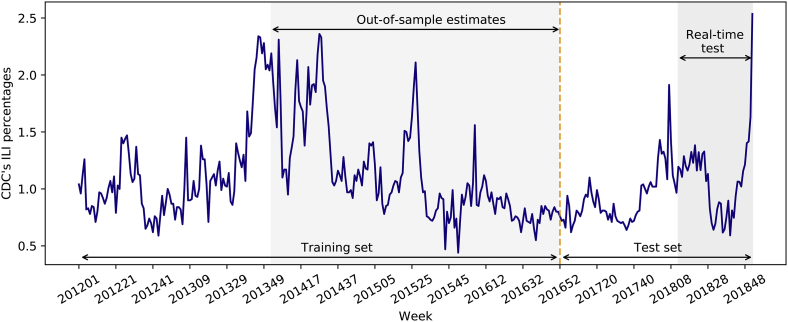
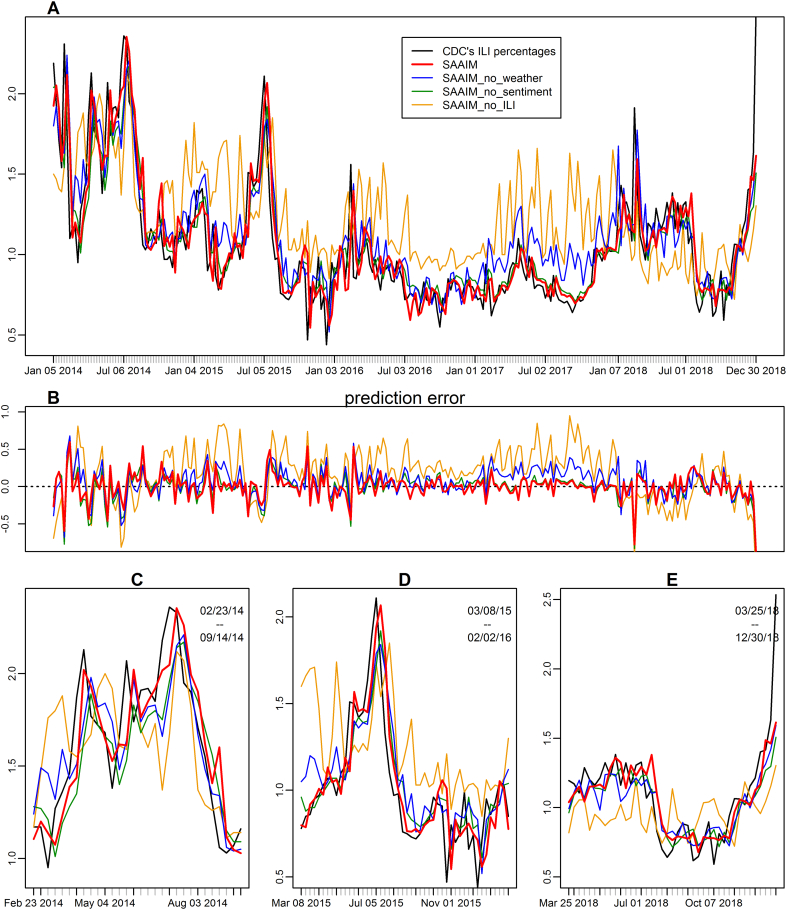
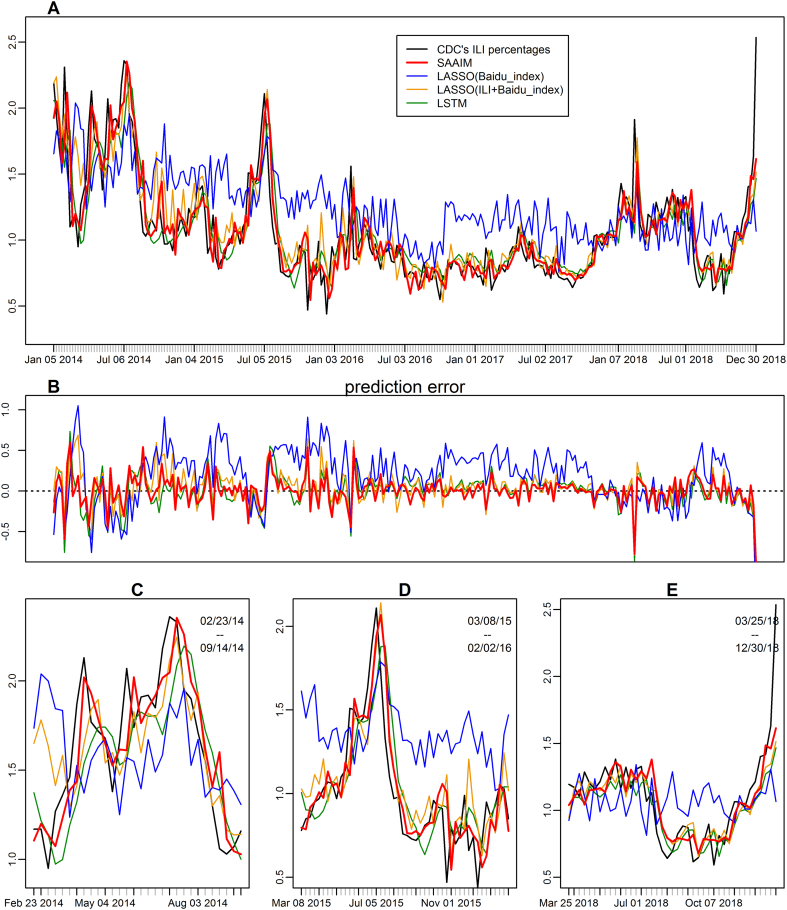
ILI% showed an irregular seasonal trend from 2012 to 2018 in Chongqing. Compared with three reference models, SAAIM achieved the best performance on forecasting ILI% of Chongqing with the mean absolute percentage error (MAPE) of 11·9%, 7·5%, and 11·9% during the periods of the year 2014-2016, 2017, and 2018 respectively. Among the three categories of source data, historical influenza activity contributed the most to the forecast accuracy by decreasing the MAPE by 19·6%, 43·1%, and 11·1%, followed by weather information (MAPE reduced by 3·3%, 17·1%, and 2·2%), and Internet-related public sentiment data (MAPE reduced by 1·1%, 0·9%, and 1·3%).
Accurate influenza forecast in areas with irregular seasonal influenza trends can be made by SAAIM with multi-source electronic data.
流感活动的早期检测及及时响应是季节性流感流行和流感大流行防范的关键组成部分。然而,大多数相关研究都是在区域或国家层面上进行的,且流感趋势具有季节性。对于流感趋势不规律的局部地区,几乎没有可行的策略来预测流感活动。
收集了包括中国重庆市历史流感样病例(ILI%)百分比、天气数据、百度搜索指数和新浪微博数据在内的多源电子数据,并将其整合到一个创新的自适应人工智能模型(SAAIM)中。该模型是通过使用自适应权重调整机制将季节性自回归综合移动平均模型和 XGBoost 模型相结合构建而成。SAAIM 应用于 2017 年至 2018 年重庆市的 ILI%预测,其性能与三种之前可用的预测模型进行了比较。
2012 年至 2018 年期间,重庆市 ILI%呈不规则季节性趋势。与三种参考模型相比,SAAIM 在预测重庆市 ILI%方面表现最佳,2014 年至 2016 年、2017 年和 2018 年的年平均绝对百分比误差(MAPE)分别为 11.9%、7.5%和 11.9%。在三种来源数据中,历史流感活动对预测准确性的贡献最大,将 MAPE 降低了 19.6%、43.1%和 11.1%,其次是天气信息(MAPE 分别降低了 3.3%、17.1%和 2.2%),以及与互联网相关的公众情绪数据(MAPE 分别降低了 1.1%、0.9%和 1.3%)。
使用多源电子数据,SAAIM 可以对流感趋势不规则的地区进行准确的流感预测。