Jaakkola Kari, Saukkoriipi Annika, Jokelainen Jari, Juvonen Raija, Kauppila Jaana, Vainio Olli, Ziegler Thedi, Rönkkö Esa, Jaakkola Jouni Jk, Ikäheimo Tiina M
Institute of Health Sciences, University of Oulu, P,O, Box 5000, FI-90014 Oulu, Finland.
Environ Health. 2014 Mar 28;13(1):22. doi: 10.1186/1476-069X-13-22.
Both temperature and humidity may independently or jointly contribute to the risk of influenza infections. We examined the relations between the level and decrease of temperature, humidity and the risk of influenza A and B virus infections in a subarctic climate.
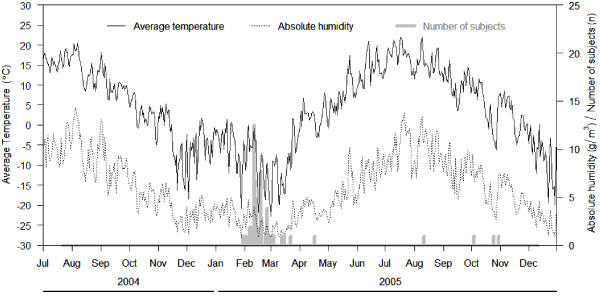
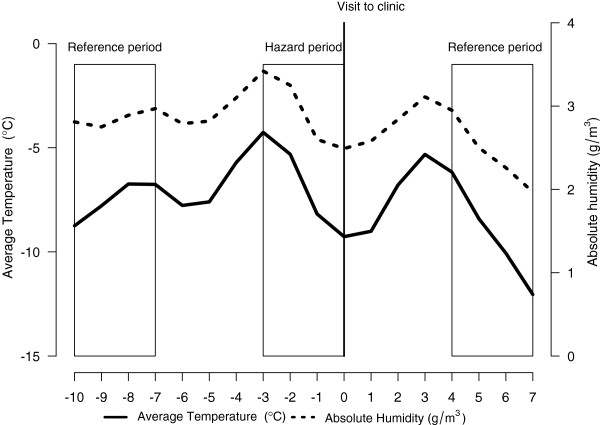
We conducted a case-crossover study among military conscripts (n = 892) seeking medical attention due to respiratory symptoms during their military training period and identified 66 influenza A and B cases by PCR or serology. Meteorological data such as measures of average and decline in ambient temperature and absolute humidity (AH) during the three preceding days of the onset (hazard period) and two reference periods, prior and after the onset were obtained.
The average temperature preceding the influenza onset was -6.8 ± 5.6°C and AH 3.1 ± 1.3 g/m3. A decrease in both temperature and AH during the hazard period increased the occurrence of influenza so that a 1°C decrease in temperature and 0.5 g decrease per m3 in AH increased the estimated risk by 11% [OR 1.11 (1.03 to 1.20)] and 58% [OR 1.58 (1.28 to 1.96)], respectively. The occurrence of influenza infections was positively associated with both the average temperature [OR 1.10 per 1°C (95% confidence interval 1.02 to 1.19)] and AH [OR 1.25 per g/m3 (1.05 to 1.49)] during the hazard period prior to onset.
Our results demonstrate that a decrease rather than low temperature and humidity per se during the preceding three days increase the risk of influenza episodes in a cold climate.
温度和湿度可能单独或共同导致流感感染风险。我们研究了亚北极气候下温度、湿度的水平及下降与甲型和乙型流感病毒感染风险之间的关系。
我们对军事训练期间因呼吸道症状就医的应征入伍军人(n = 892)进行了病例交叉研究,并通过聚合酶链反应(PCR)或血清学鉴定出66例甲型和乙型流感病例。获取了发病前三天(危险期)以及发病前和发病后的两个参照期的气象数据,如环境温度和绝对湿度(AH)的平均值及下降幅度。
流感发病前的平均温度为-6.8±5.6°C,AH为3.1±1.3 g/m³。危险期内温度和AH的下降均增加了流感的发生率,温度每下降1°C和AH每立方米下降0.5 g分别使估计风险增加11%[比值比(OR)1.11(1.03至1.20)]和58%[OR 1.58(1.28至1.96)]。流感感染的发生率与发病前危险期内的平均温度[每1°C的OR为1.10(95%置信区间1.02至1.19)]和AH[每g/m³的OR为1.25(1.05至1.49)]均呈正相关。
我们的结果表明,在寒冷气候中,发病前三天温度和湿度的下降而非低温和低湿度本身增加了流感发作的风险。