Rumisha Susan F, Smith Thomas A, Masanja Honorati, Abdulla Salim, Vounatsou Penelope
Swiss Tropical and Public Health Institute, Socinstrasse 57, 4051 Basel, Switzerland.
Malar J. 2014 Mar 28;13:124. doi: 10.1186/1475-2875-13-124.
The precise nature of the relationship between malaria mortality and levels of transmission is unclear. Due to methodological limitations, earlier efforts to assess the linkage have lead to inconclusive results. The malaria transmission intensity and mortality burden across Africa (MTIMBA) project initiated by the INDEPTH Network collected longitudinally entomological data within a number of sites in sub-Saharan Africa to study this relationship. This work linked the MTIMBA entomology database with the routinely collected vital events within the Rufiji Demographic Surveillance System to analyse the transmission-mortality relation in the region.
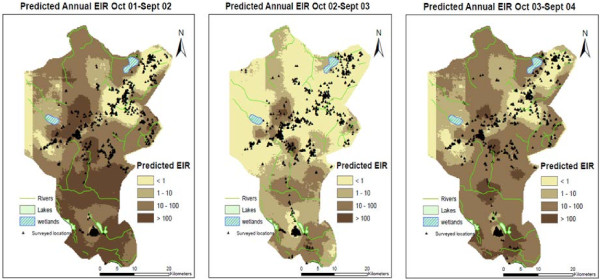
Bayesian Bernoulli spatio-temporal Cox proportional hazards models with village clustering, adjusted for age and insecticide-treated nets (ITNs), were fitted to assess the relation between mortality and malaria transmission measured by entomology inoculation rate (EIR). EIR was predicted at household locations using transmission models and it was incorporated in the model as a covariate with measure of uncertainty. Effects of covariates estimated by the model are reported as hazard ratios (HR) with 95% Bayesian confidence interval (BCI) and spatial and temporal parameters are presented.
Separate analysis was carried out for neonates, infants and children 1-4 years of age. No significant relation between all-cause mortality and intensity of malaria transmission was indicated at any age in childhood. However, a strong age effect was shown. Comparing effects of ITN and EIR on mortality at different age categories, a decrease in protective efficacy of ITN was observed (i.e. neonates: HR = 0.65; 95% BCI:0.39-1.05; infants: HR = 0.72; 95% BCI:0.48-1.07; children 1-4 years: HR = 0.88; 95% BCI:0.62-1.23) and reduction on the effect of malaria transmission exposure was detected (i.e. neonates: HR = 1.15; 95% BCI:0.95-1.36; infants: HR = 1.13; 95% BCI:0.98-1.25; children 1-4 years: HR = 1.04; 95% BCI:0.89-1.18). A very strong spatial correlation was also observed.
These results imply that assessing the malaria transmission-mortality relation involves more than the knowledge on the performance of interventions and control measures. This relation depends on the levels of malaria endemicity and transmission intensity, which varies significantly between different settings. Thus, sub-regions analyses are necessary to validate and assess reproducibility of findings.
疟疾死亡率与传播水平之间关系的确切性质尚不清楚。由于方法上的局限性,早期评估这种联系的努力得出了不确定的结果。由深入网络发起的非洲疟疾传播强度与死亡率负担(MTIMBA)项目在撒哈拉以南非洲的多个地点纵向收集了昆虫学数据,以研究这种关系。这项工作将MTIMBA昆虫学数据库与鲁菲吉人口监测系统中常规收集的生命事件相联系,以分析该地区的传播-死亡率关系。
采用具有村庄聚类的贝叶斯伯努利时空Cox比例风险模型,并对年龄和经杀虫剂处理的蚊帐(ITN)进行校正,以评估死亡率与通过昆虫学接种率(EIR)衡量的疟疾传播之间的关系。使用传播模型在家庭位置预测EIR,并将其作为具有不确定性度量的协变量纳入模型。模型估计的协变量效应报告为风险比(HR)及95%贝叶斯置信区间(BCI),并给出空间和时间参数。
对新生儿、婴儿和1-4岁儿童进行了单独分析。在儿童期的任何年龄,全因死亡率与疟疾传播强度之间均未显示出显著关系。然而,显示出很强的年龄效应。比较不同年龄组中ITN和EIR对死亡率的影响,观察到ITN的保护效力有所下降(即新生儿:HR = 0.65;95% BCI:0.39 - 1.05;婴儿:HR = 0.72;95% BCI:0.48 - 1.07;1-4岁儿童:HR = 0.88;95% BCI:0.62 - 1.23),并且检测到疟疾传播暴露效应的降低(即新生儿:HR = 1.15;95% BCI:0.95 - 1.36;婴儿:HR = 1.13;95% BCI:0.98 - 1.25;1-4岁儿童:HR = 1.04;95% BCI:0.89 - 1.18)。还观察到非常强的空间相关性。
这些结果表明,评估疟疾传播-死亡率关系所涉及的不仅仅是对干预措施和控制措施效果的了解。这种关系取决于疟疾流行程度和传播强度水平,不同环境之间差异显著。因此,需要进行次区域分析以验证和评估研究结果的可重复性。