Centre MURAZ Research Institute, Ministry of Health/Burkina Faso, PO Box 390, Bobo-Dioulasso, Burkina Faso.
BMC Public Health. 2012 Sep 5;12:739. doi: 10.1186/1471-2458-12-739.
Infant mortality rates (IMR) remain high in many sub-Saharan African countries, especially in rural settings where access to health services may be limited. Studies in such communities can provide relevant data on the burden of and risk factors for infant death. We measured IMR and explored risk factors for infant death in a cohort of children born in Banfora Health District, a rural area in South-West Burkina Faso.
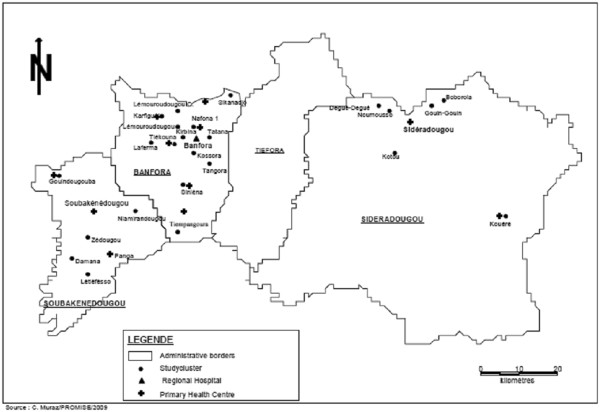
A prospective community-based cohort study was nested within the PROMISE-EBF trial (NCT00397150) in 24 villages of the study area. Maternal and infant baseline characteristics were collected at recruitment and after birth, respectively. Home visits were conducted at weeks 3, 6, 12, 24 and 52 after birth. Descriptive statistics were calculated using robust standard errors to account for cluster sampling. Cox multivariable regression was used to investigate potential risk factors for infant death.
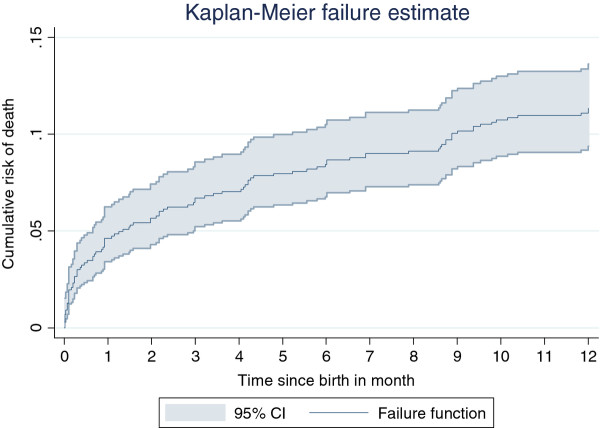
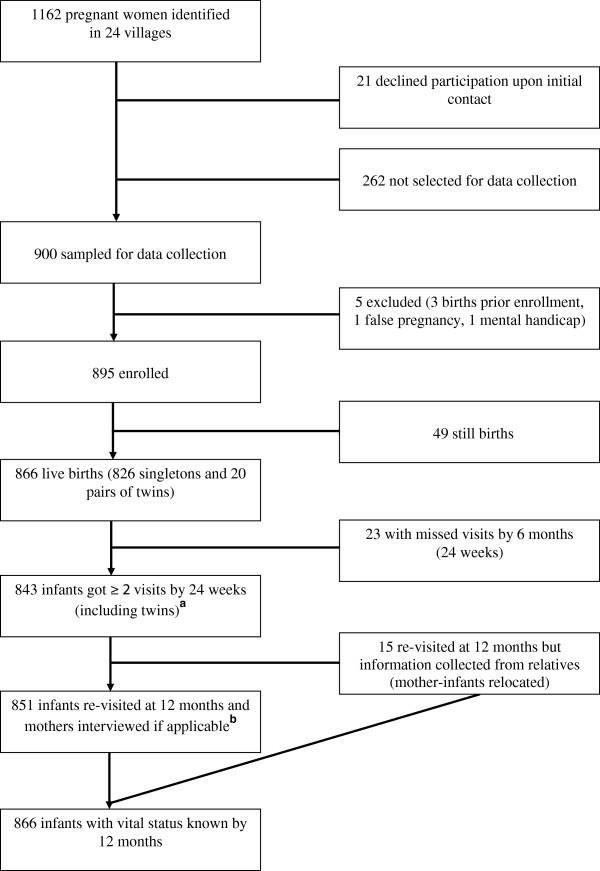
Among the 866 live born children included in the study there were 98 infant deaths, yielding an IMR of 113 per 1000 live births (95% CI: 89-143). Over 75% of infant deaths had occurred by 6 months of age and the post neonatal infant mortality rate was 67 per 1000 live births (95% CI: 51-88). Infections (35%) and preterm births complications (23%) were the most common probable causes of death by 6 months. Multivariable analyses identified maternal history of child death, polygyny, twin births and poor anthropometric z-scores at week-3 as factors associated with increased risk of infant death.
We observed a very high IMR in a rural area of Burkina Faso, a country where 75% of the population lives in rural settings. Community-based health interventions targeting mothers and children at high risk are urgently needed to reduce the high burden of infant deaths in these areas.
婴儿死亡率(IMR)在许多撒哈拉以南非洲国家仍然很高,特别是在农村地区,那里获得卫生服务的机会可能有限。在这些社区进行的研究可以提供有关婴儿死亡负担和危险因素的相关数据。我们在布基纳法索西南部 Banfora 卫生区的一个农村社区的儿童队列中测量了 IMR,并探讨了婴儿死亡的危险因素。
一项前瞻性社区为基础的队列研究嵌套在研究区域的 24 个村庄的 PROMISE-EBF 试验(NCT00397150)中。在招募时和出生后分别收集母婴基线特征。在出生后第 3、6、12、24 和 52 周进行家访。使用稳健标准误差计算描述性统计数据,以考虑到聚类抽样。使用 Cox 多变量回归分析调查婴儿死亡的潜在危险因素。
在纳入研究的 866 名活产婴儿中,有 98 名婴儿死亡,IMR 为每 1000 例活产 113 例(95%CI:89-143)。超过 75%的婴儿死亡发生在 6 个月龄之前,新生儿期婴儿死亡率为每 1000 例活产 67 例(95%CI:51-88)。在 6 个月时,感染(35%)和早产并发症(23%)是最常见的可能死因。多变量分析确定了母亲有儿童死亡史、一夫多妻制、双胞胎分娩和第 3 周时体重指数低是婴儿死亡风险增加的相关因素。
我们在布基纳法索的一个农村地区观察到非常高的 IMR,该国 75%的人口居住在农村地区。迫切需要针对高危母婴的以社区为基础的卫生干预措施,以减少这些地区婴儿死亡的高负担。