Calderon Leonardo A, Sobrinho Juliana C, Zaqueo Kayena D, de Moura Andrea A, Grabner Amy N, Mazzi Maurício V, Marcussi Silvana, Nomizo Auro, Fernandes Carla F C, Zuliani Juliana P, Carvalho Bruna M A, da Silva Saulo L, Stábeli Rodrigo G, Soares Andreimar M
Centro de Estudos de Biomoléculas Aplicadas à Saúde, CEBio, Fundação Oswaldo Cruz, Fiocruz Rondônia e Departamento de Medicina, Universidade Federal de Rondônia, UNIR, Porto Velho, RO, Brazil.
Fundação Hermínio Ometto, UNIARARAS, Núcleo de Ciências da Saúde-NUCISA, 13607-339 Araras, SP, Brazil.
Biomed Res Int. 2014;2014:203639. doi: 10.1155/2014/203639. Epub 2014 Feb 13.
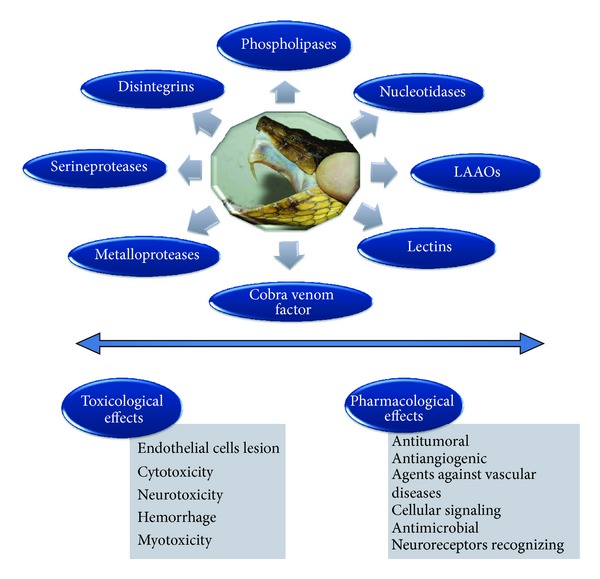
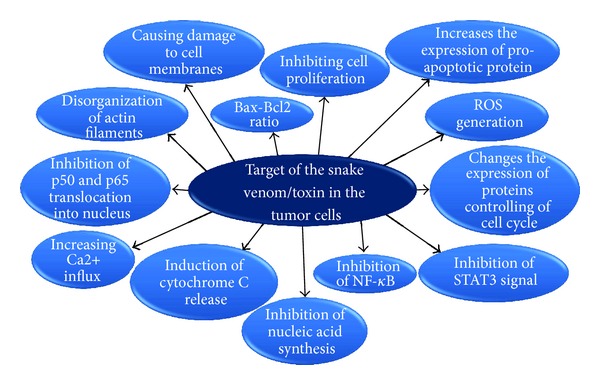
For more than half a century, cytotoxic agents have been investigated as a possible treatment for cancer. Research on animal venoms has revealed their high toxicity on tissues and cell cultures, both normal and tumoral. Snake venoms show the highest cytotoxic potential, since ophidian accidents cause a large amount of tissue damage, suggesting a promising utilization of these venoms or their components as antitumoral agents. Over the last few years, we have studied the effects of snake venoms and their isolated enzymes on tumor cell cultures. Some in vivo assays showed antineoplastic activity against induced tumors in mice. In human beings, both the crude venom and isolated enzymes revealed antitumor activities in preliminary assays, with measurable clinical responses in the advanced treatment phase. These enzymes include metalloproteases (MP), disintegrins, L-amino acid oxidases (LAAOs), C-type lectins, and phospholipases A2 (PLA2s). Their mechanisms of action include direct toxic action (PLA2s), free radical generation (LAAOs), apoptosis induction (PLA2s, MP, and LAAOs), and antiangiogenesis (disintegrins and lectins). Higher cytotoxic and cytostatic activities upon tumor cells than normal cells suggest the possibility for clinical applications. Further studies should be conducted to ensure the efficacy and safety of different snake venom compounds for cancer drug development.
半个多世纪以来,细胞毒性药物一直被作为癌症的一种可能治疗方法进行研究。对动物毒液的研究表明,它们对正常组织和肿瘤组织及细胞培养物具有高毒性。蛇毒表现出最高的细胞毒性潜力,因为蛇咬伤会造成大量组织损伤,这表明这些毒液或其成分有望用作抗肿瘤药物。在过去几年中,我们研究了蛇毒及其分离出的酶对肿瘤细胞培养物的影响。一些体内试验显示对小鼠诱导肿瘤具有抗肿瘤活性。在人类中,粗毒液和分离出的酶在初步试验中均显示出抗肿瘤活性,在晚期治疗阶段有可测量的临床反应。这些酶包括金属蛋白酶(MP)、去整合素、L-氨基酸氧化酶(LAAO)、C型凝集素和磷脂酶A2(PLA2)。它们的作用机制包括直接毒性作用(PLA2)、自由基生成(LAAO)、诱导凋亡(PLA2、MP和LAAO)以及抗血管生成(去整合素和凝集素)。与正常细胞相比,对肿瘤细胞具有更高的细胞毒性和细胞生长抑制活性表明其具有临床应用的可能性。应进一步开展研究,以确保不同蛇毒化合物用于癌症药物开发的有效性和安全性。