Moniuszko Anna, Rückert Claudia, Alberdi M Pilar, Barry Gerald, Stevenson Brian, Fazakerley John K, Kohl Alain, Bell-Sakyi Lesley
The Roslin Institute and Royal (Dick) School of Veterinary Studies, University of Edinburgh, Easter Bush, Midlothian EH25 9RG, Scotland, UK; Department of Infectious Diseases and Neuroinfections, Medical University in Białystok, Żurawia 14, 15-540 Białystok, Poland.
The Roslin Institute and Royal (Dick) School of Veterinary Studies, University of Edinburgh, Easter Bush, Midlothian EH25 9RG, Scotland, UK.
Ticks Tick Borne Dis. 2014 Jun;5(4):415-22. doi: 10.1016/j.ttbdis.2014.01.010. Epub 2014 Mar 29.
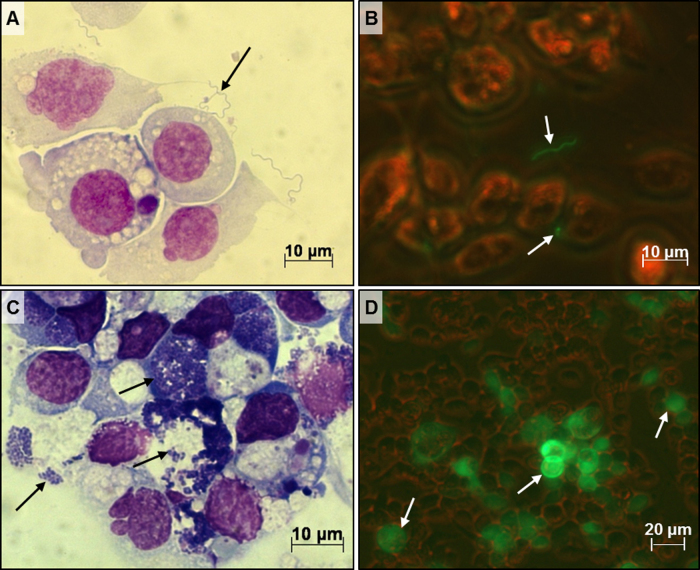
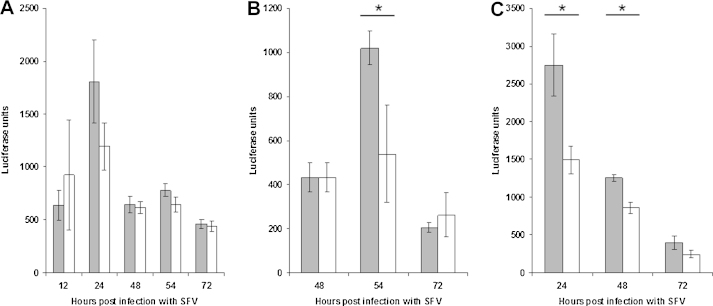
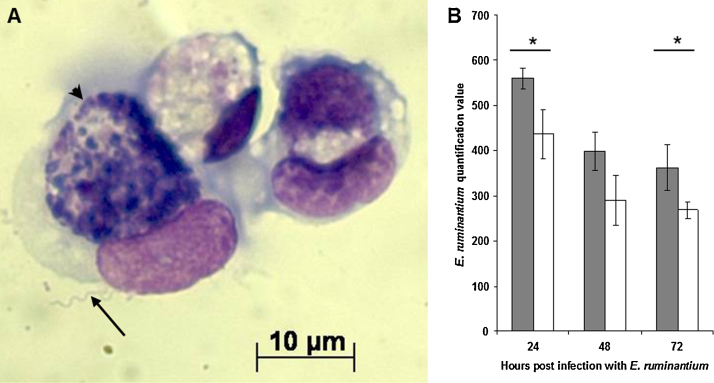
Ticks transmit various human and animal microbial pathogens and may harbour more than one pathogen simultaneously. Both viruses and bacteria can trigger, and may subsequently suppress, vertebrate host and arthropod vector anti-microbial responses. Microbial coinfection of ticks could lead to an advantage or disadvantage for one or more of the microorganisms. In this preliminary study, cell lines derived from the ticks Ixodes scapularis and Ixodes ricinus were infected sequentially with 2 arthropod-borne pathogens, Borrelia burgdorferi s.s., Ehrlichia ruminantium, or Semliki Forest virus (SFV), and the effect of coinfection on the replication of these pathogens was measured. Prior infection of tick cell cultures with the spirochaete B. burgdorferi enhanced subsequent replication of the rickettsial pathogen E. ruminantium whereas addition of spirochaetes to cells infected with E. ruminantium had no effect on growth of the latter. Both prior and subsequent presence of B. burgdorferi also had a positive effect on SFV replication. Presence of E. ruminantium or SFV had no measurable effect on B. burgdorferi growth. In tick cells infected first with E. ruminantium and then with SFV, virus replication was significantly higher across all time points measured (24, 48, 72h post infection), while presence of the virus had no detectable effect on bacterial growth. When cells were infected first with SFV and then with E. ruminantium, there was no effect on replication of either pathogen. The results of this preliminary study indicate that interplay does occur between different pathogens during infection of tick cells. Further study is needed to determine if this results from direct pathogen-pathogen interaction or from effects on host cell defences, and to determine if these observations also apply in vivo in ticks. If presence of one pathogen in the tick vector results in increased replication of another, this could have implications for disease transmission and incidence.
蜱虫传播多种人类和动物的微生物病原体,并且可能同时携带不止一种病原体。病毒和细菌都能触发,且随后可能抑制脊椎动物宿主和节肢动物媒介的抗菌反应。蜱虫的微生物共感染可能对一种或多种微生物产生有利或不利影响。在这项初步研究中,将源自肩突硬蜱和蓖麻硬蜱的细胞系先后用2种节肢动物传播的病原体——伯氏疏螺旋体狭义亚种、反刍兽埃立克体或塞姆利基森林病毒(SFV)进行感染,并测定共感染对这些病原体复制的影响。先用螺旋体伯氏疏螺旋体感染蜱细胞培养物会增强随后立克次氏体病原体反刍兽埃立克体的复制,而向感染了反刍兽埃立克体的细胞中添加螺旋体对后者的生长没有影响。伯氏疏螺旋体的预先存在和后续存在对SFV复制也有积极作用。反刍兽埃立克体或SFV的存在对伯氏疏螺旋体的生长没有可测量的影响。在首先用反刍兽埃立克体感染然后用SFV感染的蜱细胞中,在所有测量时间点(感染后24、48、72小时)病毒复制都显著更高,而病毒的存在对细菌生长没有可检测到的影响。当细胞首先用SFV感染然后用反刍兽埃立克体感染时,对任何一种病原体的复制都没有影响。这项初步研究的结果表明,在蜱细胞感染期间不同病原体之间确实会发生相互作用。需要进一步研究以确定这是直接的病原体 - 病原体相互作用还是对宿主细胞防御的影响导致的,以及确定这些观察结果是否也适用于蜱虫的体内情况。如果蜱虫媒介中一种病原体的存在导致另一种病原体的复制增加,这可能对疾病传播和发病率产生影响。