Huang Honglei, Ideh Readon C, Gitau Evelyn, Thézénas Marie L, Jallow Muminatou, Ebruke Bernard, Chimah Osaretin, Oluwalana Claire, Karanja Henri, Mackenzie Grant, Adegbola Richard A, Kwiatkowski Dominic, Kessler Benedikt M, Berkley James A, Howie Stephen R C, Casals-Pascual Climent
Wellcome Trust Centre for Human Genetics.
Child Survival Theme, Medical Research Council Unit, The Gambia;
Clin Infect Dis. 2014 Jun;58(12):1707-15. doi: 10.1093/cid/ciu202. Epub 2014 Apr 2.
Pneumonia is the leading cause of death in children globally. Clinical algorithms remain suboptimal for distinguishing severe pneumonia from other causes of respiratory distress such as malaria or distinguishing bacterial pneumonia and pneumonia from others causes, such as viruses. Molecular tools could improve diagnosis and management.
We conducted a mass spectrometry-based proteomic study to identify and validate markers of severity in 390 Gambian children with pneumonia (n = 204) and age-, sex-, and neighborhood-matched controls (n = 186). Independent validation was conducted in 293 Kenyan children with respiratory distress (238 with pneumonia, 41 with Plasmodium falciparum malaria, and 14 with both). Predictive value was estimated by the area under the receiver operating characteristic curve (AUC).
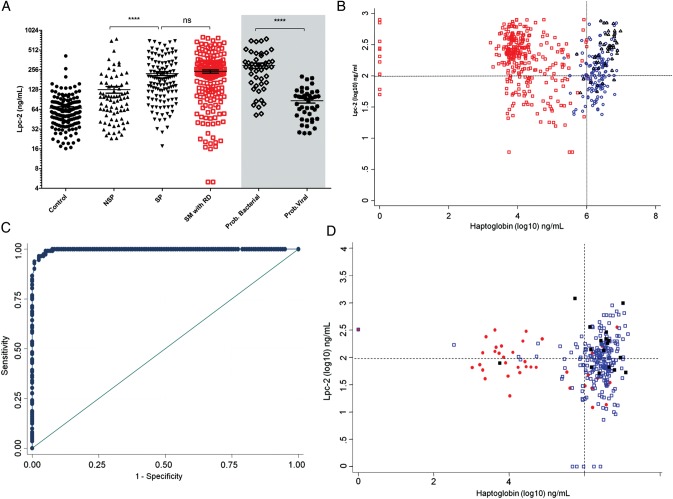
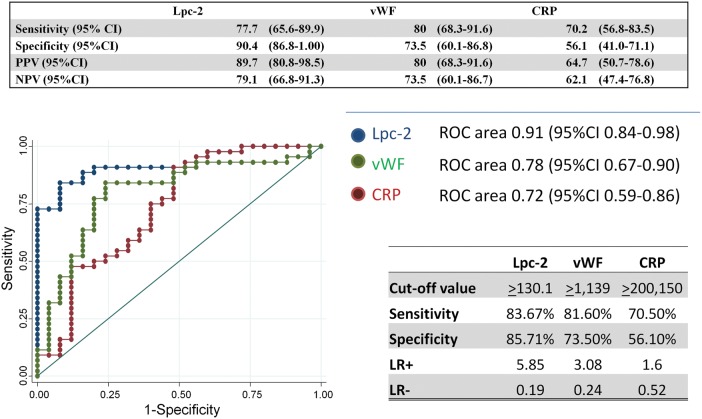
Lipocalin 2 (Lpc-2) was the best protein biomarker of severe pneumonia (AUC, 0.71 [95% confidence interval, .64-.79]) and highly predictive of bacteremia (78% [64%-92%]), pneumococcal bacteremia (84% [71%-98%]), and "probable bacterial etiology" (91% [84%-98%]). These results were validated in Kenyan children with severe malaria and respiratory distress who also met the World Health Organization definition of pneumonia. The combination of Lpc-2 and haptoglobin distinguished bacterial versus malaria origin of respiratory distress with high sensitivity and specificity in Gambian children (AUC, 99% [95% confidence interval, 99%-100%]) and Kenyan children (82% [74%-91%]).
Lpc-2 and haptoglobin can help discriminate the etiology of clinically defined pneumonia and could be used to improve clinical management. These biomarkers should be further evaluated in prospective clinical studies.
肺炎是全球儿童死亡的主要原因。在区分重症肺炎与其他呼吸窘迫病因(如疟疾),或区分细菌性肺炎与其他病因(如病毒性肺炎)方面,临床算法仍不够理想。分子工具可能会改善诊断和治疗。
我们开展了一项基于质谱的蛋白质组学研究,以识别和验证390名冈比亚肺炎患儿(n = 204)以及年龄、性别和社区匹配的对照组儿童(n = 186)的病情严重程度标志物。对293名有呼吸窘迫的肯尼亚儿童进行了独立验证(238名肺炎患儿、41名恶性疟原虫疟疾患儿和14名同时患有肺炎和疟疾的患儿)。通过受试者操作特征曲线下面积(AUC)评估预测价值。
2-微球蛋白(Lpc-2)是重症肺炎的最佳蛋白质生物标志物(AUC,0.71[95%置信区间,0.64 - 0.79]),对菌血症(78%[64% - 92%])、肺炎球菌菌血症(84%[71% - 98%])和“可能的细菌病因”(91%[84% - 9 8%])具有高度预测性。这些结果在同样符合世界卫生组织肺炎定义的肯尼亚重症疟疾和呼吸窘迫患儿中得到了验证。在冈比亚儿童(AUC,99%[95%置信区间,99% - 100%])和肯尼亚儿童(82%[74% - 91%])中,Lpc-2和触珠蛋白的组合能以高灵敏度和特异性区分呼吸窘迫的细菌源性与疟疾源性。
Lpc-2和触珠蛋白有助于鉴别临床诊断肺炎的病因,并可用于改善临床治疗。这些生物标志物应在前瞻性临床研究中进一步评估。