Department of Veterinary Clinical and Diagnostic Science, Faculty of Veterinary Medicine, University of Calgary, Calgary, Alberta, Canada.
Department of Clinical Sciences, College of Veterinary Medicine, Cornell University, Ithaca, New York, USA.
J Vet Intern Med. 2022 Jul;36(4):1430-1443. doi: 10.1111/jvim.16448. Epub 2022 May 26.
Acute phase proteins (APP) may guide treatment of pneumonia in dogs but correlations with radiographic abnormalities are poorly characterized.
Develop a thoracic radiographic severity scoring system (TRSS), assess correlation of radiographic changes with APP concentrations, and compare time to APP and radiograph normalization with duration of antimicrobials treatment.
Sixteen client-owned dogs, 12 with aspiration pneumonia, and 4 with community-acquired pneumonia.
Concentrations of C-reactive protein (CRP), serum amyloid A (SAA), and haptoglobin were measured on days 1, 3, 7, 14, 28, and 60 and orthogonal 2-view thoracic radiographs were obtained on days 1, 7, 14, 28, and 60. Treatment was clinician-guided and blinded to APP concentrations. Radiographic severity scores were assigned by blinded, randomized retrospective review by 2 board-certified radiologists with arbitration by a third radiologist.
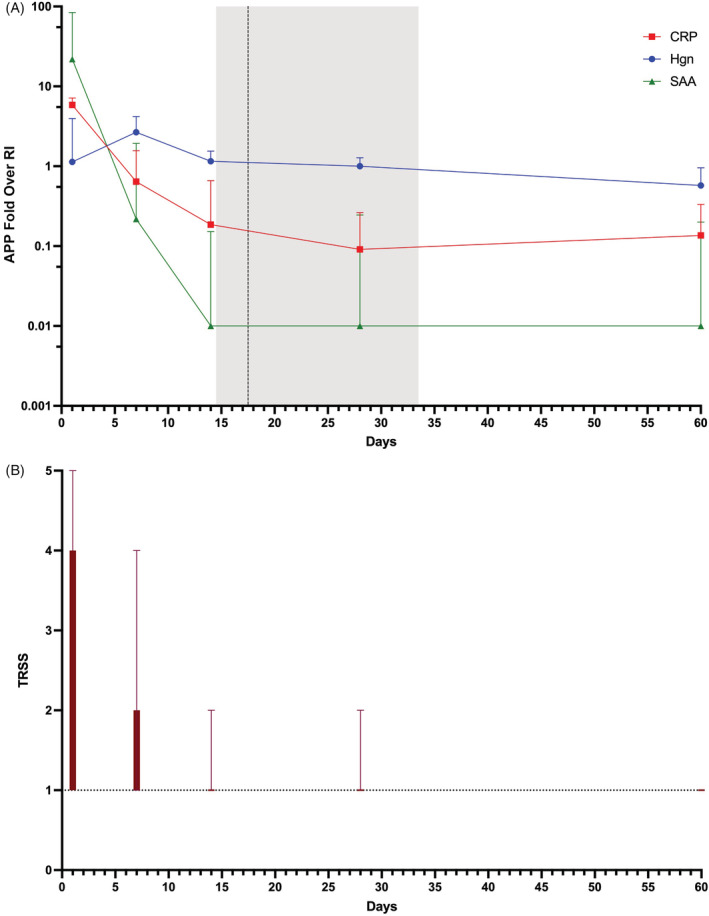
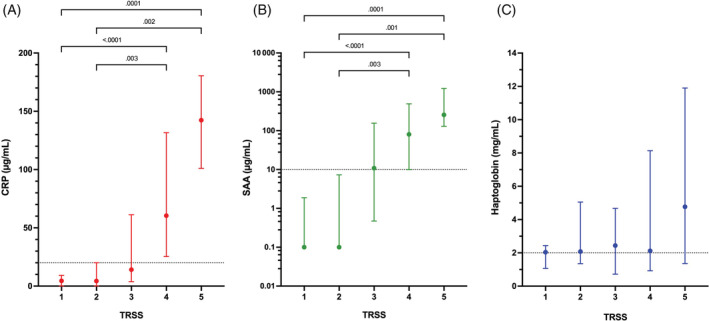
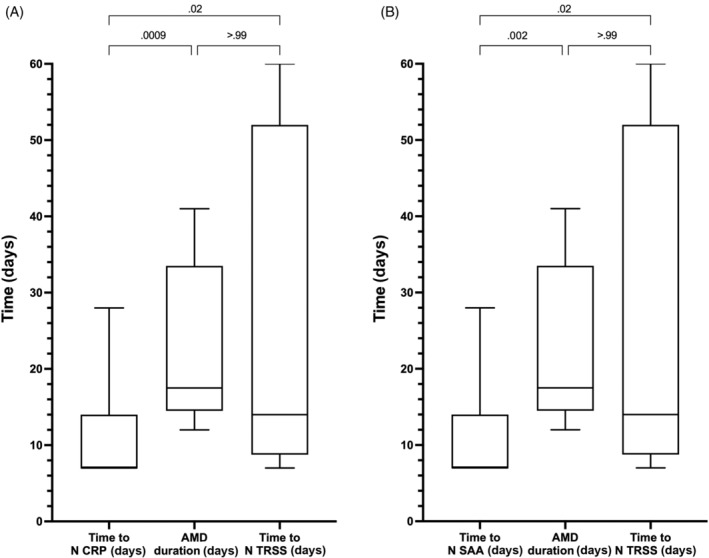
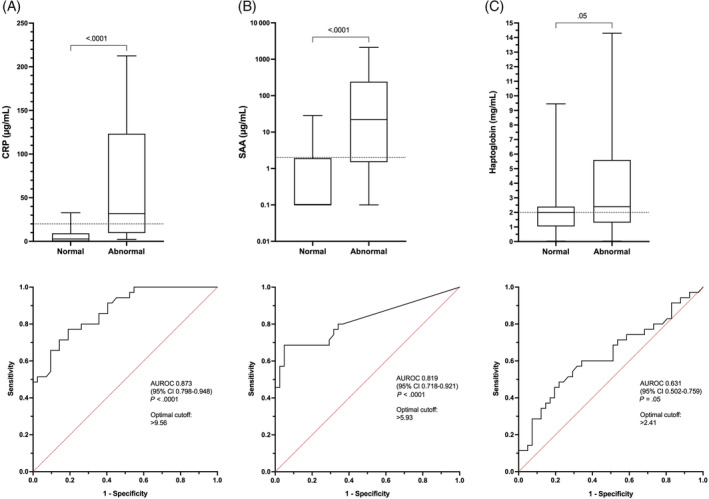
Median (interquartile range [IQR]) time to normalization of CRP (7 days [7-14]) and SAA concentrations (7 days [7-14]) were shorter than antimicrobial treatment duration (17.5 days [14.5-33.5]; P = .001 and .002, respectively) and TRSS normalization (14 days [8.8-52], P = .02 and .02, respectively). The CRP and SAA concentrations were positively correlated with TRSS (CRP r , 0.643; SAA r , 0.634; both P < .0001). Both CRP and SAA identified normal thoracic radiographs area under the curve (AUC) 0.873 and 0.817, respectively, both P < .0001. Interobserver agreement for TRSS assignment was moderate (κ, .499; P < .0001).
Concentrations of CRP and SAA normalized before radiographic resolution and before clinicians discontinued antimicrobial treatment. The CRP and SAA concentrations may guide duration of antimicrobial treatment for dogs with pneumonia.
急性相蛋白(APP)可能有助于指导犬肺炎的治疗,但与放射影像学异常的相关性尚未明确。
建立一种胸部放射影像学严重程度评分系统(TRSS),评估放射影像学变化与 APP 浓度的相关性,并比较 APP 和放射影像学恢复正常的时间与抗菌药物治疗持续时间的关系。
16 只患犬,其中 12 只为吸入性肺炎,4 只为社区获得性肺炎。
分别于第 1、3、7、14、28 和 60 天检测 C 反应蛋白(CRP)、血清淀粉样蛋白 A(SAA)和触珠蛋白的浓度,并于第 1、7、14、28 和 60 天进行正交 2 视图胸部放射影像学检查。治疗由临床医生根据 APP 浓度指导,并对 APP 浓度进行盲法。由 2 位经过 board-certified 的放射科医生进行盲法、随机回顾性评分,并由第 3 位放射科医生进行仲裁,确定放射影像学严重程度评分。
CRP(7 天 [7-14])和 SAA 浓度(7 天 [7-14])恢复正常的中位时间(四分位数间距 [IQR])短于抗菌药物治疗持续时间(17.5 天 [14.5-33.5];P =.001 和.002)和 TRSS 恢复正常的时间(14 天 [8.8-52];P =.02 和.02)。CRP 和 SAA 浓度与 TRSS 呈正相关(CRP r,0.643;SAA r,0.634;均 P <.0001)。CRP 和 SAA 均能识别正常的胸部放射影像学,曲线下面积(AUC)分别为 0.873 和 0.817,均 P <.0001。TRSS 赋值的观察者间一致性为中度(κ,.499;P <.0001)。
CRP 和 SAA 浓度在放射影像学分辨率恢复之前,以及临床医生停止抗菌药物治疗之前就已经恢复正常。CRP 和 SAA 浓度可能有助于指导肺炎患犬的抗菌药物治疗持续时间。