Drummond Aaron, Sauer James D
School of Education, Flinders University, Adelaide, South Australia, Australia.
School of Psychology, University of Portsmouth, Portsmouth, United Kingdom.
PLoS One. 2014 Apr 3;9(4):e87943. doi: 10.1371/journal.pone.0087943. eCollection 2014.
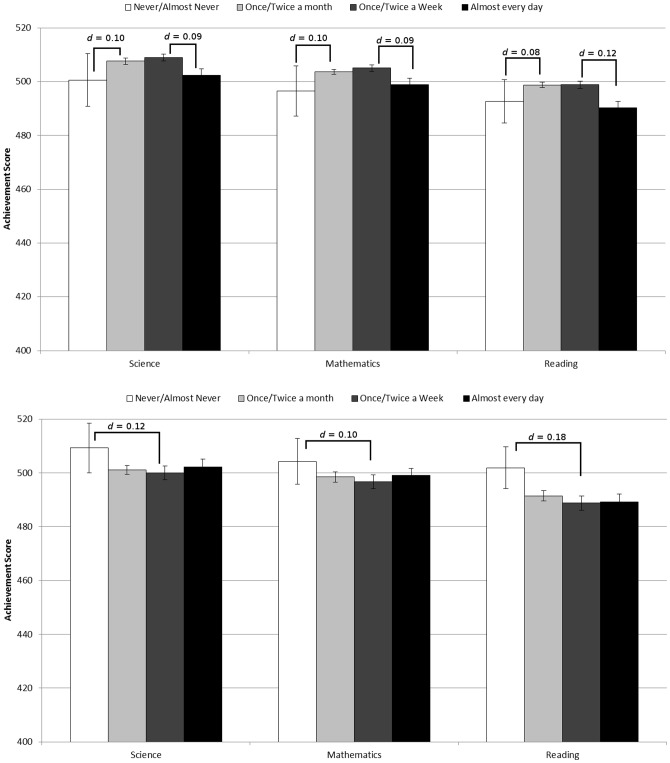
Video-gaming is a common pastime among adolescents, particularly adolescent males in industrialized nations. Despite widespread suggestions that video-gaming negatively affects academic achievement, the evidence is inconclusive. We reanalyzed data from over 192,000 students in 22 countries involved in the 2009 Programme for International Student Assessment (PISA) to estimate the true effect size of frequency of videogame use on adolescent academic achievement in science, mathematics and reading. Contrary to claims that increased video-gaming can impair academic performance, differences in academic performance were negligible across the relative frequencies of videogame use. Videogame use had little impact on adolescent academic achievement.
电子游戏是青少年中常见的消遣活动,在工业化国家中尤其受青少年男性欢迎。尽管有广泛的观点认为电子游戏会对学业成绩产生负面影响,但证据并不确凿。我们重新分析了来自22个国家的超过19.2万名参与2009年国际学生评估项目(PISA)的学生的数据,以估计电子游戏使用频率对青少年科学、数学和阅读学业成绩的真实效应大小。与增加电子游戏使用会损害学业表现的说法相反,不同电子游戏使用相对频率下的学业表现差异可以忽略不计。电子游戏使用对青少年学业成绩几乎没有影响。