Ramakrishnan Nagarajan, Daphnee D K, Ranganathan Lakshmi, Bhuvaneshwari S
Department of Critical Care Medicine, Apollo Hospitals, Chennai, Tamil Nadu, India.
Department of Dietetics, Apollo Hospitals, Chennai, Tamil Nadu, India.
Indian J Crit Care Med. 2014 Mar;18(3):144-8. doi: 10.4103/0972-5229.128704.
Adequate nutritional support is crucial in prevention and treatment of malnutrition in critically ill-patients. Despite the intention to provide appropriate enteral nutrition (EN), meeting the full nutritional requirements can be a challenge due to interruptions. This study was undertaken to determine the cause and duration of interruptions in EN.
Patients admitted to a multidisciplinary critical care unit (CCU) of a tertiary care hospital from September 2010 to January 2011 and who received EN for a period >24 h were included in this observational, prospective study. A total of 327 patients were included, for a total of 857 patient-days. Reasons and duration of EN interruptions were recorded and categorized under four groups-procedures inside CCU, procedures outside CCU, gastrointestinal (GI) symptoms and others.
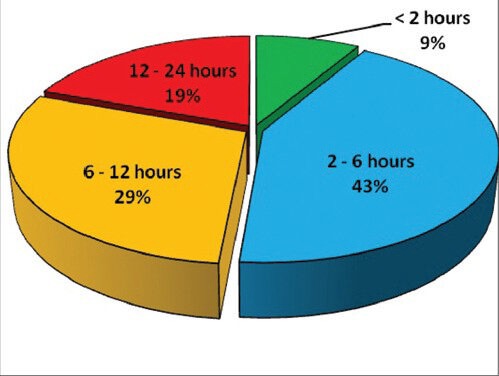
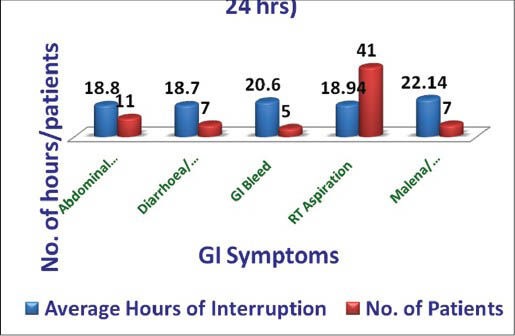
Procedure inside CCU accounted for 55.9% of the interruptions while GI symptoms for 24.2%. Although it is commonly perceived that procedures outside CCU are the most common reason for interruption, this contributed only to 18.4% individually; ventilation-related procedures were the most frequent cause (40.25%), followed by nasogastric tube aspirations (15.28%). Although GI bleed is often considered a reason to hold enteral feed, it was one of the least common reasons (1%) in our study. Interruption of 2-6 h was more frequent (43%) and most of this (67.1%) was related to "procedures inside CCU".
Awareness of reasons for EN interruptions will aid to modify protocol and minimize interruptions during procedures in CCU to reach nutrition goals.
充足的营养支持对于危重症患者营养不良的预防和治疗至关重要。尽管有意提供适当的肠内营养(EN),但由于中断,满足全部营养需求可能是一项挑战。本研究旨在确定EN中断的原因和持续时间。
纳入2010年9月至2011年1月入住一家三级医院多学科重症监护病房(CCU)且接受EN超过24小时的患者,进行这项观察性前瞻性研究。共纳入327例患者,总计857个患者日。记录EN中断的原因和持续时间,并分为四组——CCU内的操作、CCU外的操作、胃肠道(GI)症状及其他。
CCU内的操作占中断原因的55.9%,而GI症状占24.2%。尽管通常认为CCU外的操作是最常见的中断原因,但单独来看其仅占18.4%;与通气相关的操作是最常见的原因(40.25%),其次是鼻胃管抽吸(15.28%)。尽管GI出血常被视为暂停肠内喂养的一个原因,但在我们的研究中它是最不常见的原因之一(1%)。2至6小时的中断更为频繁(43%),其中大部分(67.1%)与“CCU内的操作”有关。
了解EN中断的原因将有助于修改方案,并在CCU操作期间尽量减少中断,以实现营养目标。