Woollams Anna M, Hoffman Paul, Roberts Daniel J, Lambon Ralph Matthew A, Patterson Karalyn E
a School of Psychological Sciences , University of Manchester , Manchester , UK.
Cogn Neuropsychol. 2014;31(5-6):461-81. doi: 10.1080/02643294.2014.882300. Epub 2014 Apr 7.
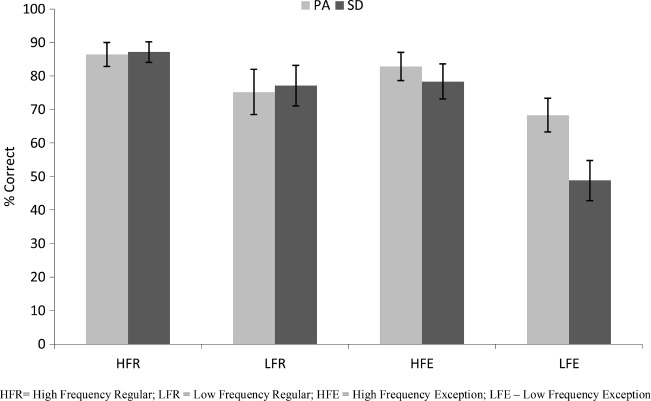
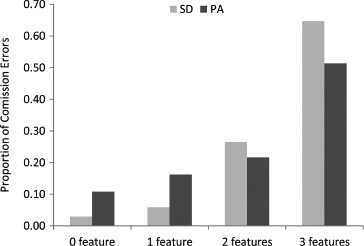
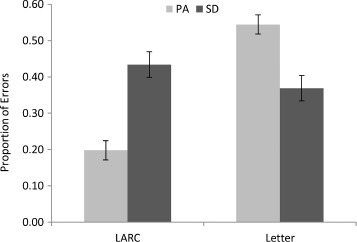
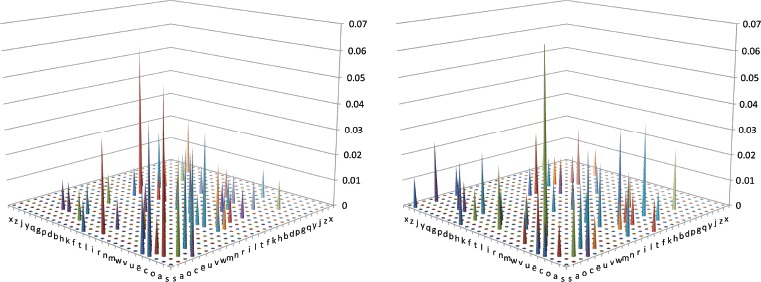
Exaggerated effects of word length upon reading-aloud performance define pure alexia, but have also been observed in semantic dementia. Some researchers have proposed a reading-specific account, whereby performance in these two disorders reflects the same cause: impaired orthographic processing. In contrast, according to the primary systems view of acquired reading disorders, pure alexia results from a basic visual processing deficit, whereas degraded semantic knowledge undermines reading performance in semantic dementia. To explore the source of reading deficits in these two disorders, we compared the reading performance of 10 pure alexic and 10 semantic dementia patients, matched in terms of overall severity of reading deficit. The results revealed comparable frequency effects on reading accuracy, but weaker effects of regularity in pure alexia than in semantic dementia. Analysis of error types revealed a higher rate of letter-based errors and a lower rate of regularization responses in pure alexia than in semantic dementia. Error responses were most often words in pure alexia but most often nonwords in semantic dementia. Although all patients made some letter substitution errors, these were characterized by visual similarity in pure alexia and phonological similarity in semantic dementia. Overall, the data indicate that the reading deficits in pure alexia and semantic dementia arise from impairments of visual processing and knowledge of word meaning, respectively. The locus and mechanisms of these impairments are placed within the context of current connectionist models of reading.
单词长度对朗读表现的夸张影响定义了纯失读症,但在语义性痴呆中也有观察到。一些研究人员提出了一种特定于阅读的解释,即这两种障碍中的表现反映了相同的原因:正字法加工受损。相比之下,根据获得性阅读障碍的主要系统观点,纯失读症是由基本视觉加工缺陷导致的,而语义知识的退化则会破坏语义性痴呆中的阅读表现。为了探究这两种障碍中阅读缺陷的根源,我们比较了10名纯失读症患者和10名语义性痴呆患者的阅读表现,这些患者在阅读缺陷的总体严重程度上相匹配。结果显示,在阅读准确性方面,二者的词频效应相当,但纯失读症中规则性效应比语义性痴呆中的更弱。对错误类型的分析表明,纯失读症中基于字母的错误发生率更高,规则化反应的发生率更低,相比于语义性痴呆。纯失读症患者的错误反应大多是单词,而语义性痴呆患者的错误反应大多是非单词。尽管所有患者都犯了一些字母替换错误,但在纯失读症中这些错误以视觉相似性为特征,而在语义性痴呆中以语音相似性为特征。总体而言,数据表明纯失读症和语义性痴呆中的阅读缺陷分别源于视觉加工受损和词义知识受损。这些损伤的位点和机制是在当前阅读的联结主义模型背景下进行探讨的。