Department of Medical Genetics, Faculty of Medical Sciences, Tarbiat Modares University, Tehran P.O. Box 14115-111, Iran.
Genes (Basel). 2012 Jan 20;3(1):90-114. doi: 10.3390/genes3010090.
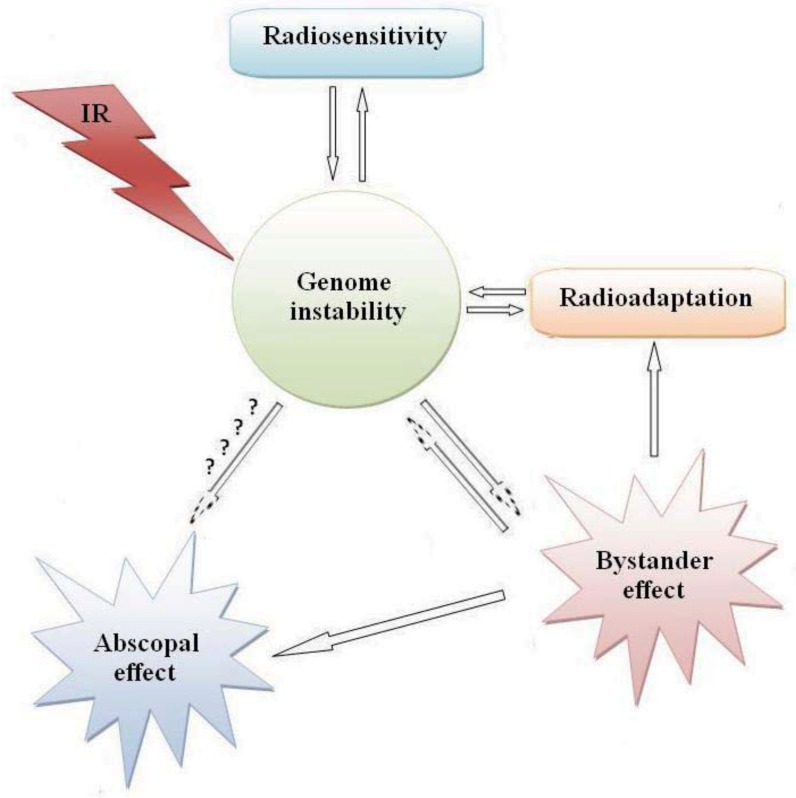
Although radiation carcinogenesis has been shown both experimentally and epidemiologically, the use of ionizing radiation is also one of the major modalities in cancer treatment. Various known cellular and molecular events are involved in carcinogenesis. Apart from the known phenomena, there could be implications for carcinogenesis and cancer prevention due to other biological processes such as the bystander effect, the abscopal effect, intrinsic radiosensitivity and radioadaptation. Bystander effects have consequences for mutation initiated cancer paradigms of radiation carcinogenesis, which provide the mechanistic justification for low-dose risk estimates. The abscopal effect is potentially important for tumor control and is mediated through cytokines and/or the immune system (mainly cell-mediated immunity). It results from loss of growth and stimulatory and/or immunosuppressive factors from the tumor. Intrinsic radiosensitivity is a feature of some cancer prone chromosomal breakage syndromes such as ataxia telangectiasia. Radiosensitivity is manifested as higher chromosomal aberrations and DNA repair impairment is now known as a good biomarker for breast cancer screening and prediction of prognosis. However, it is not yet known whether this effect is good or bad for those receiving radiation or radiomimetic agents for treatment. Radiation hormesis is another major concern for carcinogenesis. This process which protects cells from higher doses of radiation or radio mimic chemicals, may lead to the escape of cells from mitotic death or apoptosis and put cells with a lower amount of damage into the process of cancer induction. Therefore, any of these biological phenomena could have impact on another process giving rise to genome instability of cells which are not in the field of radiation but still receiving a lower amount of radiation. For prevention of radiation induced carcinogenesis or risk assessment as well as for successful radiation therapy, all these phenomena should be taken into account.
虽然辐射致癌已在实验和流行病学中得到证实,但电离辐射的应用也是癌症治疗的主要方式之一。各种已知的细胞和分子事件都涉及致癌作用。除了已知的现象外,由于旁观者效应、远隔效应、固有放射敏感性和放射适应性等其他生物学过程,可能会对致癌作用和癌症预防产生影响。旁观者效应对辐射致癌的突变起始癌症模型有影响,为低剂量风险估计提供了机制上的依据。远隔效应对于肿瘤控制很重要,是通过细胞因子和/或免疫系统(主要是细胞介导的免疫)介导的。它是由于肿瘤中生长和刺激以及/或免疫抑制因子的丧失而产生的。固有放射敏感性是某些易患癌症的染色体断裂综合征的特征,如共济失调毛细血管扩张症。放射敏感性表现为更高的染色体畸变,现在已知 DNA 修复受损是乳腺癌筛查和预后预测的良好生物标志物。然而,对于接受辐射或放射模拟剂治疗的患者,这种效应是好是坏尚不清楚。辐射兴奋也是致癌作用的另一个主要关注点。这种保护细胞免受更高剂量辐射或放射模拟化学物质的过程,可能导致细胞逃避有丝分裂死亡或凋亡,并使受损伤较小的细胞进入癌症诱导过程。因此,这些生物学现象中的任何一种都可能对非辐射领域但仍接受较低剂量辐射的细胞的基因组不稳定性产生影响。为了预防辐射诱导的致癌作用或风险评估以及成功的放射治疗,所有这些现象都应该考虑进去。