Zeng Weihong, Wang Ying, Liu Zhicui, Khanniche Asma, Hu Qingliang, Feng Yan, Ye Weiyi, Yang Jianglong, Wang Shujun, Zhou Lin, Shen Hao, Wang Yan
1] Shanghai Institute of Immunology, Institute of Medical Sciences, Shanghai Jiaotong University School of Medicine, Shanghai, China [2] College of Public Health, Shanghai Jiaotong University School of Medicine, Shanghai, China.
Shanghai Institute of Immunology, Institute of Medical Sciences, Shanghai Jiaotong University School of Medicine, Shanghai, China.
Cell Mol Immunol. 2014 Jul;11(4):367-76. doi: 10.1038/cmi.2014.16. Epub 2014 Apr 7.
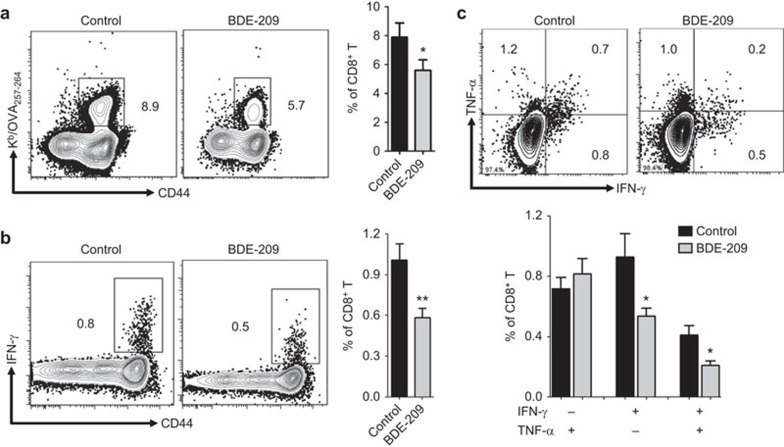
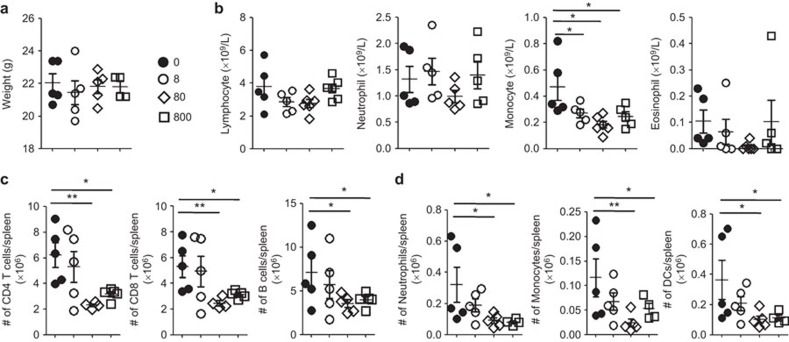
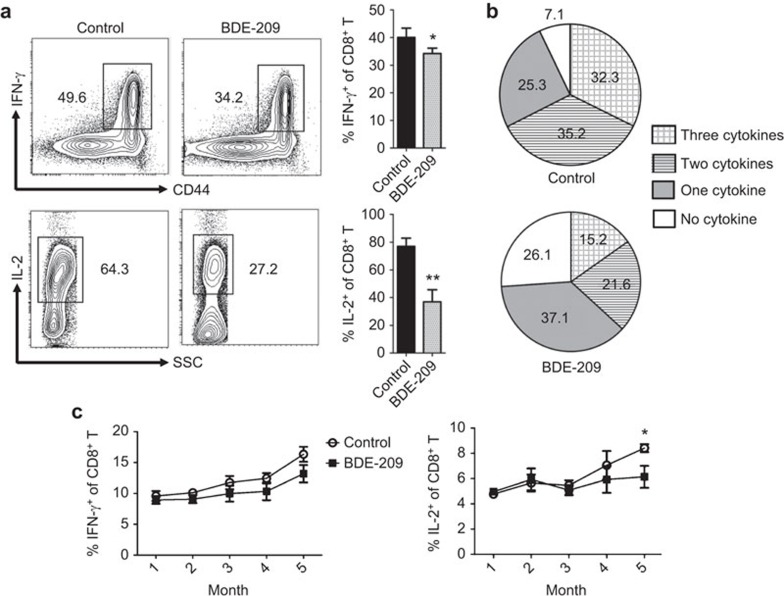
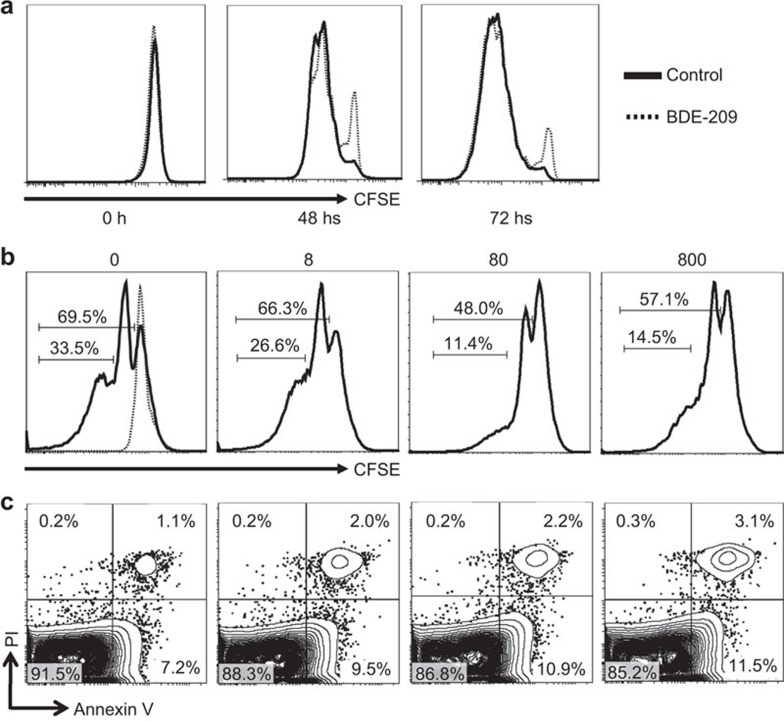
Polybrominated diphenyl ethers (PBDEs) are ubiquitous environmental pollutants that accumulate to high levels in human populations that are subject to occupational or regional industry exposure. PBDEs have been shown to affect human neuronal, endocrine and reproductive systems, but their effect on the immune system is not well understood. In this study, experimental adult mice were intragastrically administered 2,2',3,3',4,4',5,5',6,6'-decabromodiphenyl ether (BDE-209) at doses of 8, 80 or 800 mg/kg of body weight (bw) at 2-day intervals. Our results showed that continuous exposure to BDE-209 resulted in high levels of BDE-209 in the plasma that approached the levels found in people who work in professions with high risks of PDBE exposure. Reduced leukocytes, decreased cytokine (IFN-γ, IL-2 and TNF-α) production and lower CD8 T-cell proliferation were observed in the mice exposed to BDE-209. Additionally, mice with long-term BDE-209 exposure had lower numbers of antigen-specific CD8 T cells after immunization with recombinant Listeria monocytogenes expressing ovalbumin (rLm-OVA) and the OVA-specific CD8 T cells had reduced functionality. Taken together, our study demonstrates that continuous BDE-209 exposure causes adverse effects on the number and functionality of immune cells in adult mice.
多溴二苯醚(PBDEs)是普遍存在的环境污染物,在遭受职业或区域工业暴露的人群中会累积到很高的水平。已表明PBDEs会影响人类的神经、内分泌和生殖系统,但其对免疫系统的影响尚不清楚。在本研究中,成年实验小鼠每隔2天按8、80或800毫克/千克体重(bw)的剂量经胃内给予2,2',3,3',4,4',5,5',6,6'-十溴二苯醚(BDE-209)。我们的结果表明,持续暴露于BDE-209会导致血浆中BDE-209水平升高,接近在从事PDBE暴露高风险职业的人群中发现的水平。在暴露于BDE-209的小鼠中观察到白细胞减少、细胞因子(IFN-γ、IL-2和TNF-α)产生减少以及CD8 T细胞增殖降低。此外,长期暴露于BDE-209的小鼠在用表达卵清蛋白的重组单核细胞增生李斯特菌(rLm-OVA)免疫后,抗原特异性CD8 T细胞数量减少,且OVA特异性CD8 T细胞的功能降低。综上所述,我们的研究表明,持续暴露于BDE-209会对成年小鼠免疫细胞的数量和功能产生不利影响。