Research Institute on Addictions, State University of New York at Buffalo.
Exp Clin Psychopharmacol. 2014 Apr;22(2):166-75. doi: 10.1037/a0034741.
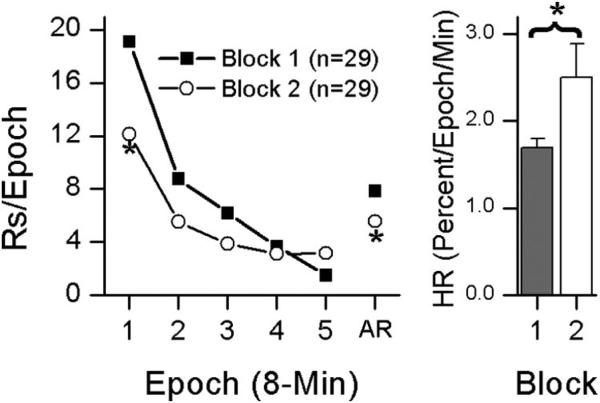
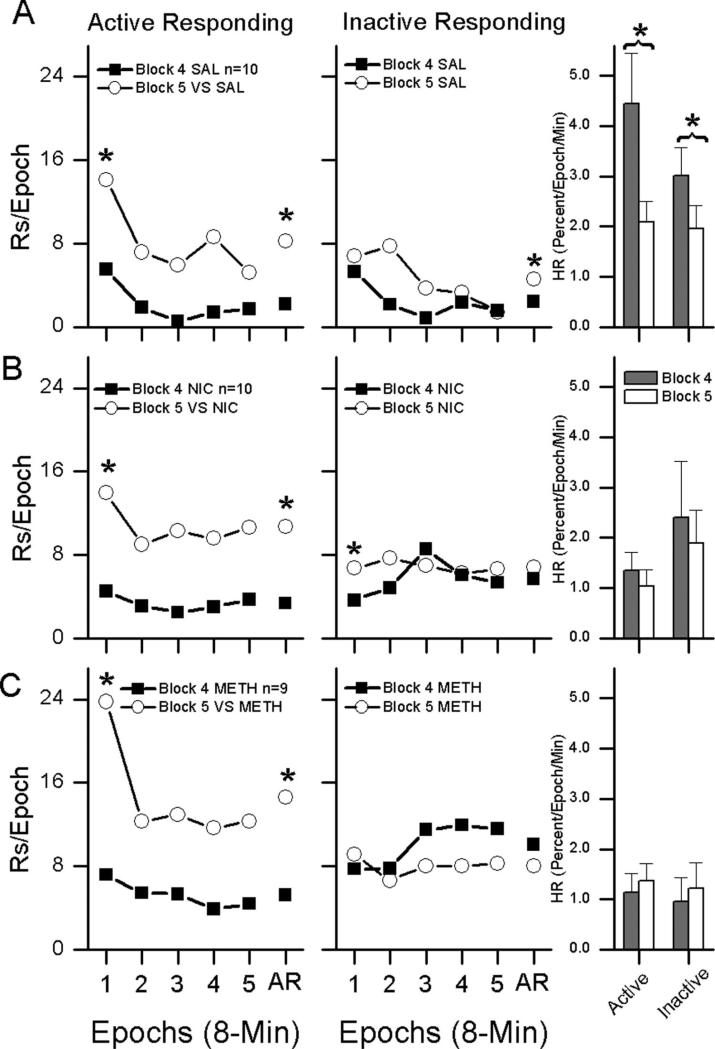
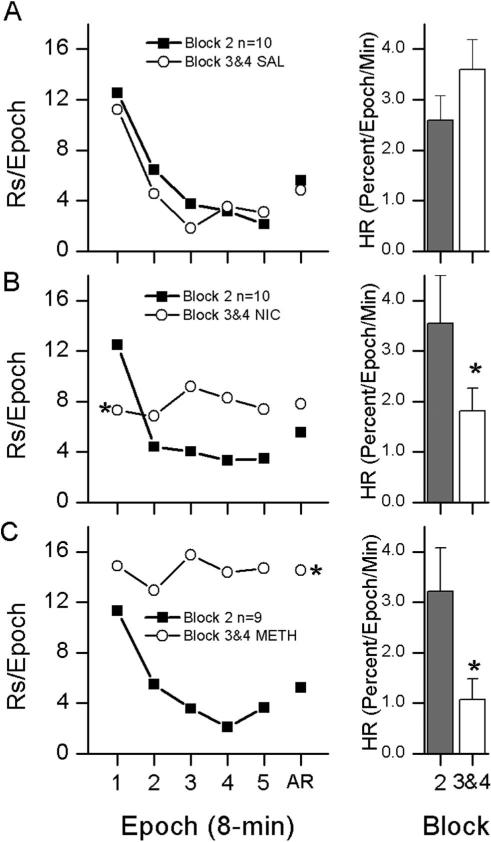
The reinforcing effectiveness of a sensory stimulus such as light-onset rapidly habituates (Lloyd, Gancarz, Ashrafioun, Kausch, & Richards, 2012). According to memory-based theories, habituation occurs if a memory exists for perceived stimulation, and dishabituation occurs if a memory does not exist and the stimulation is "unexpected." According to Redgrave and Gurney (2006), unexpected response-contingent sensory stimuli increase phasic firing of dopamine neurons, providing a sensory error signal that reflects the difference between perceived and expected stimuli. Together, memory-based theories of habituation and the sensory error signal hypothesis predict a disruption (slowing) of habituation rate by novel response-contingent sensory stimulation or by artificial increases in dopamine neurotransmission by stimulant drugs. To test these predictions, we examined the effects of stimulant drugs on both the operant level of responding (snout-poking) and operant responding for a sensory reinforcer (light-onset) presented according to a fixed ratio 1 schedule. Robust within-session decreases in responding indicating habituation were observed. The effects of stimulant drugs (saline, n = 10; nicotine, 0.40 mg/kg, n = 10; and methamphetamine, 0.75 mg/kg, n = 9) on habituation in rats were determined. Nicotine was found to decrease habituation rate and did not affect response rate, while methamphetamine decreased habituation rate and increased response rate. In addition, introduction of a novel visual stimulus reinforcer decreased habituation rate and increased responding. These findings show that habituation of reinforcer effectiveness modulates operant responding for sensory reinforcers, and that stimulant drugs may disrupt normally occurring habituation of reinforcer effectiveness by increasing dopamine neurotransmission.
感官刺激(如光起始)的增强效果会迅速习惯化(Lloyd、Gancarz、Ashrafioun、Kausch 和 Richards,2012)。根据基于记忆的理论,如果存在对感知刺激的记忆,则会发生习惯化;如果不存在记忆且刺激是“意外的”,则会发生去习惯化。根据 Redgrave 和 Gurney(2006)的说法,意外的与反应相关的感官刺激会增加多巴胺神经元的相位放电,提供反映感知刺激与预期刺激之间差异的感官错误信号。基于记忆的习惯化理论和感官错误信号假说共同预测,新颖的与反应相关的感官刺激或兴奋剂药物人工增加多巴胺神经传递会破坏(减慢)习惯化率。为了检验这些预测,我们考察了兴奋剂药物对操作性反应水平(鼻触探测)和操作性反应的影响,这些反应是根据固定比率 1 时间表呈现的感觉强化物(光起始)。观察到反应(鼻触探测)的内会话减少,表明习惯化。确定了兴奋剂药物(生理盐水,n = 10;尼古丁,0.40mg/kg,n = 10;和甲基苯丙胺,0.75mg/kg,n = 9)对大鼠习惯化的影响。发现尼古丁降低了习惯化率,而不影响反应率,而甲基苯丙胺降低了习惯化率并增加了反应率。此外,引入新的视觉刺激强化物会降低习惯化率并增加反应。这些发现表明,强化物有效性的习惯化调节了对感觉强化物的操作性反应,而兴奋剂药物可能通过增加多巴胺神经传递来破坏强化物有效性的正常习惯化。