Sun Jimin, Gong Zhenyu, Lv Huakun, Chen Zhiping, Chai Chengliang, Liu Shelan, Ling Feng, Lu Ye, Cai Jian, Yu Zhao, Miao Ziping, Ren Jiangping, Chen Enfu
Zhejiang Provincial Center for Disease Control and Prevention, Hang Zhou, China.
PLoS One. 2014 Apr 7;9(4):e93775. doi: 10.1371/journal.pone.0093775. eCollection 2014.
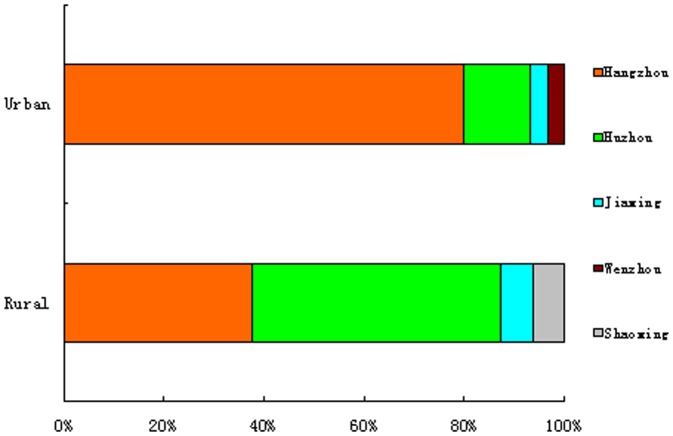
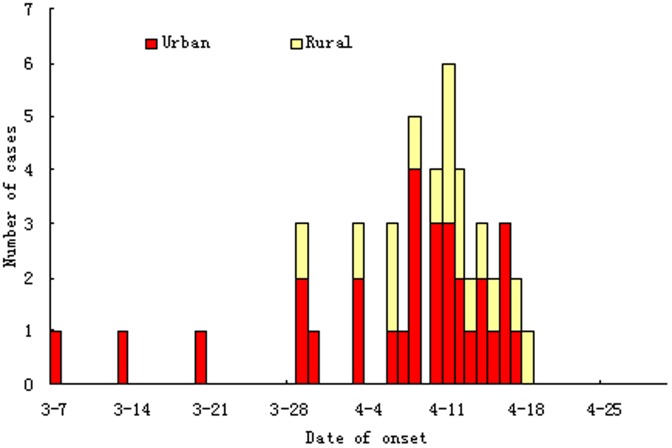
A total of 134 cases of H7N9 influenza infection were identified in 12 provinces of China between March 25 and September 31, 2013. Of these, 46 cases occurred in Zhejiang Province. We carried out a preliminary comparison of characteristics between rural and urban H7N9 cases from Zhejiang Province, China. Field investigations were conducted for each confirmed H7N9 case. A standardized questionnaire was used to collect information about demographics, exposure history, clinical signs and symptoms, timelines of medical visits and care after onset of illness. Of the 46 H7N9 cases in Zhejiang Province identified between March 25 and September 31, 2013, there were 16 rural cases and 30 urban cases. Compared to urban cases, there was a higher proportion of females among the rural cases [11/16 (69%) vs. 6/30 (20%), P = 0.001]. Among the rural cases, 14/15 (93%) with available data had a history of recent poultry exposure, which was significantly higher than that among urban cases (64%, P = 0.038). More patients from the rural group had a history of breeding poultry compared with those from the urban group [38% (6/16) vs. 10% (3/30), respectively; P = 0.025]. Interestingly, the median number of medical visits of patients from rural areas was higher than that of patients from urban areas (P = 0.046). There was no difference between the two groups in terms of age distribution, fatality rate, incubation period, symptoms, and underlying medical conditions. In conclusion, compared to patients from urban areas, more patients from rural areas were female, had an exposure history, had a history of breeding poultry, and had a higher number of medical visits. These findings indicate that there are different exposure patterns between patients living in rural and urban areas and that more rural cases were infected through backyard poultry breeding.
2013年3月25日至9月31日期间,中国12个省份共确诊134例H7N9流感感染病例。其中,46例发生在浙江省。我们对中国浙江省农村和城市H7N9病例的特征进行了初步比较。对每例确诊的H7N9病例进行了现场调查。使用标准化问卷收集有关人口统计学、暴露史、临床体征和症状、发病后就诊和治疗时间线的信息。在2013年3月25日至9月31日期间浙江省确诊的46例H7N9病例中,有16例农村病例和30例城市病例。与城市病例相比,农村病例中女性比例更高[11/16(69%)对6/30(20%),P = 0.001]。在农村病例中,有可用数据的14/15(93%)有近期家禽接触史,显著高于城市病例(64%,P = 0.038)。与城市组相比,农村组中有更多患者有家禽养殖史[分别为38%(6/16)对10%(3/30);P = 0.025]。有趣的是,农村地区患者的就诊中位数高于城市地区患者(P = 0.046)。两组在年龄分布、死亡率、潜伏期、症状和基础疾病方面没有差异。总之,与城市地区患者相比,农村地区患者女性更多,有暴露史,有家禽养殖史,就诊次数更多。这些发现表明,农村和城市地区居民的暴露模式不同,更多农村病例是通过后院家禽养殖感染的。